Recent Content

PCIe Enumeration Failure for CXL IP
When attempting to validate the Agilex 7 R-Tile Compute Express Link (CXL) 1.1/2.0 IP (Type 2 and Type 3) using a CXL compatible host server, the host server is unable to complete PCIe bus enumeration. The host server stalls while attempting to complete PCIe bus enumeration. The stall never resolves after boot, and access to to the host is never granted. Depiction of the stall and its status code from the host server's perspective is provided as an attached PNG file titled: "pcie_enumeration_stall". Debugging Information: A PCIe Gen 5.0 reference design using the Altera R-Tile Avalon Streaming IP For PCI Express was used to validate that PCIe enumeration could complete fully without failure, and that the host server could exchange data with the FPGA. While running the CXL example design, the Quartus System Console's Link Logger indicates that the LTSSM state is in the "UP_L0" before the PCIe bus enumeration stall. The state may sometimes change when attempting to "Refresh" the status during the PCIe bus enumeration stall. The state may briefly enter recovery (UP_L0 -> REC_IDLE -> REC_RCVRCFG -> REC_RCSVLOCK -> REC_COMPLETE -> UP_L0). Depiction of the Quartus System Console's Link Logger when this occurs is provided as an attached PNG file titled: "ltssm_link_logger". While running the CXL example design, the Quartus System Console's Link Logger indicates that the advertised and negotiated link speeds and widths are both 32.0 GT and x16. Depiction of a CXL Type 3 Quartus System Console's Overview is provided as an attached PNG file titled: "cxl_ip_systemconsole_overview". Instead of generating the example design, the pre-compiled binary offered by Altera for Type 2 and Type 3 CXL IP designs was used and resulted in the exact same failures as shown above. CXL.mem transaction registers (M2S and S2M) are 0x00, indicating that the host server never progresses far enough to begin sending/receiving transactions/requests. Between the PCIe build that functions and the CXL build that does not function (stalls at enumeration), no server UEFI settings were changed. A CXL enable function was enabled for all tests. Several PCIe UEFI settings were changed in an attempt to resolve the enumeration stall, but none changed the outcome. Attempting to disable the CXL Compliance 2.0 and the HDM decoder registers both did not resolve the issue. The FPGA was powered and programmed before the server was launched. Two different CXL servers were tested and both resulted in the same behavior. The relevant PCIe and CXL settings from BIOS is provided as an attached PNG file titled: "cxl_server_settings". The CXL REFCLK was tested as both COMMON and SRIS/SRNS. Each test changed SW3 to use relevant onboard and connected based clocks. IP Settings: CXL IP settings are uploaded as PNG files titled: "cxl_ip_settings_N". The settings tested are the default provided settings as well as a version with a 300 MHz PLD clock (SRIS). Hardware Details: FPGA is connected to host server via PCIe Gen 5.0 x16 slot on Tile 14C. FPGA device is the Altera Agilex 7 FPGA I-Series Development Kit (Production 2x R-Tile & 1x F-Tile) (AGIB027R29A1E1VB) The DIMM provided with the development kit is slotted into DIMM Slot A. SW1 is set to 1000 (PCIe PRSNT x16). SW3 is set to 0110 for designs using the CXL/PCIe common clock and 0000 for designs using the CXL/PCIe onboard REFCLK (SRIS). Software Details: Quartus Prime Pro Edition v25.1 was used to generate the designs. R-Tile Altera FPGA IP for Compute Express Link (CXL) was generated with version 1.17.0. FPGA Design: The FPGA design is generated using the example design with the IP settings given above. A pre-compiled binary provided by Altera was also used to test instead of a generated design. Server details: SMC AS-1126HS-TN (CXL 2.0 via 4x PCIe gen5 x16 slots) CPU: 2x AMD EPYC 9135 (CXL 2.0) RAM: 4x Micron 64GB @ 6000 MT/s UEFI: AMI 1.7a 10/30/2025 Attachments: The system console debug register outputs are saved to CSV files attached to this post. These CSV files are taken from a CXL Type 3 reference design with PLD REFCLK at 300 MHz (SRIS). Questions: Can you provide guidance on how to obtain more information on the enumeration status other than the LTSSM register? Can you provide the UEFI/BIOS settings for PCIe/CXL that was used to test this IP as reference? Could the configuration space registers (DVSEC/HDM) or the TLP handling implemented in the CXL example design RTL create this PCIe enumeration failure? Can you provide guidance on what debug/status registers the CXL IP provides that could be relevant to this issue?536Views0likes6Comments
Quartus 25.1std | Signal Tap Crash
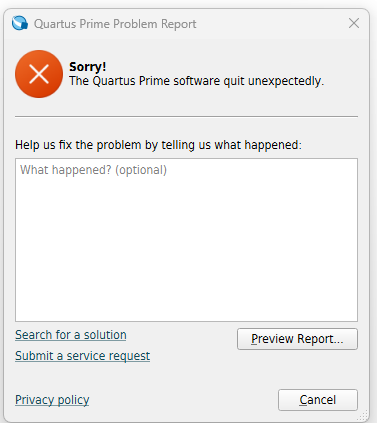
Hello, I would like to ask for help. I'm programming a Cyclone V with Quartus 21.1 Standard edition. I'm trying to implement signal tap to my design. My stp file is able to compile with the .sof/.pof generation but when I go to acquire data Quartus by clicking "run analysis" keeps on crashing. I get the following problem. Problem Details Error: *** Fatal Error: Uncaught C++ Exception Module: quartus.exe Stack Trace: 0xc41c9: RaiseException + 0x89 (KERNELBASE) 0x671f: _CxxThrowException + 0x8f (VCRUNTIME140) 0x3b551: std::_Xout_of_range + 0x21 (MSVCP140) 0x56ef: std::_String_val<std::_Simple_types<char> >::_Xran + 0xf (sld_chi) 0x9682: CHI_CONTROL_NODE_STP_V6::construct_load_data + 0x2f2 (sld_chi) 0xe6be: CHI_CONTROL_NODE_STP_V6::initialize_setup_offload_cache + 0x4ee (sld_chi) 0xdac4: CHI_CONTROL_NODE_STP_V6::init_acquisition + 0x174 (sld_chi) 0x1182c: CHI_CONTROL_NODE_STP_V6::start + 0x22c (sld_chi) 0x58e5: CHI_CONTROL_NODE_STP::acquisition_thread_proc + 0x35 (sld_chi) 0x13b18: msg_thread_wrapper + 0x78 (CCL_MSG) 0x15f13: mem_thread_wrapper + 0x73 (ccl_mem) 0x2773: thr_thread_begin + 0x33 (ccl_thr) 0x2cd86: BaseThreadInitThunk + 0x16 (KERNEL32) 0xacaeb: RtlUserThreadStart + 0x2b (ntdll) End-trace Quartus Prime Version 25.1std.0 Build 1129 10/21/2025 SC Standard Edition Executable: quartus Comment: None System Information Platform: windows64 OS name: Windows 10 OS version: 10.0 Quartus Prime Information Address bits: 64 Version: 25.1std.0 Build: 1129 Edition: Standard Edition I can't seem to get to the bottom of why this is happening. I don't believe there are any Quartus patches for signal tap for version 25.1std.0 If someone could help that would be greatly appreciated.101Views0likes7Comments25.3 PRO Release
Version: Release 25.3 PRO Quartus Build/TAG: B109/QPDS25.3_REL_GSRD_PR Release Date: October 10, 2025 Device Affected: Agilex™ 3, Agilex™ 5, Agilex™ 7, Startix® 10, Arria® 10 Release Type: Major release/Binary release Binary Release Path: http://releases.rocketboards.org/2025.10/ Major Features Released Support of GHRD 2.0 in Agilex™ 5 which includes foundational boot to Linux, ability to create compatible phase 2 bitstreams, parameterized HPS for maximum performance and best practices. Support of GSRD 2.0 Yocto layers for the Agilex 5 E-Series Premium DevKit with OOBE daughtercard for the GHRD 2.0 baseline design. Agilex 5 GSRD Development User Experience Improvement through KAS using a graphical/text interface to configure a limited number of high-level options on top of simplified Yocto recipes. - GSRD 2.0 with Kas Build System Support for running Agilex 5 Simics Simulation under the GSRD 2.0 framework. Booting from SD Card and QSPI is supported. - Exercising Simics Simulation from GSRD 2.0 Support GHRD and GSRD for Agilex™ M-Series PRQ HBM2e for DK-Sl-AGM039EA development kit. The GSRD is capable of booting to Linux. - Build the GSRD for DK-DEV-AGM039EA Hypervisor Multi-OS Support Example, demonstrating Linux and Zephyr running side-by-side in the HPS cluster. - HPS Xen Hypervisor GSRD System Example Design: Agilex™ 3 FPGA and SoC C-Series Development Kit Support for monitoring of SEU errors from the SDM in the HPS in Agilex™ 7. Add capability to measure the latency of Linux SMC calls. Support Nios V Lockstep application with a fail-safe mechanism597Views3likes11Comments
Dual Port Nios V BSP error
I've created a Nios V qsys with dual port onchip memory in Quartus Pro 26.1 True dual port, first port connected to instruction manager, second - to data manager. Base addresses automatically assigned the same to both. But i'am unable to create the BSP due to memory regions overlapping error! Of course the addresses are same - its the same physical onchip memory! Any solytion, please? Regards, Vlad.253Views0likes6Comments
Mailbox Client HAL API: Erroneous behavior in flash erase boundary checks (Agilex 3 / Nios V)
Hi, I am currently working on an Agilex 3 platform using the Nios V in Quartus Prime Pro 25.3. I discovered unexpected behavior in the Mailbox Client HAL API when trying to erase 32K blocks of flash. In the file intel_mailbox_client_flash.c in function mailbox_client_flash_erase_block: The function receives a dynamic block_size as an argument but ignores it during the boundary check, relying instead on the global dev_info->region_info.block_size. Because it checks against the maximum hardware block_size (i.e., 64K) instead of the actual block_size parameter passed to the function, it mistakenly blocks legitimate erase commands at the final sectors of the region. Below is the code snippet: int mailbox_client_flash_erase_block(intel_mailbox_client* fd, int block_offset, int block_size) { if(block_offset < 0 || block_offset > dev_info->region_info.region_size - dev_info->region_info.block_size || (block_offset & (SZ_4K - 1)) != 0) { return -EINVAL; } } I suggest changing the boundary check to use the local block_size parameter that was explicitly passed to the function: if(block_offset < 0 || block_offset > dev_info->region_info.region_size - block_size || (block_offset & (SZ_4K - 1)) != 0) { return -EINVAL; } A similar logic flaw exists in the caller function mailbox_client_flash_erase. The input validation check uses the static hardware block size (dev_info->region_info.block_size) instead of taking the requested length into account. I suppose this check should prevent out-of-bounds erases in the first place, so checking if there is one 64K block left in the flash is actually pointless. int mailbox_client_flash_erase(intel_mailbox_client* fd, int offset, int length) { if(offset < 0 || offset > dev_info->region_info.region_size - dev_info->region_info.block_size) { return -EINVAL; } } I suggest using: if(offset < 0 || offset > dev_info->region_info.region_size - length) { return -EINVAL; } Any feedback on this behavior would be appreciated. Thanks!17Views1like1Comment
Agilex-7 AXI MCDMA for PCIe hang
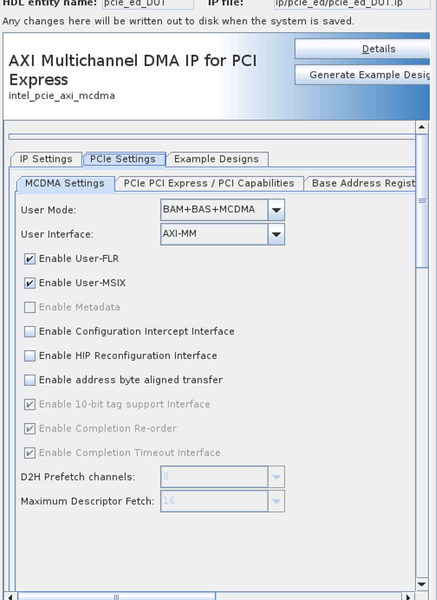
Hi! I'm working with AGIB023R18A1E1VC device and having issues with AXI Multichanned DMA IP for PCIe. Since I require a PCIe bridge, I configured the IP in MCDMA+BAS+BAM mode (PCIe Gen 4, 512-bit), generated an example design, and integrated the subsystem into my project. Although I do not use MCDMA, I rely heavily on the BAS and BAM functionality. The issue I’m seeing is that writing more than 448 bytes to the BAS causes the host to hang and subsequently reset. Notably, between the write transaction and the host reset, the FPGA internal logic is still able to write to the BAS, indicating no hang on the AXI bus. There are no issues with read transactions. We observe this issue not with only one card. At first we run into it in Q25.1 but still have it in Q25.3.1 If you need some captures from the signal tap or any additional details I may provide them. Thank you in advance! Mikhail.460Views0likes16CommentsUSB Blaster III and Cyclone III
ai_responder Hi, Cyclone III is supposed to be supported by USB Blaster III. I was wondering which Quartus version would be needed? Last Quartus version for Cyclone III is 13,1 as far as I know. Is USB Blaster III working with 13.1? best regards Ben85Views0likes3CommentsUnable to configure new license server
I am struggling to get our Quartus license to work on a new server. We had to replace the old server as the operating system is going out of support. A new license file has been requested and recievd which matches the mac address of the new server In the license file it references alterad and mgcld. If i install the flexLM version of the license manager then alterad is present but mgcld is not. I have tried commenting that line out - still doesn't work. If I change the license manager type and install the siemens one, that has no alterad and my understanding is that I should be changing the license file to use saltd instead of mgcld - I have done that, it still doesn't work. I guess I must be doing something wrong. I have setup numerous flexlm and other types of license servers and do not usually encounter many issues but this is really causing us problems. Do you have anywhere that will guide me through what I need to do stet by step? The documentation in the link from the license file (https://docs.altera.com/r/docs/683472/25.3/altera-fpga-software-installation-and-licensing/setting-up-a-license-file-in-the-license-server) suggests that the license manager should have both alterad and saltd executables, but as i say, neither flex or siemens license managers install both. I havr tried installing both license managers and referencing alterad and mgcld in their respective loctions but that did not work Also - I just tried to get a new lic file to see if it would then ref the correct exes for either of the lic managers and I have just been emailed no less than 5 license files, Unsure what they are all for? This is the error message when I attempt to start the server lmgrd is not running: Cannot connect to license server system. The license server manager (lmgrd) has not been started yet, the wrong port@host or license file is being used, or the port or hostname in the license has been changed174Views0likes2Comments


Featured Places
Community Resources
Check out the support articles on personalizing your community account, contributing to the community, and providing community feedback directly to the admin team!Tags
- troubleshooting10,401 Topics
- fpga dev tools quartus® prime software pro4,353 Topics
- FPGA Dev Tools Quartus II Software3,131 Topics
- stratix® 10 fpgas and socs1,552 Topics
- agilex® 7 fpgas and socs1,546 Topics
- arria® 10 fpgas and socs1,381 Topics
- stratix® v fpgas1,315 Topics
- arria® v fpgas and socs1,229 Topics
- Configuration1,095 Topics
- cyclone® v fpgas and socs1,058 Topics
Recent Blogs
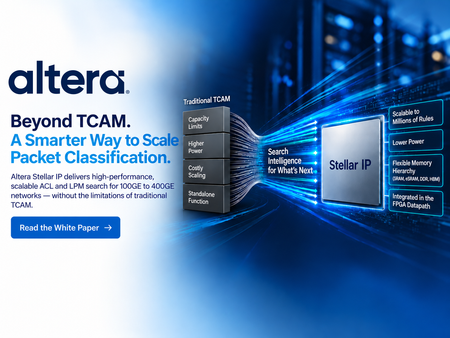
PACKET CLASSIFICATION | FPGA | NETWORKING + SECURITY Every packet decision starts with classification. Routers, firewalls, SmartNICs, security gateways, and service-edge platforms must determine which policy applies before traffic can be forwarded, blocked, inspected, redirected, or prioritized. TCAM earned its place in these systems because it provides predictable lookup behavior and native ternary matching for ACL and LPM workloads. But as policy databases grow, search keys widen, and rules change more frequently, the traditional approach of scaling specialized ternary memory creates tougher tradeoffs in capacity, power, resource utilization, and system integration. Altera Stellar solutions takes a different approach. Instead of scaling packet classification by building ever-larger ternary-memory structures, Stellar turns classification into an optimized search problem that runs on configurable FPGA resources. The result is an FPGA-native path for large, dynamic packet-classification tables without giving up the policy semantics that made TCAM useful in the first place. TCAM scales through memory expansion. Stellar scales through search intelligence. Keep the TCAM semantics. Change the scaling model. Stellar preserves the intent of ACL, LPM, and multi-field classification, but changes how those rules are represented and searched. The Stellar Software Stack organizes policies into optimized graph structures, partitions the rule database, and continuously manages those search structures as the database evolves. The hardware then executes the search using configurable FPGA search engines while rule information is stored in conventional memory resources. Depending on the configuration, Stellar can use on-chip M20K memory, eSRAM, DDR, or HBM. That gives architects more freedom to balance throughput, capacity, latency, power, and FPGA resource use around the needs of the actual system. Use dense memory where it makes sense, and intelligence where it matters A traditional TCAM combines storage and comparison circuitry inside specialized ternary-memory arrays. That architecture delivers deterministic matching, but scaling the table means scaling the specialized comparison structure as well. Stellar separates rule storage from search execution. Ternary information can be represented as value-and-mask data in conventional memory, while graph organization and software-managed optimization direct each search toward the relevant parts of the database. As tables grow from thousands of entries toward hundreds of thousands or millions, this creates a different path for scaling capacity and power. The white paper goes deeper into why this matters, including the tradeoffs between TCAM and Stellar, the role of memory hierarchy, and a set of Stellar configurations spanning different key widths, capacities, memory resources, and projected five-tuple performance. Bring classification into the programmable datapath The value is bigger than the lookup engine itself. Stellar is designed to operate inside the FPGA alongside packet parsing, telemetry, encryption, traffic management, host-interface logic, and customer packet-processing RTL. For system architects, that means classification can become part of the same programmable platform already handling the datapath. A firewall can pair large, dynamic ACL processing with the rest of its traffic pipeline. A router can combine LPM and policy enforcement with programmable networking functions. A SmartNIC can integrate flow classification with offload and customer-specific acceleration. That system-level flexibility is especially relevant for 100GE to 400GE designs where classification must scale without consuming the platform that surrounds it. Read the full whitepaper! The full Altera white paper, Altera TCAM Alternative Solutions Scale Packet Classification to Millions of Rules for Networking Equipment, explains the architecture behind Stellar and the design choices that make it different. It covers TCAM fundamentals and scaling limits, Stellar graph-based search and software partitioning, memory-hierarchy options, configuration examples, quantitative architectural comparisons, dynamic updates, and deployment use cases across networking and security. Read the white paper See how Stellar uses search intelligence, configurable FPGA resources, and a flexible memory hierarchy to create a scalable alternative for large ACL and LPM workloads.
17 days ago0likes
4 MIN READ
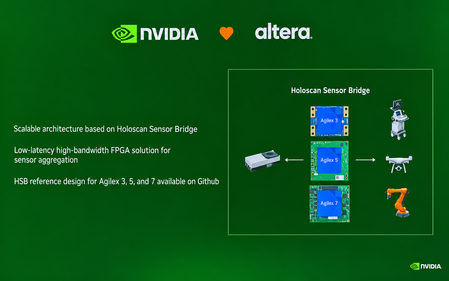
September 28, 2026 The next generation of embedded systems will not be defined by compute alone. It will depend on how quickly, reliably, and intelligently systems can move data from the physical world into AI engines and turn insights back into action. That message came through clearly at Embedded World North America 2026, held September 22–24 at the Anaheim Convention Center. For Altera, the show provided an opportunity to highlight a growing collaboration with NVIDIA and demonstrate the role of FPGAs in high-performance edge AI architectures. Connecting sensors to AI with flexibility and determinism At the center of the story was NVIDIA Holoscan Sensor Bridge technology. The solution creates a high-bandwidth, low-latency path between real-world sensors and GPU-based AI processing, an increasingly important capability for robotics, industrial automation, intelligent video, medical systems, and other physical AI applications. FPGAs are well suited to this role because they can provide deterministic processing, flexible I/O, and protocol adaptation close to the sensor. Rather than forcing every application into the same hardware configuration, FPGA-based designs can be tailored to performance, connectivity, and latency requirements of a specific system. In the show’s keynote, NVIDIA Vice President Deepu Talla described the value of this flexibility: “You can select any of the Altera FPGAs depending on the application and pair them with any of the NVIDIA frameworks.” Altera’s post noted that Altera offers Holoscan Sensor Bridge solutions spanning 10G to 100G, where 25G and 100G offer significantly more bandwidth compared to other Holoscan ecosystem partners, helping developers scale connectivity for demanding edge workloads. The result is a practical sensor-to-compute architecture: Altera FPGAs handle the flexible, deterministic front end, while NVIDIA platforms provide the accelerated environment for AI and robotics workloads. An ecosystem approach to accelerating development The demonstrations also underscored that successful edge AI deployments require more than individual components. Developers need reference designs, production-ready boards, and partners that help bridge the gap between evaluation and deployment. Altera’s growing Holoscan ecosystem includes more than 10 reference designs and partner boards. These building blocks can help teams reduce integration effort and move faster from proof of concept to a real-time AI product. One example was on display at Altera partner Critical Link’s booth. Critical Link was recognized as a Best in Show Award winner in the AI & Machine Learning category at the show. Visitors to the booth could see a live demonstration of a 5-camera Holoscan Sensor Bridge solution, using Critical Link’s MitySOM-A5E as the featured Agilex® 5 FPGA hardware platform. The demonstration showed how an Agilex 5 FPGA-based system can help bring sensor data into an NVIDIA-powered AI pipeline while preserving the low-latency, high-bandwidth behavior required by edge applications. From 10G to 100G: Building the data plane for edge AI Altera’s Holoscan Sensor Bridge solutions are designed to make the sensor-to-GPU path faster and more adaptable. A recent Altera technical blog describes 10G, 25G, and 100G reference designs, including a 25G design on Agilex 5 SoC FPGAs for multi-camera sensor data flow and accelerated processing at the edge. In this architecture, the FPGA serves as the data plane: connecting to diverse sensors, aggregating streams, adapting protocols, and preprocessing data before it reaches the NVIDIA GPU. That division of labor helps reduce data-movement bottlenecks while preserving deterministic timing and giving developers room to evolve the system as sensor interfaces and AI workloads change. Altera Technical Holoscan blog for Robotics: Altera Pushes the Boundaries of Edge AI with New Holoscan Sensor Bridge Solutions | Altera Community - 355665 Watch the 25G Holoscan demo video: YouTube/Altera Why the sensor-to-compute path matters As AI moves into physical environments, system designers are balancing several competing requirements: Real-time response: Applications such as robotics and industrial inspection cannot always afford the delay of sending raw sensor data to a remote system. High-bandwidth data movement: Modern sensors generate increasingly rich data streams that must be transported without creating a bottleneck. Deterministic behavior: Safety-critical and industrial systems need predictable timing and consistent performance. Design flexibility: Product teams must support different sensors, interfaces, and deployment conditions without redesigning the entire platform. Faster development: Reference designs and ecosystem partnerships can shorten the path from concept to production. The Altera and NVIDIA approach addresses these needs by combining FPGA-based connectivity and processing with GPU-accelerated AI. It gives developers a modular foundation for building systems that can adapt as sensors, models, and application requirements evolve. Building what comes next at the edge The conversation at Embedded World North America 2026 pointed toward a broader shift in embedded design. Edge systems are becoming intelligent, connected, and increasingly autonomous, but their performance still depends on the data path that feeds them. By pairing Altera FPGAs with NVIDIA platforms and collaborating with partners such as Critical Link, developers gain more options for designing that path. The combination of flexible hardware, high-speed connectivity, and accelerated AI can help transform raw sensor input into timely decisions at the point where data is created. For teams developing the next generation of robotics, industrial automation, intelligent vision, and physical AI systems, this is the opportunity: Build a sensor-to-compute architecture that is fast enough for today’s workloads, flexible enough for tomorrow’s requirements, and ready to scale from demonstration to deployment. Learn more about Altera’s Physical AI-related Solutions: Holoscan: https://www.altera.com/fpga-solutions/sensory-interfaces Robotics: https://www.altera.com/fpga-solutions/robotics-solutions-stack Video: https://www.altera.com/fpga-solutions/video-solutions-stack
17 days ago0likes
1 MIN READ
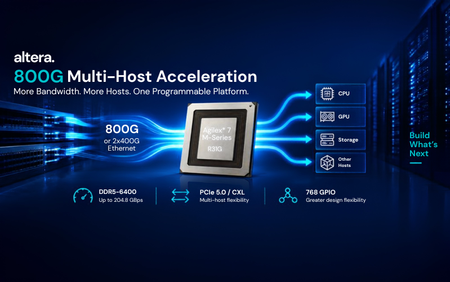
Altera has begun shipping the new Agilex® 7 M-Series R31G multi-host acceleration package, giving customers a new way to build high-bandwidth systems that connect more hosts while moving more data through the network and memory subsystem. R31G is designed for architectures where data must move quickly between the network, memory, and multiple CPUs, GPUs, or other hosts. By bringing 800G or 2x400G Ethernet together with expanded PCIe 5.0/CXL host connectivity, the package opens new possibilities for AI NICs, storage acceleration, cloud acceleration, and other high-throughput platforms. What R31G enables More network bandwidth: 800G or 2x400G Ethernet capability for high-throughput data paths. More host connectivity: Two PCIe 5.0 x16 host interfaces, or up to four independent PCIe 5.0 x8 connections, with CXL support for flexible multi-host architectures. More memory bandwidth and I/O: DDR5-6400 and LPDDR5-6400 support, up to 204.8 GBps of memory bandwidth, and 768 GPIO in a compact 56 x 45 mm package. The result is a programmable platform that can connect, accelerate, and adapt as infrastructure requirements evolve, while keeping high-speed networking, host connectivity, and memory bandwidth tightly integrated. More network bandwidth. More hosts. More memory bandwidth. One programmable platform. Learn more in the Agilex® 7 M-Series product site.
24 days ago0likes
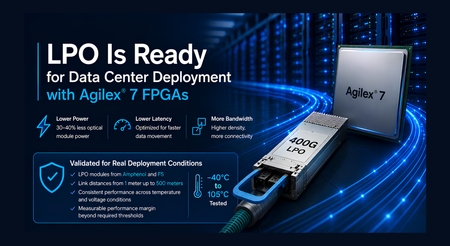
As AI, cloud, and high-performance computing systems continue to scale, data center operators need more bandwidth within increasingly constrained power and thermal envelopes. Linear Pluggable Optics (LPO) offers an important path forward by simplifying optical modules, reducing power consumption, and lowering latency. LPO places signal-conditioning responsibilities in the host device, allowing the optical module to operate without the DSP used in traditional retimed optics. This architecture can reduce optical module power by 30% to 40%, helping data center designers increase connectivity density while simplifying cooling and thermal management. Altera Brings LPO to the FPGA Market Altera is the first FPGA provider to publicly demonstrate Linear Pluggable Optics interoperability using production FPGA devices. Continued validation with LPO modules from Amphenol and FS further demonstrates the breadth of the emerging ecosystem supported by Altera. Agilex® 7 FPGAs and SoCs bring the power and latency advantages of LPO to programmable platforms used in SmartNICs, data processing units, AI accelerators, and custom infrastructure. The initial public demonstration established that Agilex 7 devices could successfully interoperate with 400G LPO modules. The latest validation advances that milestone by confirming that the implementation meets the performance requirements expected for deployment in demanding data center environments. Validated for Real Deployment Conditions Comprehensive testing confirms that Agilex 7 F-Tile transceivers meet the electrical and link-performance requirements defined by the 100G-DR-LPO specification. The validation demonstrated: Compliance with the required transmit, receive, and link-performance criteria Successful interoperability with LPO modules from Amphenol and FS Successful LPO connectivity across distances from 1 meter to 500 meters Consistent performance across temperature and voltage conditions Measurable performance margin beyond required thresholds Testing covered demanding signal conditions, voltage variation, and temperatures ranging from minus 40 degrees Celsius to 105 degrees Celsius for electrical characterization. Functional link testing included a 1-meter LPO connection, a 100-meter active optical cable, and 500-meter LPO modules from Amphenol and FS. The results demonstrate robust, repeatable operation across multiple module suppliers and link distances, with measurable margin relative to the required performance limits. For customers, this validation provides confidence that Agilex® 7 support for LPO is ready for real-world deployment. Following the industry’s first public FPGA interoperability demonstration, the solution has now been evaluated against LPO performance requirements using modules from multiple suppliers and over link distances up to 500 meters. Together, these results demonstrate a practical foundation for deploying LPO connectivity in next-generation data center systems. More Efficient Connectivity for AI and Cloud Infrastructure The value of LPO grows as data centers deploy more high-speed optical connections. Eliminating the DSP from each optical module can reduce power across thousands of links, simplify optical module design, ease thermal pressure at the front panel, and support lower-latency data movement. Agilex 7 FPGAs add programmability to this more efficient optical architecture. Customers can combine LPO connectivity with packet processing, acceleration, security, telemetry, and evolving protocol support on a single adaptable platform. This flexibility is especially valuable for AI clusters and cloud infrastructure, where workloads, network architectures, and connectivity standards continue to evolve. Validation with multiple module vendors also gives system designers greater flexibility as the LPO supplier ecosystem continues to develop. Ready for the Next Generation of Data Centers The combination of public interoperability and comprehensive validation marks a major step for LPO in the FPGA market. Altera has demonstrated that LPO works with production Agilex 7 devices and validated that the solution meets key LPO requirements with measurable operating margin. This gives customers a proven foundation for evaluating and deploying lower-power, lower-latency optical connectivity in real data center environments. With Agilex® 7 FPGAs, LPO is ready for real-world data center deployment.
2 months ago0likes
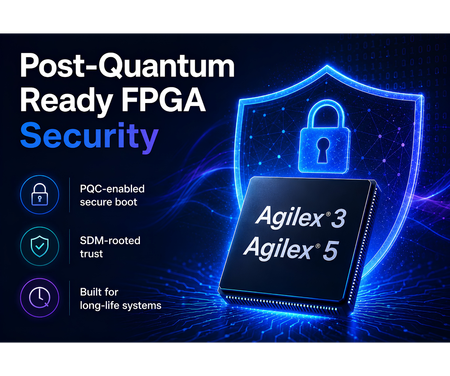
Security requirements are entering a new phase. Systems being designed today may remain deployed for many years, while regulatory expectations, cryptographic standards, and threat models continue to evolve. For designs in industrial, communications, infrastructure, aerospace, defense, and embedded applications, long-term security is becoming a core platform requirement. FPGA-based designs allow designs to meet today’s security needs and evolve with tomorrow’s requirements. Altera is now offering Agilex® 3 and Agilex® 5 devices with PQC-enabled secure boot and configuration support, helping customers prepare for the next generation of security requirements. With the Quartus® Prime Pro Edition 26.1.1 release, customers can begin using a PQC flow that works with Agilex 3 and Agilex 5 based hardware. This milestone extends the security architecture already built into the Agilex platform. Agilex devices use the Secure Device Manager as a hardware root of trust for secure configuration and device management. By combining PQC-capable devices with Quartus software enablement, Altera is helping customers strengthen the FPGA chain of trust as post-quantum requirements move from planning to implementation. The value is immediate and practical. Customers can start designing with supported devices today, while using Quartus 26.1.1 to take advantage of the current software flow. This gives teams a path to address emerging compliance and security expectations without needing a future platform redesign. The same hardware foundation also allows for additional security enhancements over time. Customers designing with PQC-capable Agilex 3 and Agilex 5 devices can benefit from planned software and firmware improvements enabled by the underlying hardware, with no further FPGA hardware upgrade required for those enhancements. Agilex 3 devices bring this capability to power- and cost-optimized FPGA and SoC designs used in embedded, edge, industrial, control, and platform-management applications. Agilex 5 devices extend the same security direction into mid-range FPGA and SoC designs that require higher performance, greater integration, and broader system capability. Post-quantum readiness will continue to advance, and Altera is building that evolution into the Agilex platform roadmap. With PQC-capable Agilex 3 and Agilex 5 devices and Quartus 26.1.1 software enablement, customers have a practical starting point today and a scalable foundation for future security enhancements.
2 months ago0likes