agilex
48 Topics
A Full Vision Pipeline: Using MIPI in Agilex® 5 and Agilex® 3 FPGAs
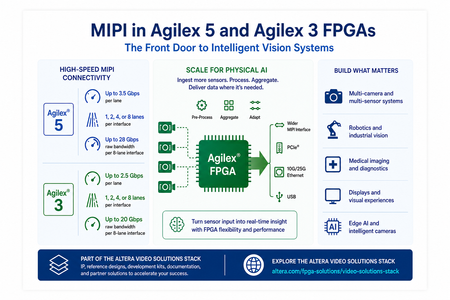
Agilex® 5 and Agilex® 3 FPGAs now provide native MIPI D-PHY support for CSI-2 camera and DSI display interfaces, making it easier to bring sensor and display data directly into FPGA fabric for real-time processing, aggregation, adaptation, and transport. The blog highlights how scalable MIPI bandwidth, multi-interface connectivity, and integration with the Altera Video Solutions Stack enable high-performance vision, robotics, medical imaging, edge AI, and display systems while simplifying the path from image capture to processing and AI workflows.630Views0likes0CommentsAltera Extends Agilex®, MAX® 10, and Cyclone® V Lifecycles Through 2045 for Long-Life Systems
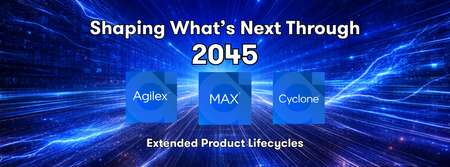
Altera is extending the availability of its Agilex®, MAX® 10, and Cyclone® V FPGA families through 2045 to support long-lifecycle applications like industrial, aerospace, and medical systems. This helps customers avoid costly redesigns and ensures reliable, long-term supply, reinforcing Altera as a trusted partner for decades-long deployments.1.9KViews3likes1Comment
Runtime Reconfiguration You Can Trust
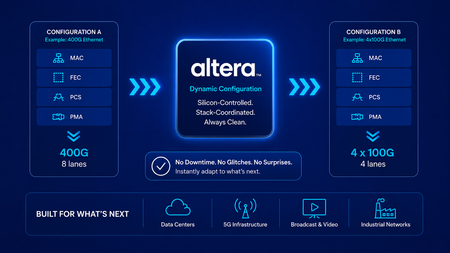
Runtime flexibility is only valuable when it is reliable High-speed systems are being asked to do more with the same hardware. A data-center platform may need to operate as a single 400G Ethernet link in one deployment, then support multiple 100G links in another. A front-haul or edge system may need to adapt to different rates, protocol roles, or customer configurations over the life of the product. The promise is simple: deploy one platform, then adapt it as requirements change. But in high-speed design, changing a configuration is not the hardest part. Changing it correctly is. A live transition is not just a speed change. It can require coordinated updates across the the various networking layers, along with clocking, lane mapping, reset behavior, and link recovery. If those layers do not move together and in the right order, the result can be an unstable link, silent data corruption, or a system that hangs indefinitely waiting for CDR lock. That is the real value of Altera Dynamic Reconfiguration: it gives designers confidence that runtime transitions are clean, verified, and repeatable. The Altera difference: clean, verified transitions Altera Dynamic Reconfiguration is built around a profile-driven, silicon-aware flow. Designers define the target operating modes in Quartus Prime, and the system generates validated profiles for each supported state. At runtime, the Dynamic Reconfiguration Controller applies the selected profile through a managed, hardware-driven sequence. It orchestrates the transition across the full protocol stack, ensuring MAC, FEC, PCS, and PMA layers are updated in a coordinated and deterministic order, rather than leaving the designer to manually manage each step. The result: clean, verified transitions - no partial configurations, no unsequenced resets, and no user-managed state machines to debug at 2 a.m. This matters because the transition itself is often where risk appears. A system may appear to support multiple modes on paper, but if each layer must be independently controlled, reset, and validated by user logic, the design team carries the burden of proving that every edge case works under real operating conditions. Altera reduces that risk by turning reconfiguration into a controlled system operation. The selected profile is known, and the transition is repeatable. Silicon-driven confidence The assurance comes from the architecture. Agilex devices use hardened transceiver and protocol IP designed for high-speed operation. Rather than treating reconfiguration as a collection of ad hoc register writes, Altera Dynamic Reconfiguration works with hardened IP and validated profiles to help ensure that runtime switching happens in a controlled, silicon-driven way. That silicon foundation is especially important at 100G and 400G data rates, where small sequencing mistakes can lead to difficult debug cycles. When designers hand-craft transceiver reset state machines, getting the order right, the timing right, and the edge cases right can take weeks. With Altera, those critical sequencing responsibilities are built into the reconfiguration flow. The benefit is not just ease of use. Ease of use is a result. The primary benefit is trust: designers can enable live switching with greater confidence that the system will move from one valid state to another without glitches. A practical advantage for real systems In real deployments, flexibility has business value only if it does not create operational risk. Altera Dynamic Reconfiguration helps a single hardware platform support multiple configurations while avoiding the disruption of a full FPGA reprogramming cycle or duplicate hardware paths for every possible mode. For networking platforms, this can mean supporting different Ethernet configurations on the same physical transceiver resources. For multi-protocol systems, it can mean adapting a port role as requirements evolve. For platform owners, it means more deployment options from the same hardware design. This is where Altera has a practical positioning advantage: customers get runtime flexibility with more of the critical transition behavior handled by the platform. Instead of asking designers to manually manage every reconfiguration step, Altera provides a structured flow designed to produce predictable, verified results. What the demo proves The Agilex 7 400G Dynamic Reconfiguration demo turns this story into proof. In the demo, two Agilex 7 FPGA boards are connected over QSFP-DD, and the system dynamically switches between a 400G Ethernet configuration and multiple 100G Ethernet links using the same setup. The demonstration shows more than a mode change. It shows live traffic validation, link status, packet counters, error status, and FEC behavior during the transition. That is the point: the feature is not theoretical. It is running on silicon, switching in real time, and validating the kind of clean transition designers need before they trust the feature in production systems. Why this matters now As data-center, telecom, edge, and industrial systems become more configurable, customers increasingly need hardware platforms that can support multiple roles over time. The question is no longer whether a system can support more than one mode. The question is whether it can switch modes cleanly, predictably, and with confidence. Altera Dynamic Reconfiguration is designed for that moment. It combines hardened IP performance, profile-driven control, and coordinated sequencing to deliver runtime flexibility without compromising reliability. Dynamic reconfiguration is valuable because it enables flexibility. Altera makes it compelling because it makes that flexibility trustworthy. Watch the Runtime Reconfiguration You Can Trust demo video548Views1like0CommentsWhy Integration Matters in Direct RF FPGA Design
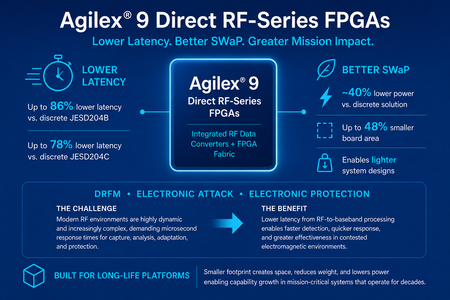
Agilex® 9 Direct RF-Series FPGAs help system designers address two critical RF system priorities: lower latency and improved SWaP (size, weight, and power). By integrating high-performance RF data converters directly with FPGA fabric, Agilex 9 Direct RF-Series FPGAs can reduce RF-to-baseband latency, simplify the signal chain, lower system power, and free up valuable board space for future capabilities addition. In a draft comparison of discrete JESD-based architectures versus an Agilex 9 integrated Direct RF approach, the integrated solution showed up to 78% lower latency versus a JESD204C discrete solution and up to 86% lower latency versus a JESD204B discrete solution. The comparison also showed approximately 40% lower power consumption and up to 48% board-area reduction. These gains support both primary value propositions: faster system response through lower latency, and better SWaP through fewer external components, lower power, and a smaller, more efficient RF design. Digital radio frequency memory (DRFM), electronic attack, and electronic protection are good examples of applications where latency improvements can make a meaningful difference. In these types of RF systems, lower RF-to-baseband latency helps systems act on complex signals faster, improving responsiveness, timing precision, and mission effectiveness in contested electromagnetic environments. The SWaP benefit is also critical in long-lifecycle aerospace and defense platforms which may remain operational for decades, yet have limited space, weight, power, and cooling capacity for new hardware. As signal environments evolve, these platforms need room to add or upgrade capabilities without major system redesigns. By integrating RF data conversion with FPGA processing, Agilex 9 Direct RF-Series FPGAs can help system designers improve responsiveness, reduce board area, simplify the RF signal chain, and create more headroom for future upgrades. Learn more about Agilex 9 Direct RF-Series FPGAs and the benefits of integrated data converters. Discover how Agilex 9 Direct RF-Series FPGAs enable lower-latency and more power-efficient RF system designs Download the Altera® Direct RF-Series FPGA Wideband Product Brief Source for draft proof points: Agilex 9 Direct RF-Series integrated data converter app note draft, version 0.1, last updated March 31, 2026.468Views0likes0CommentsAgilex® 7 FPGAs and SoCs M-Series Extends Production-Ready Memory Leadership with DDR5-6400
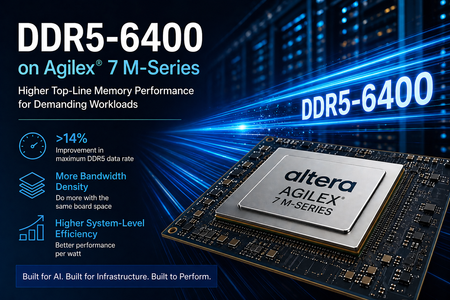
New DDR5-6400 support delivers a 14% increase in maximum DDR5 data rate, strengthening Agilex® 7 M-Series device’s memory leadership on a production device family. This effort reflects Altera’s continued investment to improve features on platforms already in volume production. For customers building high-performance FPGA-based systems, memory capability is a core platform requirement, and the level of memory performance increasingly shapes overall system differentiation. That is why this latest Agilex 7 M-Series enhancement matters. With DDR5 support increasing from 5600 MT/s to 6400 MT/s, Agilex 7 M-Series devices support a 14% increase in maximum DDR5 performance on a device family already shipping in production. The significance of this update goes beyond speed alone. It reinforces a broader story about platform value: more usable bandwidth, better system efficiency, and continued innovation on a platform customers can design around today. More bandwidth, better system efficiency DDR5-6400 is not just a higher interface number. It enables more memory bandwidth from the same platform, helping customers move more data through bandwidth-intensive designs. That added bandwidth can also improve bandwidth density at the system level. In practical terms, it can help designers reach target throughput with a more optimized memory subsystem, potentially reducing DIMM or channel requirements in some designs and improving overall platform efficiency. Those advantages become increasingly important in the kinds of applications Agilex 7 M-Series devices are built to address. Across AI, networking, video processing, and data center infrastructure, system performance depends not only on compute capability, but also on how efficiently data can be moved and sustained through the platform. A broader production-ready platform advantage This update also says something important about the platform itself. Agilex 7 M-Series devices already offer production-ready support for advanced external memory technologies, and DDR5-6400 extends that advantage further. As next-generation infrastructure platforms evolve for AI, scale-out networking, and data-intensive acceleration, advanced memory capability is becoming an increasingly important platform differentiator. DDR5 support is now emerging across a broader range of FPGA segments, including mid-range devices such as Agilex 5 and even power- and cost-optimized devices such as Agilex 3 (with LPDDR5 support). Agilex 7 M-Series devicesbrings DDR5-6400 to a high-end FPGA platform tier built for larger, more data-intensive AI, networking, and infrastructure applications. By combining advanced memory performance with substantially greater logic capacity, it delivers differentiation at the platform level. This enhancement is enabled through an upcoming release of Quartus® Prime Pro Edition and is designed to be backward compatible with previously shipped silicon and boards. Customers interested in enabling DDR5-6400 should contact Altera for additional guidance on supported configurations, applicable speed grades, and implementation details. Conclusion The move to DDR5-6400 on Agilex 7 FPGAs and SoCs M-Series delivers a 14% improvement in maximum DDR5 data rate, improving bandwidth density and system-level efficiency while extending the value of a production-ready platform for evolving customer requirements. Watch the DDR5-6400 Demo Performance Video622Views0likes0CommentsAgilex® 7 M-Series Expands with Three New Package Options for Increasing Bandwidth and Connectivity
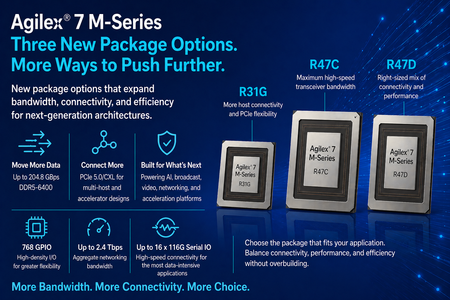
Altera introduced three new Agilex® 7 M-Series FPGA package options, R31G, R47C, and R47D, to give customers more flexibility in balancing bandwidth, connectivity, and performance for AI, networking, video, embedded, and acceleration applications. The new options support DDR5-6400, up to 204.8 GB/s memory bandwidth, and expanded transceiver configurations, enabling designers to optimize systems for PCIe connectivity, maximum data throughput, or efficient right-sized scaling.543Views0likes0CommentsAgilex® 7 F-Tile at 200G: High-Speed Ethernet in Action
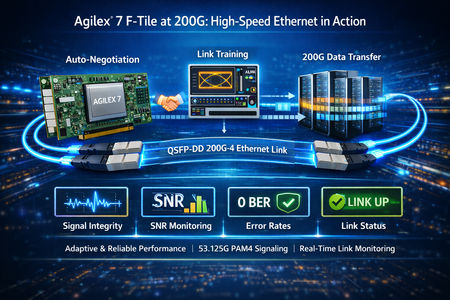
This post demonstrates a 200G-4 Ethernet link running on Agilex 7 FPGAs using F-Tile transceivers. It walks through the full link bring-up process, including Auto-Negotiation and Link Training, followed by stable high-speed data transmission using 53.125G PAM4 lanes over QSFP-DD. The demo provides real-time visibility into link status, signal integrity, and error metrics, and evaluates performance across loopback configurations and varying cable lengths. The result highlights reliable link initialization, consistent throughput, and robust operation under practical system conditions.271Views0likes0CommentsBeyond Traditional Mid-Range: The Agilex® 5 Approach
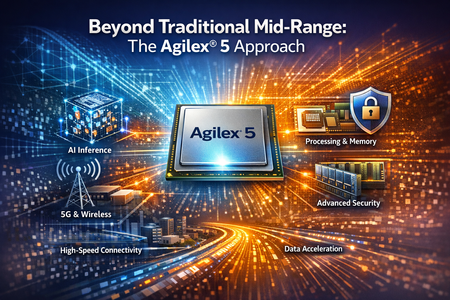
This post explains how the definition of mid-range FPGAs has evolved from logic density to system-level capability. It highlights how Agilex 5 FPGAs address modern embedded and edge requirements by integrating compute, AI acceleration, memory, connectivity, and security into a single platform. The article also covers how Agilex 5 D-Series extends mid-range performance with higher logic density, increased bandwidth, and enhanced AI capabilities, enabling more complex and data-intensive workloads while maintaining efficiency and design simplicity.306Views0likes0CommentsEnabling Runtime Flexibility in High-Speed Designs with F-Tile Dynamic Reconfiguration
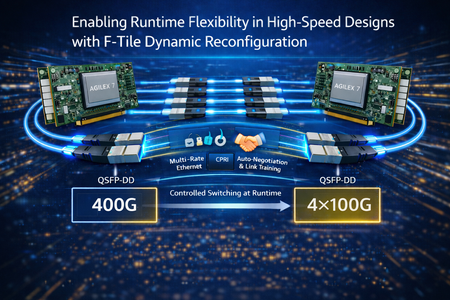
This post demonstrates how F-Tile Dynamic Reconfiguration in Agilex 7 FPGAs enables real-time switching between 400G and 4×100G Ethernet without system downtime. It explains how predefined configuration profiles, system-level data path reconfiguration (MAC, PCS, FEC, PMA), and software control enable predictable, production-ready transitions. The article also highlights support for multi-rate Ethernet, protocol flexibility, and continuous traffic validation, showing how FPGA-based systems can adapt dynamically to changing network conditions.307Views0likes0CommentsFrom Talk to Deployment: Altera at Mobile World Congress 2026
This blog recaps Altera’s presence at Mobile World Congress 2026, highlighting a shift in the wireless industry from experimentation to real-world deployment. It covers key announcements such as validated interoperability with Broadcom for 5G-Advanced and early 6G radio systems, production-ready massive MIMO reference designs, and growing momentum in satellite (NTN) communications. The post also showcases FPGA-based AI use cases running directly at the RAN edge and emphasizes the strength of Altera’s partner ecosystem. Overall, it presents practical advancements in scalable, power-efficient wireless infrastructure built on Agilex FPGAs.321Views0likes0Comments