agilex
48 Topics
Altera Extends Agilex®, MAX® 10, and Cyclone® V Lifecycles Through 2045 for Long-Life Systems
Altera is extending the availability of its Agilex®, MAX® 10, and Cyclone® V FPGA families through 2045 to support long-lifecycle applications like industrial, aerospace, and medical systems. This helps customers avoid costly redesigns and ensures reliable, long-term supply, reinforcing Altera as a trusted partner for decades-long deployments.1.9KViews3likes1Comment
Runtime Reconfiguration You Can Trust
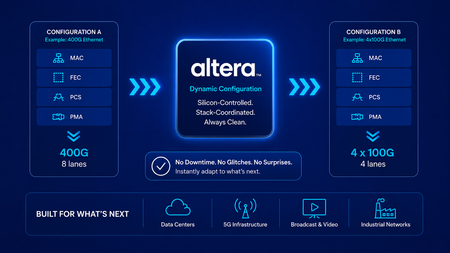
Runtime flexibility is only valuable when it is reliable High-speed systems are being asked to do more with the same hardware. A data-center platform may need to operate as a single 400G Ethernet link in one deployment, then support multiple 100G links in another. A front-haul or edge system may need to adapt to different rates, protocol roles, or customer configurations over the life of the product. The promise is simple: deploy one platform, then adapt it as requirements change. But in high-speed design, changing a configuration is not the hardest part. Changing it correctly is. A live transition is not just a speed change. It can require coordinated updates across the the various networking layers, along with clocking, lane mapping, reset behavior, and link recovery. If those layers do not move together and in the right order, the result can be an unstable link, silent data corruption, or a system that hangs indefinitely waiting for CDR lock. That is the real value of Altera Dynamic Reconfiguration: it gives designers confidence that runtime transitions are clean, verified, and repeatable. The Altera difference: clean, verified transitions Altera Dynamic Reconfiguration is built around a profile-driven, silicon-aware flow. Designers define the target operating modes in Quartus Prime, and the system generates validated profiles for each supported state. At runtime, the Dynamic Reconfiguration Controller applies the selected profile through a managed, hardware-driven sequence. It orchestrates the transition across the full protocol stack, ensuring MAC, FEC, PCS, and PMA layers are updated in a coordinated and deterministic order, rather than leaving the designer to manually manage each step. The result: clean, verified transitions - no partial configurations, no unsequenced resets, and no user-managed state machines to debug at 2 a.m. This matters because the transition itself is often where risk appears. A system may appear to support multiple modes on paper, but if each layer must be independently controlled, reset, and validated by user logic, the design team carries the burden of proving that every edge case works under real operating conditions. Altera reduces that risk by turning reconfiguration into a controlled system operation. The selected profile is known, and the transition is repeatable. Silicon-driven confidence The assurance comes from the architecture. Agilex devices use hardened transceiver and protocol IP designed for high-speed operation. Rather than treating reconfiguration as a collection of ad hoc register writes, Altera Dynamic Reconfiguration works with hardened IP and validated profiles to help ensure that runtime switching happens in a controlled, silicon-driven way. That silicon foundation is especially important at 100G and 400G data rates, where small sequencing mistakes can lead to difficult debug cycles. When designers hand-craft transceiver reset state machines, getting the order right, the timing right, and the edge cases right can take weeks. With Altera, those critical sequencing responsibilities are built into the reconfiguration flow. The benefit is not just ease of use. Ease of use is a result. The primary benefit is trust: designers can enable live switching with greater confidence that the system will move from one valid state to another without glitches. A practical advantage for real systems In real deployments, flexibility has business value only if it does not create operational risk. Altera Dynamic Reconfiguration helps a single hardware platform support multiple configurations while avoiding the disruption of a full FPGA reprogramming cycle or duplicate hardware paths for every possible mode. For networking platforms, this can mean supporting different Ethernet configurations on the same physical transceiver resources. For multi-protocol systems, it can mean adapting a port role as requirements evolve. For platform owners, it means more deployment options from the same hardware design. This is where Altera has a practical positioning advantage: customers get runtime flexibility with more of the critical transition behavior handled by the platform. Instead of asking designers to manually manage every reconfiguration step, Altera provides a structured flow designed to produce predictable, verified results. What the demo proves The Agilex 7 400G Dynamic Reconfiguration demo turns this story into proof. In the demo, two Agilex 7 FPGA boards are connected over QSFP-DD, and the system dynamically switches between a 400G Ethernet configuration and multiple 100G Ethernet links using the same setup. The demonstration shows more than a mode change. It shows live traffic validation, link status, packet counters, error status, and FEC behavior during the transition. That is the point: the feature is not theoretical. It is running on silicon, switching in real time, and validating the kind of clean transition designers need before they trust the feature in production systems. Why this matters now As data-center, telecom, edge, and industrial systems become more configurable, customers increasingly need hardware platforms that can support multiple roles over time. The question is no longer whether a system can support more than one mode. The question is whether it can switch modes cleanly, predictably, and with confidence. Altera Dynamic Reconfiguration is designed for that moment. It combines hardened IP performance, profile-driven control, and coordinated sequencing to deliver runtime flexibility without compromising reliability. Dynamic reconfiguration is valuable because it enables flexibility. Altera makes it compelling because it makes that flexibility trustworthy. Watch the Runtime Reconfiguration You Can Trust demo video548Views1like0Comments