Forum Discussion

 Honored Contributor
The difference between the RTL level simulation and the Gate lavel simution
HI!
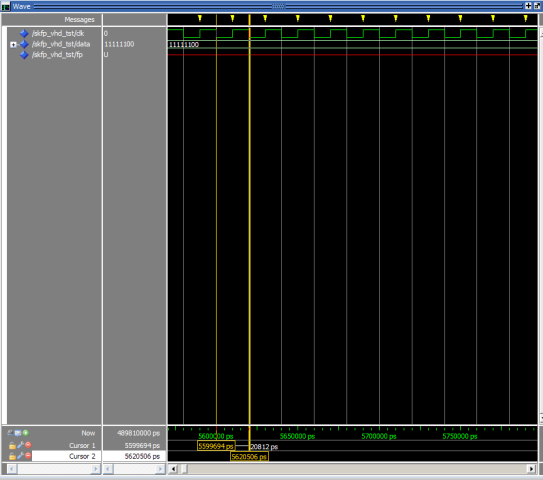
Everyone! I am using Quartus ii web 9.1 . Now There is a problem between the RTL level simulation and Gate lavel simution. I need help! this is the code: LIBRARY IEEE; USE IEEE.STD_LOGIC_1164.ALL; USE IEEE.STD_LOGIC_ARITH.ALL; USE IEEE.STD_LOGIC_UNSIGNED.ALL; ENTITY SKFP IS PORT(CLK : IN STD_LOGIC; DATA: IN STD_LOGIC_VECTOR(7 DOWNTO 0); FP : OUT STD_LOGIC ); END ENTITY SKFP; ARCHITECTURE ART OF SKFP IS SIGNAL FULL: STD_LOGIC; BEGIN PROCESS(CLK) VARIABLE COUNT:STD_LOGIC_VECTOR(7 DOWNTO 0); BEGIN IF CLK'EVENT AND CLK='1' THEN IF COUNT="11111111" THEN COUNT:=DATA; FULL<='1'; ELSE COUNT:=COUNT+1; FULL<='0'; END IF; END IF; END PROCESS; PROCESS(FULL) VARIABLE TEMP: STD_LOGIC; BEGIN IF FULL'EVENT AND FULL='1' THEN TEMP:=NOT TEMP; IF TEMP='1' THEN FP<='1'; ELSIF TEMP='0' THEN FP<='0'; END IF; END IF; END PROCESS; END ARCHITECTURE ART; and this is the testbench: -- Copyright (C) 1991-2009 Altera Corporation -- Your use of Altera Corporation's design tools, logic functions -- and other software and tools, and its AMPP partner logic -- functions, and any output files from any of the foregoing -- (including device programming or simulation files), and any -- associated documentation or information are expressly subject -- to the terms and conditions of the Altera Program License -- Subscription Agreement, Altera MegaCore Function License -- Agreement, or other applicable license agreement, including, -- without limitation, that your use is for the sole purpose of -- programming logic devices manufactured by Altera and sold by -- Altera or its authorized distributors. Please refer to the -- applicable agreement for further details. -- *************************************************************************** -- This file contains a Vhdl test bench template that is freely editable to -- suit user's needs .Comments are provided in each section to help the user -- fill out necessary details. -- *************************************************************************** -- Generated on "08/22/2010 20:56:38" -- Vhdl Test Bench template for design : SKFP -- -- Simulation tool : ModelSim-Altera (VHDL) -- LIBRARY ieee; USE ieee.std_logic_1164.all; ENTITY SKFP_vhd_tst IS END SKFP_vhd_tst; ARCHITECTURE SKFP_arch OF SKFP_vhd_tst IS -- constants -- signals CONSTANT NEWCLK:TIME:=20 NS; SIGNAL CLK : STD_LOGIC; SIGNAL DATA : STD_LOGIC_VECTOR(7 DOWNTO 0); SIGNAL FP : STD_LOGIC; COMPONENT SKFP PORT ( CLK : IN STD_LOGIC; DATA : IN STD_LOGIC_VECTOR(7 DOWNTO 0); FP : OUT STD_LOGIC ); END COMPONENT; BEGIN i1 : SKFP PORT MAP ( -- list connections between master ports and signals CLK => CLK, DATA => DATA, FP => FP ); DATA<="11111100"; init : PROCESS -- variable declarations BEGIN CLK <= '0'; WAIT FOR NEWCLK/2; CLK <= '1'; WAIT FOR NEWCLK/2; END PROCESS init; END SKFP_arch; The problem is, when I use the RTL level simulation, I found It's not right. this is the simulation printscreen. http://images.cnblogs.com/cnblogs_com/tdyizhen1314/257630/r_mo1.bmp But when I use the Gate level simulation, and there is no problem. the printscreen is: http://images.cnblogs.com/cnblogs_com/tdyizhen1314/257630/r_mo2.bmp Now I need help, Please tell me the difference! thanks!7 Replies
 Altera_Forum
Yes, your design is missing a reset expression for count.
- Altera_Forum
You are right. Maybe I didn't make the question clear before . as long as I spcify initial values to the variables temp and count . the RTL level simulation is OK .
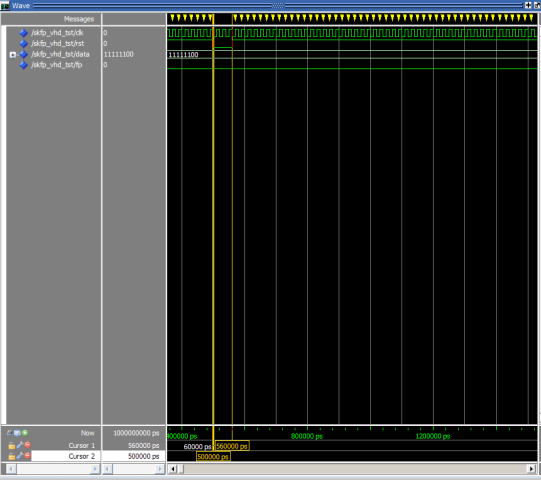
However, AS rbugalho said, " 2. You can add a reset signal to the module and make sure the testbench performs a reset at the beginning of the simulation." According to his method , I tried and I failed . this is the main problem which is bothering me all the time. PS: rbugalho is the first respondent to the topic. - Altera_Forum
As I mentioned above, the variables temp and count needs initialization. Without resetting count to a defined value, your design won't work in RTL simulation.
As a side remark. Your above design is using a ripple clock (the output of one process is used as a clock in another process). This is legal VHDL, but not recommended coding style, because it creates timing issues for other signals, that are fed from the first to the second process. You don't have them now, but most likely will in a more complex design. The problem and possible solutions ("clock enable method") have been discussed frequently in Altera forum and are covered by VHDL text books. - Altera_Forum
HI!
FvM! I tried before according to your method. It's OK to spcify initial values to the variables temp and count , But when I use an explicite reset(your second way) , there is still a question. If you want to have a look about the details please see the reply above this. Thanks! - Altera_Forum
rbugalho,
Thanks for your reply. I tried before according to your method. It's OK to spcify initial values to the variables temp and count , But when I use an explicite reset(your second way) , there is still a question. This is the code After the modification: LIBRARY IEEE; USE IEEE.STD_LOGIC_1164.ALL; USE IEEE.STD_LOGIC_ARITH.ALL; USE IEEE.STD_LOGIC_UNSIGNED.ALL; ENTITY SKFP IS PORT(CLK : IN STD_LOGIC; RST : IN STD_LOGIC; -- '0' IS VALID DATA: IN STD_LOGIC_VECTOR(7 DOWNTO 0); FP : OUT STD_LOGIC ); END ENTITY SKFP; ARCHITECTURE ART OF SKFP IS SIGNAL FULL: STD_LOGIC; BEGIN PROCESS(CLK,RST) VARIABLE COUNT:STD_LOGIC_VECTOR(7 DOWNTO 0); BEGIN IF RST='0' THEN FULL<='0'; ELSE IF CLK'EVENT AND CLK='1' THEN IF COUNT="11111111" THEN COUNT:=DATA; FULL<='1'; ELSE COUNT:=COUNT+1; FULL<='0'; END IF; END IF; END IF; END PROCESS; PROCESS(FULL,RST) VARIABLE TEMP: STD_LOGIC; BEGIN IF RST='0' THEN FP<='0'; ELSE IF FULL'EVENT AND FULL='1' THEN TEMP:=NOT TEMP; IF TEMP='1' THEN FP<='1'; ELSIF TEMP='0' THEN FP<='0'; END IF; END IF; END IF; END PROCESS; END ARCHITECTURE ART; and the testbench is: -- Copyright (C) 1991-2009 Altera Corporation -- Your use of Altera Corporation's design tools, logic functions -- and other software and tools, and its AMPP partner logic -- functions, and any output files from any of the foregoing -- (including device programming or simulation files), and any -- associated documentation or information are expressly subject -- to the terms and conditions of the Altera Program License -- Subscription Agreement, Altera MegaCore Function License -- Agreement, or other applicable license agreement, including, -- without limitation, that your use is for the sole purpose of -- programming logic devices manufactured by Altera and sold by -- Altera or its authorized distributors. Please refer to the -- applicable agreement for further details. -- *************************************************************************** -- This file contains a Vhdl test bench template that is freely editable to -- suit user's needs .Comments are provided in each section to help the user -- fill out necessary details. -- *************************************************************************** -- Generated on "08/23/2010 12:22:05" -- Vhdl Test Bench template for design : SKFP -- -- Simulation tool : ModelSim-Altera (VHDL) -- LIBRARY ieee; USE ieee.std_logic_1164.all; ENTITY SKFP_vhd_tst IS END SKFP_vhd_tst; ARCHITECTURE SKFP_arch OF SKFP_vhd_tst IS -- constants -- signals CONSTANT NEWCLK:TIME:=20 NS; SIGNAL CLK : STD_LOGIC; SIGNAL DATA : STD_LOGIC_VECTOR(7 DOWNTO 0); SIGNAL FP : STD_LOGIC; SIGNAL RST : STD_LOGIC; COMPONENT SKFP PORT ( CLK : IN STD_LOGIC; DATA : IN STD_LOGIC_VECTOR(7 DOWNTO 0); FP : OUT STD_LOGIC; RST : IN STD_LOGIC ); END COMPONENT; BEGIN i1 : SKFP PORT MAP ( -- list connections between master ports and signals CLK => CLK, DATA => DATA, FP => FP, RST => RST ); DATA<="11111100"; RST_TEST:PROCESS BEGIN RST<='0'; WAIT FOR NEWCLK*5; RST<='1'; WAIT FOR NEWCLK*20; RST<='0'; WAIT FOR NEWCLK*3; RST<='1'; wait for newclk*500; END PROCESS RST_TEST; init : PROCESS -- variable declarations BEGIN CLK <= '0'; WAIT FOR NEWCLK/2; CLK <= '1'; WAIT FOR NEWCLK/2; END PROCESS init; END SKFP_arch; This is the printscreen: http://images.cnblogs.com/cnblogs_com/tdyizhen1314/257630/r_mo3.bmp - Altera_Forum
It's normal simulation behaviour. The fp unknown state is copy from the variable temp in your design. While the gate level simulation reflects the default power on initialisation of registers, in functional simulation all signals are considered "unknown" unless you specify an initial value or use an explicite reset. This apllies at least to the variables temp and count.
- Altera_Forum
It's due the differences in initialization.
In the RTL simulation, the registers are initialized to "X" or "U", since this is what the VHDL and Verilog specifications call for. In gate level simulation, the registers are initialized to "0", since this is what the FPGA actually does. There are two ways to handle this. 1. You can specify initial values for the registers. 2. You can add a reset signal to the module and make sure the testbench performs a reset at the beginning of the simulation.