jesd
23 Topics
Introducing the Altera Community AI Responder — Beta
Altera is introducing the AI Responder, an assistant built into the Altera Community to help provide faster, context-aware guidance for Altera product questions. It uses relevant public Altera documentation and Knowledge Database content, with coverage continuing to expand. The AI Responder may provide source references and can hand off complex or out-of-scope questions to an Altera subject-matter expert. As a beta feature, responses may contain errors or omissions, so please review the sources and verify technical guidance against official Altera documentation before implementation. If the response does not fully address your question, add more context and tag ai_responder to continue the discussion. We welcome your feedback as we improve the Community experience.24Views0likes1Comment
JESD204B Multi-Link Implementation with AD9695 ADCs Having Different Lane Counts (L=4 and L=2)
Hello Intel Community, I am currently working on a multi-chip ADC design using the AD9695 with the JESD204B interface on an Intel Stratix 10 FPGA. I am using the JESD204B Intel FPGA IP core and have been referring to the example design provided with the IP. I have also followed the guidelines mentioned in Intel Application Note AN 804: Implementing Analog-to-Digital Converter Multi-Link Designs with Intel Stratix 10 JESD204B RX IP Core. In my design, I have three ADC chips with the following configuration: ADC 1: 4 lanes (L=4) ADC 2: 4 lanes (L=4) ADC 3: 2 lanes (L=2) All other JESD204B parameters (such as F, M, S, N, N') are identical across all three ADCs. According to AN 804, it is mentioned that when adding multiple subsequent links within a single JESD204B IP core, all links must share the same set of JESD parameters, including the number of lanes (L). Since my third ADC has a different lane count, I am unsure about the correct implementation approach. I would appreciate your guidance on the following: Can I integrate all three ADCs into a single JESD204B IP core instance by configuring it as a multi-link design, even though the lane counts differ? If not, should I instantiate three separate JESD204B IP cores, each configured as a single link (L=4, L=4, L=2 respectively)? Alternatively, should I instantiate two IP cores — one for the first two ADCs (with L=4, using the multi-link feature) and a second core for the third ADC (with L=2)? Could you please suggest the correct and most efficient path forward? Also, if I use separate IP cores, what are the key considerations for ensuring proper synchronization (Subclass 1) and reliable operation across all three links? Any insights, reference designs, or best practices would be greatly appreciated. Thank you in advance for your support. Best regards, BALAMURuGAN V147Views0likes4Comments
GTS JESD204C IP Evaluation Mode not working
Using Quartus Pro 25.3 I can't generate time limited sof for GTS JESD204C. I have reviewed Licensing 'know-How' Guild. I found and corrected an issue with the LM_LICENSE_FILE variable. I have verified that IP Evaluation Mode is enabled within Quartus. I'm working with the GTS JESD204C Example Design generated with Platform Designer selecting the "Agilex 5 E-Series 065b Premium Development Kit". I'm also using the GTS JESD204C IP Design Example User Guild. When I compile the design I get Message ID 23714 "Can not generate programming files", 115005 "Unlicensed IP: JESD204C (6AF7 0146)", and 115004 "Unlicensed encrypted design file". At this time, I'm only interested in evaluating the GTS JESD204C IP. Does this IP support evaluation mode? If so, any suggestions as to why Quartus Pro will not generate time-limited sof files?234Views0likes4Comments
JESD240B - No license
Hi, I am running the ADC on the Arrow DevKit – Agilex 5 E-Series AXE5 Eagle Development Platform. The converter is the EVAL-AD9695, which uses the JESD204B interface. I initially used ‘Generate Example Design’ and then adapted it for this converter. However, after making the changes and assigning the pins, I wanted to generate the final output file, but I encountered the following license error: On the licensing page, I do not see any entry for JESD204B anywhere. “What can I do to test the design? I previously worked with the Arria 10 GX, and I did not have such problems there.171Views0likes5Comments
JESD204B Latency Issue – Sample Shift Observed
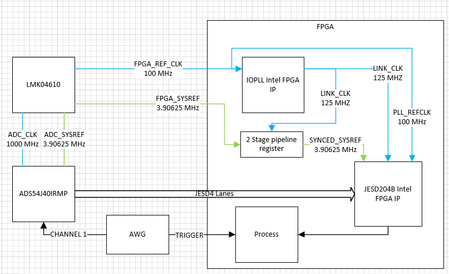
Hi All, We are using a JESD204B IP core (Subclass 1) to receive trigger-synchronized data from an ADC. After every power cycle or reconfiguration, the lane alignment results in different latency. After each power cycle or reconfiguration, we observe a shift in the ADC samples. Sometimes it's 1 sample, sometimes 3, and it can go up to 8 samples. I hope someone can help me with this issue to find out potential causes for this behavior and suggest ways to resolve or mitigate it? Can we know this latency, how to reduce this latency. Setup: JESD204B Configuration: L=4, M=1, F=2, S=4 and K=16. Subclass 1 with continuous SYSREF. The IOPLL compensation mode is set to "source synchronous"1.1KViews0likes2CommentsAgilex 7 LVDS SERDES IP : Wrong behavior in simulation (coreclock too slow)
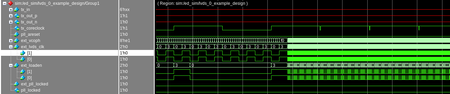
Hello, I've been trying to simulate the LVDS SERDES IP (6-bit) on my design with Questa Intel FE, and it looks like there is something weird with the coreclock output (both in TX and RX). I see the same problem either in internal or external PLL modes. In addition, I have generated the Example Design, and the problem persists (of course, the testbench checker fails). The issue is that the coreclock is about 30 times slower than expected. Here you can find some screenshots: 1) Initially, the ext_lvds_clk is a slow clock. In this case, ext_loaden is triggered every 6 cycles, and tx_coreclock is coherent too. But then the ext_lvds_clk switches to the fast clock, and we can see that ext_loaden remains coherent to that clock, but tx_coreclock doesn't. 2) Looking more in detail, we can see that coreclock remains low for 3 cycles (that's correct), but it remains high for many more cycles than 3. In consequence, most of the input samples are skipped. 3) The same situation persists once the SERDES IP locks. As a result, the same input word is serialized several times over and over again for each coreclock cycle. For information, I'm using Quartus Prime Edition 24.3 Is there anything I'm doing wrong? Thanks in advance! Jaime1.1KViews0likes2Comments
JESD204C - Reconfig XCVR Register Access
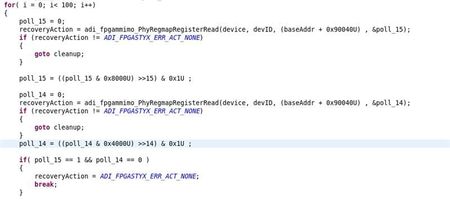
We are attempting to access the JESD XCVR Reconfiguration registers via the HPS H2F interface. We are able to successfully read from and write to the intended addresses. However, instead of receiving the full 16-bit readdata, we are consistently observing only an 8-bit readdata being returned from the JESD IP. Please note that both JESD TX CSR and RX CSR Register accesses through HPS LW bridge were working as expected. Brief description of the code snippets attached: Register write to address 0x9003C Register read from address 0x90040 Regardless of the register writes, we always receive the readdata as 0x65 Register description for these registers were not available in IP user Guide or in Register map document. Could anyone please provide or point us to the documentation or details related to the JESD Reconfig XCVR registers? This would help us better understand the expected behavior and usage.932Views0likes2CommentsDirect RF IP
We have a Stratix 10AX development kit and am trying to get setup to start developing with it. I am setup with access to the RDC and have downloaded the documentation, it says about installing the Direct RF IP but I can only see the Linux version in the RDC, is there a Windows version of the IP patch or do I have to install the tools under Linux?1KViews0likes2CommentsDirect RF Transceiver Intel FPGA IP in Stratix 10 AX
Hi, I am currently working with an FPGA Stratix 10 AX chip (1SA28T) and attempting to build a project using Quartus 22.3. However, I am encountering an error indicating that the drf_xcvr IP component is missing. Upon further internet investigation and using QSYS, I found that this IP is referred to as "Direct RF Transceiver FPGA Intel IP." I would appreciate any information regarding this IP, including whether it is available for download or how I can obtain access to it. Any support on this matter would be greatly appreciated.679Views0likes2Comments