Support Request to Debug Signal Tap Issue with SoC Based Design(GHRD) on Agilex-7 FPGA
Hi Altera Support Team, Greetings from Logic Fruit Technologies. This is Bhanu Pratap and I am working on the project in which we are using Agilex-7 SOC FPGA. Goal: Utilize Agiliex-HPS's capability on a Linux OS to control dynamic features of IP Cores at runtime. Problem Statement: We are facing an issue detecting SignalTap with SoC-based designs for runtime debugging while it's enabled and added from the Quartus project to generate the programming file. Brief Description: We are using Quartus 2025.1.1 and Altera's Agilex-7 Devkit(DKSIAAGI027FA: Agilex™ 7 FPGA I-Series Transceiver-SoC Development Kit -> 4x F-Tile, Rev C). We downloaded the base GHRD design from Altera's GitHub webpage for the corresponding Quartus version. We are following each step to test GHRD and build generation for the Linux OS. We are using HPS First booting mode, we generated the build without modification and tested it. It's working fine according to the GSRD user guide. We have added a custom AXI4 Slave based CSR module to the HSP Lightweight bus to test basic register read/write using Platform Designer. We regenerated the build and re-tested but we are not getting the expected results so we added SignalTap for debugging. Build is generated using the STP file, programmed, and the OS is booting but it's not detecting SignalTap. This looks more like a process gap. We seek your support to fix this issue. Note: If we use an FPGA design without HPS, we are able to add and detect SignalTap. Seeking for urgent support. Thanks Bhanu Pratap7Views0likes0Comments
Agilex 5/3 FreeRTOS SMP Support
Stable Version: v25.4 Quartus Version: 25.4 Supported devices: Agilex™ 3 and Agilex™ 5 Source : https://github.com/Ignitarium-Technology/freertos-socfpga Branch/Tag: v25.4-SMP Release Date: March 30, 2026 Hello Everyone, FreeRTOS port for A55/A76 HPS now supports SMP. visit the GitHub page for instructions on how to get started. Features and comments Features Agilex3 Agilex5 Agilex3 SMP Agilex5 SMP (A55 x 2 or A76 x 2) Supported features Limitations/ Known issues A55 boot Yes Yes Yes Yes Single core boot, Dual core SMP A76 boot NA Yes NA Yes Single core boot, Dual core SMP QSPI boot Yes Yes Yes Yes SD boot Yes Yes Yes Yes eMMC boot Yes Yes Yes Yes NAND boot No No No No Clk mngr driver Yes Yes Yes Yes API to get clock speed of different blocks Reset mngr driver Yes Yes Yes Yes Peripheral reset assert/de-assert DMA driver Yes Yes Yes Yes Memory to memory transfer Only support memory to memory GPIO driver Yes Yes Yes Yes Write, read and interrupt support Timer driver Yes Yes Yes Yes User defined and free running modes UART driver Yes Yes Yes Yes Full duplex Tx and Rx DMA not supported (Planned for future release I2C driver Yes Yes Yes Yes Master mode write and read Standard and fast modes DMA not supported (Planned for future release I3C driver Yes Yes Yes Yes Master mode write and read i3c and legacy i2c devices IBI not supported (Planned for future release) SPI driver Yes Yes Yes Yes Master mode write and read DMA is not supported QSPI driver Yes Yes Yes Yes QSPI flash read/write/erase NAND driver No No No No SDM mailbox driver Yes Yes Yes Yes SDM commands with SIP_SVC SMMU enable support Yes Yes Yes Yes Static identity mapping for cache coherency SDMMC driver Yes Yes Yes Yes standard and HS speeds SDMMC and eMMC devices Fat FS support Ethernet stack Yes Yes Yes Yes TCP/IP, UDP, ICMP and DHCP IPv4 and IPv6 support USB 2.0 stack NT Yes NT Yes USB mass storage class Tested with a custom board and SOF USB 3.1 stack NT Yes NT Yes USB mass storage operation WDT diver Yes Yes Yes Yes interrupt or reset on timer expiry EDAC support Yes Yes Yes Yes Error injection and detection for EMAC, USB and QSPI blocks OCRAM not supported IOSSM driver Yes Yes Yes Yes Error injection and detection Bridge driver NT Yes NT Yes Enable, Disable Reboot mngr Yes Yes Yes Yes Warm/Cold reboot FPGA manager Yes Yes Yes Yes FPGA configuration Yes: Feature available and tested, No: Feature not available in SDK, NA : Not applicable , NT: Not tested Note: If you find any issues, please raise an issue in the GitHub page. For more support/assistance visit our website .13Views0likes0Comments
Agilex5 SD controller in SDR12 mode setup
Hi, According to: https://docs.altera.com/r/docs/814346/25.3.1/hard-processor-system-technical-reference-manual-agilextm-5-socs/clocks?tocId=6fOPkXT1Zba2VR6U1OeQXg It is possible to configure SD controller in SDR12 mode with 25Mhz sdclk for sdcard: The clock to the SD card is the controller clock divided by 2 in these cases, and by 1 in all other cases. I have problem to obtain this setup: In my setup clocks are set as follows: l4_mp_clk = 200MHz (NOC 400Mhz clk /2) softphydiv is 4 so: clk_phy = clk_ctrl = 50Mhz (l4_mp_clk / 4) So controller frequency is 50Mhz. How to configure the SDMMC or COMBOPHY to divide controller clk by 2 for SDR12 mode? I don't see such option in register list: https://www.intel.com/content/www/us/en/content-details/775831/agilex-5-hps-register-map.html and u-boot drivers and devicetreee examples either. https://github.com/altera-fpga/u-boot-socfpga/tree/socfpga_v2025.10 sdhc_cadence, combophy drivers and dts examples in arch/arm/dts How to do this for uboot sd/combophy Cadence driver? With sd-uhs-sdr12 parameter for mmc node I still see 50Mhz on the sd clk pin from HPS to SD card. Marcin Z.107Views0likes4Comments
Cyclone5 SoC: U-Boot not detecting USB-HUB
Hello there, I'm working on a design on top of a Chameleon96 Board (CycloneV based), featuring a USB OTG Chip USB3300, and connected to it an USB 2513B Hub. My issue is that neither U-Boot or Linux are able to detect the USB Hub connected to the USB3300. This used to work with older U-Boot versions and are still working on my board, but I was not able to reproduce such behavior with up-to-date versions (cloned from https://github.com/altera-fpga/u-boot-socfpga and https://github.com/altera-fpga/linux-socfpga). The Chameleon96 has two GPIO pins to control the reset of the mentioned USB chips, with a fixed configuration on the USB 2513B (the I2C interface is not exposed). With my version (U-Boot 2025.07-gd4f268660a70-dirty and Linux 6.12.33-g3234b1ed8956), the USB OTG is detected and the hub registered with logs like the following: [ 0.883275] dwc2 ffb40000.usb: supply vusb_d not found, using dummy regulator [ 0.890619] dwc2 ffb40000.usb: supply vusb_a not found, using dummy regulator [ 0.898034] dwc2 ffb40000.usb: Configuration mismatch. dr_mode forced to host [ 0.905721] dwc2 ffb40000.usb: DWC OTG Controller [ 0.910454] dwc2 ffb40000.usb: new USB bus registered, assigned bus number 1 [ 0.917571] dwc2 ffb40000.usb: irq 32, io mem 0xffb40000 [ 0.923324] usb usb1: New USB device found, idVendor=1d6b, idProduct=0002, b2 [ 0.931588] usb usb1: New USB device strings: Mfr=3, Product=2, SerialNumber1 [ 0.938800] usb usb1: Product: DWC OTG Controller [ 0.943509] usb usb1: Manufacturer: Linux 6.12.33-g3234b1ed8956 dwc2_hsotg [ 0.950362] usb usb1: SerialNumber: ffb40000.usb [ 0.955682] hub 1-0:1.0: USB hub found [ 0.959499] hub 1-0:1.0: 1 port detected but the connected USB hub never shows up. Similarly 'usb start' from the U-Boot prompt just shows something called U-Boot Root Hub: => usb start starting USB... USB DWC2 Bus usb@ffb40000: 1 USB Device(s) found scanning usb for storage devices... 0 Storage Device(s) found => usb tree USB device tree: 1 Hub (480 Mb/s, 0mA) U-Boot Root Hub Older u-boot versions (and linux) are able to detect the USB hub after 'usb start'. In this case, the root hub is named DWT OTC RootHub, and I don't know if this is just a change of naming somewhere or something wrong is also happening while detecting the USB3300 Hub: SOCFPGA_CHAMELEON96 # usb start (Re)start USB... USB0: Core Release: 2.93a scanning bus 0 for devices... 2 USB Device(s) found scanning usb for storage devices... 0 Storage Device(s) found SOCFPGA_CHAMELEON96 # usb tree USB device tree: 1 Hub (480 Mb/s, 0mA) | DWC OTG RootHub | +-2 Hub (480 Mb/s, 2mA) the linux kernel (4.1.33-ltsi-altera) is also able to detect the USB Hub as can be seen in these logs: [ 0.913203] ffb40000.usb supply vusb_d not found, using dummy regulator [ 0.919864] ffb40000.usb supply vusb_a not found, using dummy regulator [ 0.957196] dwc2 ffb40000.usb: EPs: 16, dedicated fifos, 8064 entries in SPRM [ 1.817295] dwc2 ffb40000.usb: DWC OTG Controller [ 1.822011] dwc2 ffb40000.usb: new USB bus registered, assigned bus number 1 [ 1.829076] dwc2 ffb40000.usb: irq 44, io mem 0x00000000 [ 1.834617] usb usb1: New USB device found, idVendor=1d6b, idProduct=0002 [ 1.841394] usb usb1: New USB device strings: Mfr=3, Product=2, SerialNumber1 [ 1.848596] usb usb1: Product: DWC OTG Controller [ 1.853282] usb usb1: Manufacturer: Linux 4.1.33-ltsi-altera-svn260 dwc2_hsog [ 1.860481] usb usb1: SerialNumber: ffb40000.usb [ 1.865670] hub 1-0:1.0: USB hub found [ 1.869457] hub 1-0:1.0: 1 port detected ... [ 2.367190] usb 1-1: new high-speed USB device number 2 using dwc2 [ 2.577385] usb 1-1: New USB device found, idVendor=0424, idProduct=2513 [ 2.584069] usb 1-1: New USB device strings: Mfr=0, Product=0, SerialNumber=0 [ 2.591939] hub 1-1:1.0: USB hub found [ 2.595782] hub 1-1:1.0: 3 ports detected I think I've ported all the needed configuration to the u-boot sources (basically resetting the USB hub using the attached GPIOs, and I also tried the reset sequence manually from U-Boot with the gpio command) and I'm not able to figure out how to find where the issue might be. I've forked u-boot sources here: https://github.com/teiram/u-boot-socfpga/, using the socfpga_chameleon96_defconfig configuration. Could you please support me in order to troubleshoot what the issue might be? I tried to backport my changes to some different branches on u-boot-socpfga but got the same results or even worse (no boot at all). I also have sources for a working U-Boot but they are quite old and the configuration changed sensibly since. I think all the needed options are set. Cheers, Manuel271Views0likes19CommentsReading S25FL256S OTP region via QSPI Indirect Transfer on Cyclone V HPS — data comes back incorrect
What I'm trying to do I need to read OTP memory region of the S25FL256S flash using command 0x4B. The system normally runs in quad-SPI mode (0xEC, 4-byte address). Since the data I need is more than 8 bytes (STIG limit), I'm trying to use the indirect transfer path. The 0x4B command requires: Single-SPI (1-wire address and data) 3-byte address 1 fixed dummy byte (8 clocks) after address Setup The QSPI controller is initialized at startup using the standard Altera HAL: alt_qspi_init(); // detects flash JEDEC ID, configures timing, sets up qspi_config struct alt_qspi_enable(); // enables controller, sets quad mode (0xEC, 4-byte addr, LC=10b) After this, normal quad-SPI reads via alt_qspi_read() works correctly. What I'm doing Reconfigure controller for 0x4B (OTP Read) ALT_QSPI_DEV_INST_CONFIG_t read_cfg = { .op_code = 0x4B, .inst_type = ALT_QSPI_MODE_SINGLE, .addr_xfer_type = ALT_QSPI_MODE_SINGLE, .data_xfer_type = ALT_QSPI_MODE_SINGLE, .dummy_cycles = 8 }; alt_qspi_device_read_config_set(&read_cfg); ALT_QSPI_DEV_SIZE_CONFIG_t size_cfg = { ... .addr_size = 2, // N+1 encoding → 3 bytes on wire .page_size = 256, ... }; alt_qspi_device_size_config_set(&size_cfg); Disable QUAD on the flash device itself via STIG alt_qspi_read_register(0x35, ®s[1]); // read CR1 alt_qspi_read_register(0x05, ®s[0]); // read SR1 alt_qspi_device_wren(); regs[1] = (regs[1] & 0x3D) | 0x00 | 0x80; // QUAD=0, LC=10b alt_qspi_stig_wr_cmd(0x01, 0, 2, (uint32_t*)regs, timeout); alt_qspi_sr_wait_write(timeout); Execute indirect read // Internally: sets INDRDSTADDR, INDRDCNT, starts transfer, // then CPU drains SRAM FIFO via ALT_QSPIDATA_ADDR alt_qspi_read(dst, src, size); Problem The data returned by the indirect read is incorrect. A STIG-based read of the same region (using the same 0x4B command, 8 bytes at a time) returns the correct data. The indirect read returns wrong/shifted bytes. Hence do I need to configure anything else? Result correct value : 97C5995C5C1E9D5D7A00D4E6BD4ED53E read value : FF97C5995C5C1E9D5D7A00D4E6BD4ED5Solved90Views0likes4CommentsAgilex 5 HPS TEE
Hi, Is Arm Trust Zone supported on HPS? If so is the implementation of TEE supported on Agilex 5? I've checked TF-A sources and it seems that BL2 on this platform loads only BL31 and BL33. How about BL32? Is there an OP-TEE support? If not, are there any plans to provide it in the nearest feature?144Views0likes7CommentsAgilex 5/3 FreeRTOS SDK
Stable Version: v25.4 Quartus Version: 25.3 Supported devices: Agilex™ 3 and Agilex™ 5 Source : https://github.com/Ignitarium-Technology/freertos-socfpga Branch/Tag: v25.4 Release Date: January 16, 2026 Hello Everyone, FreeRTOS port for A55/A76 HPS in Agilex 5/3 devices are now available for public. visit the GitHub page for instructions on how to get started. Features and comments Yes: Feature available and tested, No: Feature not available in SDK, NA : Not applicable , NT: Not tested Feature Agilex3 Agilex5 Supported features Limitations/ Known issues A55 boot Yes Yes Single core boot SMP not supported A76 boot NA Yes Single core boot SMP not supported QSPI boot Yes Yes SD boot Yes Yes eMMC boot Yes Yes NAND boot No No Clk mngr driver Yes Yes API to get clock speed of different blocks Reset mngr driver Yes Yes Peripheral reset assert/de-assert DMA driver Yes Yes Memory to memory transfer Only support memory to memory GPIO driver Yes Yes Write, read and interrupt support Timer driver yes yes User defined and free running modes UART driver yes yes Full duplex Tx and Rx DMA not supported I2C driver Yes Yes Master mode write and read Standard and fast modes DMA not supported I3C driver Yes Yes Master mode write and read i3c and legacy i2c devices IBI not supported SPI driver Yes Yes Master mode write and read DMA is not supported QSPI driver Yes Yes QSPI flash read/write/erase NAND driver No No SDM mailbox driver Yes Yes SDM commands with SIP_SVC SMMU enable support Yes Yes Static identity mapping for cache coherency SDMMC driver Yes Yes standard and HS speeds SDMMC and eMMC devices Fat FS support Ethernet stack Yes Yes TCP/IP, UDP, ICMP and DHCP IPv4 and IPv6 support 100mbps and 1gbps operation USB 2.0 stack NT Yes USB mass storage class Tested with a custom board and SOF USB 3.1 stack NT yes USB mass storage operation WDT driver Yes Yes interrupt or reset on timer expiry EDAC support Yes Yes Error injection and detection for EMAC, USB and QSPI blocks OCRAM not supported IOSSM driver Yes Yes Error injection and detection Bridge driver NT Yes Enable, Disable Reboot mngr Yes Yes Warm/Cold reboot FPGA manager Yes Yes FPGA configuration Note: If you find any issues, please raise an issue in the GitHub page. For more support/assistance visit our website .230Views1like2CommentsMSGDMA ST-to-MM: Linux Driver Necessity & F2SDRAM Path Feasibility
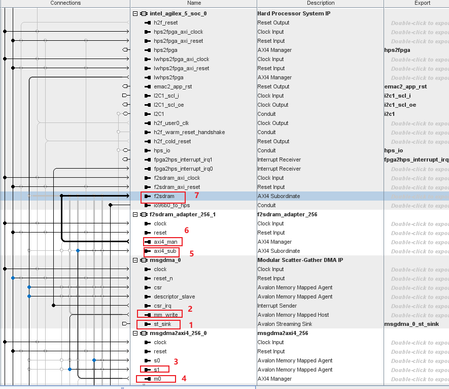
Hello everyone, I am currently working on an MSGDMA implementation. I have verified that I can read the MSGDMA CSR and Descriptor registers via the LWH2F bridge using devmem2. My setup is configured in Streaming-to-Memory-Mapped (ST-to-MM) mode. I have two specific questions regarding this setup: 1、Is configuring the MSGDMA Linux kernel driver a mandatory condition for the hardware to function correctly? Is it possible to bypass the driver and configure the MSGDMA to start data transfer directly using devmem2 (user-space access)? 2、I noticed that some implementations write to the PS-side memory via the FPGA-to-HPS bridge. However, my design utilizes the F2SDRAM link, as indicated by the numbered sequence in the attached diagram. Could you please confirm if this architectural approach is feasible?Solved120Views0likes3Comments
Arria 10 SoC Dev Kit Baremetal HPS examples issue & workflow
Hi, I recently acquired an Arria 10 SoC dev kit but I'm really struggling to run either the examples on embedded-software/bare-metal or the ones included in SoC EDS pro 20.1, trying to follow the instructions for both of them, they seem to rely on a old version of SoC EDS which included within ARM DS-5 and the toolchain, but now SoC EDS & ARM DS are separated and I cannot build the examples. With the new applications the flow for using this examples should remain the same? I mean: use Pogrammer to program the included .sof inside ghrd (or generate a updated one) -> open ARM-DS from SoC-EDS with environmental variables assigned and build with new toolchain arm-none-eabi -> run from ARM-DS (can i without license?) Seems like most of the tools used for running this examples have been discontinued (for example ) so at this point I don't know which workflow should I actually follow. PD: finally I was able to generate de application.axf from this example Altera-SoCFPGA-HardwareLib-16550-CV-GNU with an old toolchain but I don't know how to program it without a license, for now I don't want to debug anything, just do some simple tests printing by uart281Views0likes17CommentsUnique ID registers in Cyclone V
Hello everyone, I need to uniquely identify individual devices at runtime from the HPS (ARM Cortex-A9) side. Does the HPS side of the Cyclone V SoC have any built-in unique ID registers, such as: - A hardware serial number - A unique device ID - OTP (One-Time Programmable) fuses with unique identifiers - Any factory-programmed identification values What I've Tried: I've reviewed the Cyclone V documentation but haven't found clear information about unique ID registers accessible from the HPS side (unlike some other ARM SoCs that have dedicated UID registers). However I have seen Unique ID present in the FPGA side (https://www.intel.com/content/www/us/en/docs/programmable/683336/20-3/cores-user-guide.html), but this is not useful for my use case. Any guidance, documentation references, or code examples would be greatly appreciated! Thanks in advance!Solved141Views0likes4Comments