User Profile

PedroJServian
 New Contributor
Joined 2 years ago


User Widgets
Contributions
Re: Doubts about the download of the configuration of Cyclone 10 LP
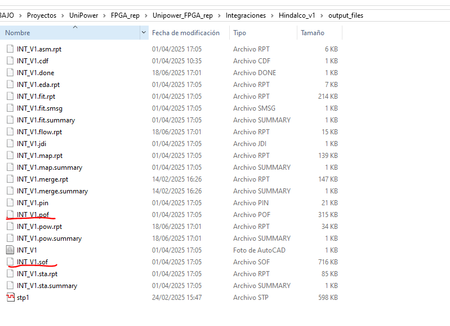
Hi @FvM , What do you refer to configuration image? The file in .sop or .pof format. I have just compiled the previous project I had in my MAX10 FPGA and those files .sof and .pof only required 716KB and 315KB respectively. However, I just took that project, I changed the device and the compilations I got gave me that those files require 1152KB(.sof) and 2049KB. I thought that maybe the program image was the .jic file that I converted but it required 16000KB. I can assure you that the design is not very complex so it can't be that it exceeded the 9Mbit of maximum image you told. Where can I found the weight of the configuration image you told so I could size the correct memory of the external flash? Thank you!!673Views0likes2CommentsDoubts about the download of the configuration of Cyclone 10 LP
Hi colleagues, I am a newbie FPGA programmer of Cyclone 10 LP. I programmed MAX10 FPGAs but for my actual design I needed to migrate to 10CL040YF484I7G device. When I programmed for the MAX10 device, I designed my .bdf, then I compiled and it generated two files .sof and .pof. The .sof file was for SRAM volatile so when I switched off the power supply the program needed to be downloaded again with the JTAG. However, with the .pof file, the FPGA remained loading the program I once loaded the first time after the power off. So as far as I'm concerned, the .pof file loads the program in the internal flash and then, I boots the FPGA with the program in the flash after a power off happened. What I'm struggling now is with this Cyclone 10 LP FPGA is that it seems that doesn't have internal flash memory so I wanted to know what are the strategies that able me to download the compiled output program to the FPGA and keep it booting to the FPGA even if the power supply of the FPGA is off. Is that possible? Do I need to put an external flash memory? Is there an option when you compile that takes logic elements of the FPGA to make a flash memory and load the output program as desired? In summary, I just want to download a program to this FPGA and that this FPGA keep the program when is shut down (only change the program when I reprogram it via JTAG). Sorry if this sound as a very dummie question, I am a new developer and I need help with this hardware issues. Thank you in advance, have a nice day. Regards, PedroSolved794Views0likes4CommentsDoubts about the implementation of I2C in my FPGA
Good morning, I am designing a communication between my FPGA MAX10 and my microcontroller. The FPGA detects some hardware faults from different sources and then it communicates to the microcontroller with a decoding communications (5 data lines with read enable from FPGA to uC, there can be 20 faults, if it is active the fault nº5 it sends 00101 and so on). So I use 7 pins to communicate wit hte uC. I am increasing my project and I am having problems with the numbers of pins that are routed to the FPGA. So I thought to send those faults with another communication and I thought about the I2C (only 2 pins). I saw in the IP Catalog the I2C Slave To Avalon-MM Master Bridge Intel FPGA IP. What I would like to know is if this IP can be used to communicate with I2C with an external microcontroller (texas family) and not having problems. I am new designing FPGAs and I get usually lost with comms. I will wait for your answer. Have a nice week. BR, PedroSolved1.2KViews0likes5CommentsRe: Problems with DEV_CLRN and PINs, MAX10
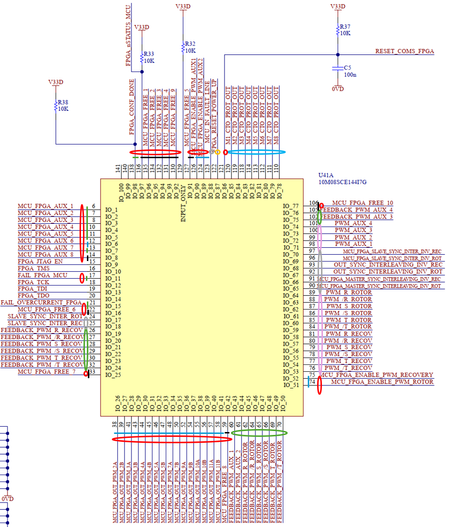
@FvM Thank you very much for your response. I recognise that I feel a little bit confused with all the configuration pins that are used in our design. I show you the schematic we have for our FPGA. The pins that are rounded with red colour go/come to/from MCU. As you can see, we route the pins of CONF_DONE, nSTATUS (THAT WE ARE NOT USING), DEV_CLRn (pin 121) (routed to the MCU as an output from MCU and input to FPGA and USED). Also, we use the DEV_OE as an input from the power up device we use to feed the electronic components. Currently we are using DEV_OE as USER pin input but I'm not sure if I should use it as DEV_OE predetermined function. I would very pleased if you could help me with this issue. Basically what I'm doing with this FPGA is obtaining PWM signals from a microcontroller (red ring from pins 38-58) and then I have designed some VHDL instances to process those signals (only if I input pin of ENABLE pwm from MCU is high) and make the PWM pulses to have a minimum pulse and dead time (IT's used for three-phase inverters to not short-circuit the bus). In order to detect a short-circuit from the semiconductors I obtain some feedback signals (green rings) from the drivers of the semiconductors that I compare with the PWM processed signals that I have triggered and I output(green rings) that I compare in a "error" designed instance and I give an error to the MCU though the pin 17. The output signals of processed PWM goes to TX of fiber optics and the feedback comes from RX of fiber optics. When I have tested the design I have seen that the "error" instance gives me an error of all the PWM signals when I write the DEV_CLRn signal from MCU to FPGA the output signals (in tri-state) have an small distrubance (I don't remmember the voltage but maybe like 200-300mV but they are in tri-state) that I guess that makes the error instance to recognise a rising/falling edge (what I used to detect errors) and because I'm not getting anything from feedback, I give an error. Then I clear it and this error doesn't appear anymore, only when the DEV_CLRn is given. What I would like to implement is the following: When the MCU and FPGA is before and during powering up, the outputs that goes to the TX fiber optics must have a value that does not trigget the IGBTs so I would need that the output be forced to 0 when the FPGA is not even getting the DEV_CLRn from the MCU and then, before I enable the PWM from the input pin. Help me with the policy I must follow to ensure the different CLR_N of the project. Now, when the PCB is powered up, the power up pin 122 goes to the FPGA but it's used as user refined (I have put it in the design as condition to trigger the pulses but I'm not sure about this position). Then, when the DEV_CLRn is written to High is when the program from .pof is loaded to the registers and starts working the FPGA but I obtain that initial error in all the pulses. Then I have a user-defined pin that enters the design and clears the different instances I would apprecite if you could give me a feedback about the policy I'am following and the source of the error I obtain at the DEV_CLRn. I will continue to make some changes during this end of week and next one so I will be informing you. Have a nice day, Pedro536Views0likes0CommentsProblems with DEV_CLRN and PINs, MAX10
Hi colleagues, I have been dealing with a problem with a design I have made for my 10M08 FPGA. My program have a "PWM treatment" design that gets some PWM signals from a microcontroller and makes a process of minimum pulse and deadband pulse to generate an adequate signal for an inverter. Then, those outputs signals come to an AND condition so the pulses are generated in fiber optics if the MCU gives me a ENABLE signal, there is no fault and there is not a power down. Then I have a design that detects if the feedback from the driver of the IGBTs that I switch with these PWM signals get the appropiate feedback from the Driver. The logic from the driver is that when a rising edge or falling edge of light comes to the receiver it transmit a pulse (no light), if the pulse last more than 1,5us, there is a shotcircuit in the IGBT. What I have been struggling when I have tested the model is that ONLY at the beggining, these errors of the IGBTs are generated and after watching some testpoints I have seen that this error is generated when the DEV_CLRn is putting in HIGH so the registers are loaded based on the manual but the output pulses are in low position as the enable signal is not given so I don't get why am I getting this error because then I clear the error with a PROGRAMMED input RESET from the MCU and the error is cleared as it doesn't have any sense (there is no commutation of the pulses). This DEV_CLRn pin is set as the "special" use in the project configuration but I don't use this pin in my design. What I would like to know is why this fault is generated when it is a "ghost" fault as the pulses are off. I would very pleased if you could help me. Thank you in advance. Pedro845Views0likes4CommentsRe: Signal tap doesnt recognise most of the entities of my bdf file. Compilation doesn't fit too
Hi Richard, It should have been something related with what you said but directly I changed the design and it started to work. I honestly don't know what happened in the design. Thank you for your advice, have a nice day. BR, Pedro1KViews0likes0CommentsSignal tap doesnt recognise most of the entities of my bdf file. Compilation doesn't fit too
Good morning colleagues, I need your help with a problem I have encountered with Quartus Prime Lite Software while programing my MAX10 FPGA 10M08SCE144I7G. I have made a design in Quartus to manage some semiconductor triggers. I have made designs in vhd that I have converted to blocks and after that, I have put them in bigger blocks. I have been working on this design and when compiling, synthesising, etc... it took about 1 minute and the design occupied 1400 logical units. However, I have made a modification of the design ‘Pulse_Minimum_V4_ind_RESET’ and when I put it in my block diagram and compile I see that it does it successfully but it takes only about 30 seconds and occupies only 500 logical units. When I open signal tap to debug the design, I see that the block ‘BLOQ_MIN_DEAD’ shows me only the instance ‘Generador_Disparos_v1_ind’ inst4 but however the instance of the same block inst5 does not show me and also does not show me the instances of ‘Pulso_Minimo_C4_ind_RESET’ that I have implemented. Honestly, I dont know what is happening because I have never had this kind of problem. I think that it is not only related to signal tap but also with the compilation because now it takes much less logic elements than before. I attach you some captures of the design and if you could let me know what could be happening would be a great advance in my development. Thank you in advance BR, Pedro1.5KViews0likes5Comments