platform
374 Topics
Warning in GTS AXI Streaming IP for PCIe generated example
Hello, I have generated the example design for the GTS AXIS Streaming IP for PCIe and I notice that there is a warning in platform designer: Component Instantiation Warning: hipim_platform.rst_ctrl_for_gts_pcie_0: Warnings found in IP parameterization. Component Instantiation Warning: pcie_ed.pio0: Warnings found in IP parameterization. What is the reason for this warning? Is it possible to glean more information about any potential issue that the warning is highlighting? Image of the warning in platform designer:46Views0likes4Comments
Questa-ModelSim UI scaling problems in Linux
Hello Has anybody been able to solve the issue of UI of Questa not scaling correctly on linux with wayland? I am using Ubuntu 26.04 with wayland and UI is just tiny, icons, are so small i cannot read any text. When opening a new project, file explorer is also tiny. Fonts i could change in the config file but icons, menus and everything else is just extremely small. Problem is even worse on high resolution displays. Regards, Haris945Views0likes15Comments
Problems with registered computers in SSLC
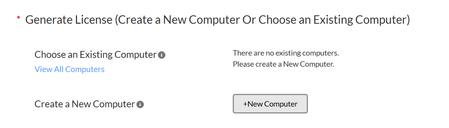
Hello, I recently logged in to the Altera SSLC to renew a license. I used to have multiple host computers registered, which now seem to be missing: (None appear either when opening the "View All Computers" window) So I tried to re-create the computer that is to host said license, and I came upon the following error: It would seem that the computer both exists and does not exist! For the sake of seriousness and good taste, I will abstain from making any jokes about Schrödinger and quantum superposition. In any case, I see some maintenance is going on today, so that might be related to the issue. Otherwise, I would greatly appreciate if this could be looked into. Thank you and regards, Noah89Views0likes3Comments
System Console master_read_memory fails above 7688 bytes on Agilex 5 (AXE5-Eagle)
A single master_read_memory of 7689 bytes or more never completes on an Agilex 5. It returns nothing, times out after 60 seconds, and leaves the JTAG channel closed so the next command fails too. 7688 bytes on the same master and the same address returns all 7688 values in under 0.1 second. The boundary is byte exact and repeats every time. I can reproduce this entirely with an unmodified example bitstream published by Arrow, so no design of mine is involved and there is nothing for me to send you. SETUP Board: Arrow AXE5-Eagle, device A5ED065BB32AE4SR0, IDCODE 0364F0DD Bitstream: axe5_eagle_voltage_temp.sof from https://github.com/ArrowElectronics/Agilex-5, path images/promo3/, md5 b391b9cd5226fe92fd2068ddc66f8442 That bitstream was built with Quartus Prime Pro 24.3 and reports "HPS present: FALSE", so it configures straight over JTAG with no bootloader merge and no HPS involvement. It exposes a Nios V node and a JTAG PHY master. Tools: Quartus Prime Pro 26.1.1 build 130, System Console from the same installation, Windows 10 Enterprise LTSC 21H2 Cable: Arrow USB Blaster ARA39943-TEI0004, JTAG clock pinned to 6 MHz, Altera JTAG Server running as a Windows service STEPS 1. Program the board over JTAG: quartus_pgm -c "Arrow-USB-Blaster [ARA39943-TEI0004]" -m jtag -o "p;axe5_eagle_voltage_temp.sof@1" 2. In System Console, open the JTAG PHY master and read: set m [lindex [get_service_paths master] 0] open_service master $m master_read_memory $m 0x0 7688 master_read_memory $m 0x0 7689 RESULT master_read_memory 7688 bytes -> 7688 values in 0 master_read_memory 7689 bytes -> nothing, 60.0 s, then: master_read_memory: This transaction did not complete e is giving up. After the failure the channel is closed and the next command reports "Channel closed" until the service is reopened. Recovering costs 20 to 60 seconds. WHAT I HAVE ALREADY RULED OUT Not the address. Identical behaviour reading from 0x0, 0x1000, 0x10000000 and 0x20000000, and shifting the base by 1, 2, 4 or 4092 bytes at a fixed size changes nothing. Only the requested byte count Not a timeout. Reads return in 0.0 s right up to 7688, then the very next byte fails. A timeout would show times rising as the limit approached, not an instant success becoming an outright fa Not the size of the reply. master_read_32 hands back a 45055 character answer without trouble, while master_read_memory fails while producing a 39044 character one. Not the design. The same byte boundary appears on two other unrelated bitstreams on this board, one with an HPS and one without, built with different Quartus versions. The Arrow example above is simy. master_read_32 IS NOT AFFECTED, AND HAS NO COMP On the same master and the same bitstream, master_read_32 was run at increasing sizes. Every one returned the full count, correctly, with no timeout and no channel closure: master_read_32 $m 0x0 4096 -> 4096 words, 16 kB spanned, 0.5 s master_read_32 $m 0x0 8192 -> 8192 words, 32 kB master_read_32 $m 0x0 16384 -> 16384 words, 64 kB spanned, 2.2 s master_read_32 $m 0x0 32768 -> 32768 words, 128 kB master_read_32 $m 0x0 65536 -> 65536 words, 256 kB spanned, 9.8 s That last one spans 262144 bytes, which is 34 times theead_memory cannot deliver, and it scales linearly at about0.15 ms per word with no sign of a ceiling. If the JTAG link, the Avalon bridge or the reply channel were the constraint, master_read_32 would degrade somewhere across that range. It does not. master_read_32 is therefore a usable workaround, but a slow one: master_read_memory returns 7688 bytes in under 0.05 s, roughly 150 kB/s, where master_read_32 sustains about 26 kB/s. Around 6 times slowp> QUESTIONS Is 7688 bytes an intended limit for master_read_memory on Agilex 5? If so, where is it documented, and does it vary by device family? The same tool version against Arria V hardware is rock solid and sh Whatever the limit is, could an oversized request return an error immediately instead of hanging for 60 seconds and closing the channel? The silent 60 second stall is far more expensive than a reject Happy to run any additional test on this board if neede250Views0likes10Comments
IEEE 1735 Encryption Public Key
We are preparing an encrypted RTL deliverable for a customer using Quartus Prime Standard Edition 21.1. Could you please confirm whether this specific edition and version supports synthesis of IEEE 1735-encrypted Verilog/SystemVerilog RTL supplied by a third-party IP vendor? If supported, could you please provide, or direct us to: The appropriate Altera/Intel public key for encrypting RTL for this tool version, together with the required key_keyowner, key_keyname, and key_method settings. The supported IEEE 1735 envelope version and encryption algorithms. Any requirements or restrictions on the encryption utility, file format, or third-party IP delivery flow. A reference encryption header or a minimal example that we can use for compatibility testing. Our current RTL encryption flow uses IEEE 1735 version 1 envelopes with vendor-specific key blocks. We would like to confirm whether adding an Altera/Intel key block is supported for the above configuration. If Quartus Prime Standard Edition 21.1 does not support this flow, could you please advise on the supported alternatives and whether a different Quartus edition or version would be required?909Views0likes5Comments
How to organize a shared cache for qsys systems?
I have written a system to generate command lines and scripts/templates for various EDA tools. This will let me share the same same design across different implementations. The designs typically reside in a git (or some other VC) repository. For Altera IP's only the *.ip is kept in the git repository. The cache tag is generated from a hash of the content of the *.ip and the Quartus version used as this uniquely defines a single *.ip file. The build script will copy the '*.ip' file and run qsys-generate in the $cache/$tag location which will be added to the IP_FILE in the tcl build script. The next time the same Quartus version and same *.ip file is used it's referenced by the IP_FILE variable. This works pretty well. Putting the *.qsys itself into a similar structure works too. But distributing the *.ip and *.qsys children of the parent.qsys in the same cache seem to be problematic as the parent.qsys logicalView XML tag seem to contain a partial relative sub-path. Is there a way to make sure that only references to the child.ip or child.qsys will be present in the parent.qsys so that it can be located by the full absolute path specified in the IP_FILE? Also how are *_hw.tcl files located and what type of references and relations between these and their respective *.ip and/or *.qsys files are stored in these files? Or is the only solution to copy the full tree structure of the qsys into the cache and hash its full content? BTW I'm using Linux only.141Views0likes3CommentsIntroducing the Altera Community AI Responder — Beta
Altera is introducing the AI Responder, an assistant built into the Altera Community to help provide faster, context-aware guidance for Altera product questions. It uses relevant public Altera documentation and Knowledge Database content, with coverage continuing to expand. The AI Responder may provide source references and can hand off complex or out-of-scope questions to an Altera subject-matter expert. As a beta feature, responses may contain errors or omissions, so please review the sources and verify technical guidance against official Altera documentation before implementation. If the response does not fully address your question, add more context and tag ai_responder to continue the discussion. We welcome your feedback as we improve the Community experience.145Views0likes1Commentgetting a licnese
Hello everyone, I just bought my DE10 standard board for my graduation project. Unfortunately, my university doesn't provide a license for the Quartus standard, and I need more than 90 days to finish the project. Is there any way to get a license as a student for free? My project is about an AI accelerator, so I need the standard version; the lite one isn't enough. Thank you,460Views1like6Comments