hps arch
34 Topics
How to use putty in Uart-to-USB communication?
I recently posted a question related to a project I've been working on. I wanted help to achieve Uart-to-USB communication to transmit counting data from my DE10-Nano to my computer. This is the post: https://community.intel.com/t5/FPGA-SoC-And-CPLD-Boards-And/How-to-obtain-the-counting-of-TTL-pulses-from-an-FPGA/m-p/1542536#M26340 ShengN helped me a lot, he even provide the modifications to the design and the C code to achieve this. However, he mentioned that I would need help from this forum with the usb putty part. I have no experience with Putty, and I'm completely new with FPGAs and hardware programming (this project was assigned to me). How can I make use of the design I got so I can transmit the counting of the FPGA to my PC.3.9KViews0likes11Comments
Cyclone® V SoC Development Kit
Hi Everyone: I am looking for Cyclone V SoC Development Kit installation for board rev C. From link https://www.intel.com/content/www/us/en/products/details/fpga/development-kits/cyclone/v-sx.html# Only found information for board Rev E. "kit Installation" is version 22.1. After download, and unzip, there is factory_recovery directory, can the files under this directory be used for restoring the factory settings for board Rev C? If not, where I can download the "kit installer" for board Rev C? Thanks2KViews0likes7Comments
Qsys: EMIF IP Core: usr_reset associated Clock
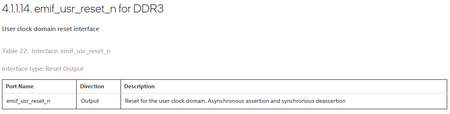
Hello, I am a bit confused by the Usage of the emif_usr_reset_n signal of the Intel EMIF IP Core. I have added a EMIF IP Core to our Platform Designer project. Based on the Documentation (4.1.1.14. emif_usr_reset_n for DDR3) I would assume the usr_reset output to have an associated clock (emif_usr_clk) with a synchronous deassertion: However in Platform Designer this reset appears without any associated clock and I get reset adapters when assigning it to reset inputs which require synchronous deassertion. I tried to explicitly set the emif_usr_reset_n output associated clock and synchronous edge, by applying this setting: But then I end up with the following Warning and I can also confirm, that the corresponding emif.ip file does not have the expected associated clock setting. So my question is: Is the documentation (4.1.1.14. emif_usr_reset_n for DDR3) correct and is the emif_usr_reset_n output really synchronous deasserted? Why does Platform Designer does not recognize the correct clock association for this signal? How do I configure the IP in a correct way to avoid any unnecessary or unexpected automatically inserted reset adapter? best regards FabianSolved1.4KViews0likes5Comments
Case (Z2-126625)|1002715
Hello, We request your help to provide us with FMD, TSCA and PFAS for below PNs: BX8071512500 BX8071512700 BX8071513500 BX8071513700 CM8066201920404 SR2L6 CM8071504555019 CM8071504820805 I210T1 I210T1BLK And we need you to confirm if part below part is correct and provide a data sheet for it IC PRE-PROG JSD100 EPM240T100I5N, EPM240T100C5N Please keep the following case number in all your replies. Case (Z2-126625)|10027151.3KViews0likes5Comments
mmc blocks written = error
Hi, By using Agilex-i series dev kit.I'm able to write a OS file from memory[0] region of ddr to mmc,but unable to write a file from memory[1] region of ddr to mmc. bdinfo log lmb_dump_all: memory.cnt = 0x2 / max = 0x10 memory[0] [0x0-0x7fffffff], 0x80000000 bytes flags: 0 ( 2GB ) memory[1] [0x280000000-0x3ffffffff], 0x180000000 bytes flags: 0 ( 6GB ) While tranfering a OS file from memory[1] region of ddr to mmc. Error pop up message as " mmc blocks written = error ". Thanks M Gokulraj1KViews0likes6CommentsA topic explaining a problem with Cyclone V SoC - u-booting .rbf file failure - got rejected.
Hi Altera Comunity et al, I guess this is more of a question for the support and moderator people of this forum. The situation is I just posted a topic explaining a problem I am experiencing with Cyclone V SoC—U-boot failing to load the .rbf (FPGA load configuration ) file , during initial system bootup. I put a lot of information - attached files, links, etc. to give better context around the issue. But that post got flagged as Spam and got rejected. And I am just wondering what to do here. I tried editing that post (removing links and removing attached files) several times already, but it still stays flagged as spam. I don't know what to do further to fix this :( The original issue topic was : "Cyclone-V-SoC: U-Boot fails to fpga load .rbf file - Command 'load' failed: Error -6" Anyone, please advise. Thank you and Best Regards, - Monk M.Solved800Views0likes16Comments
Agilex5 HPS running bare-metal code does not access FPGA fabric
I started with the following "Hello World" HPS OCRAM example: https://altera-fpga.github.io/rel-25.1/baremetal-embedded/agilex-5/e-series/premium/ug-baremetal-agx5e-premium/ I built the GHRD image with FPGA boot load set to "fabric first" and compiled the C code. With these changes, I am able to run the code and I can see the heartbeat LED toggle on the A5E premium development kit board. I am also able transmit data by writing the UART transmit register with my REG32 macro. However, I cannot access either H2F or LWH2F interfaces. I put Signal Tap on all arvalid/awvalid signals I and I do not see them toggle (I sanity checked the setup using the heartbeat counter). After looking at the documentation and the provided bare-metal drivers code, I cobbled together the following code to attempt to enable the HPS2 FPGA bridges: #define REG32(address) (*(volatile uint32_t*)address) #define REG64(address) (*(volatile uint64_t*)address) // Read the Reset manager registers uint32_t value32; value32 = REG32(0x10D1102C); printf("Reset manager initial value = 0x%08x \n", value32); // Drop the reset for SOC2FPGA bridges REG32(0x10D1102C) = 0; value32 = REG32(0x10D1102C); printf("Reset manager value after modification = 0x%08x \n", value32); printf("Enable FPGA bridges (NOTE: is this really an enable?)\n"); REG32(0x10D1205C) = 0x3; value32 = REG32(0x10D1205C); printf("Bridge enable register value after modification = 0x%08x \n", value32); Running this code I see: Reset manager initial value = 0x0000004f Reset manager value after modification = 0x00000000 Enable FPGA bridges Bridge enable register value after modification = 0x00000003 However, this loop does not show AWVALID come up on either AXI interface (I tried two different write macros to see if there is a difference): while (1) { printf("H2F: FPGA OCRAM write\n"); REG64(0x40000000) = 0x11223344; printf("H2LWF: LED controller write\n"); mem_quick_write_32(0x20010080, 0); } I feel like I am missing something obvious (like another enable) but I keep going over the code examples and the documentation and I can't find anything that could help. Any help is greatly appreciated.Solved700Views0likes16Comments
Cyclone 5 FPGA UART driver, and read/write functions.
I am using a Cyclone 5 MitySOM on the Critical link dev kit. I am trying to setup a custom UART (RX, TX) lines from the FPGA GPIOs, not going through any external chip other than and FTDI connected to a PC. I prefer to have this code in System Verilog. I have found some example of source for the RX and TX transactions, but nothing on how they get integrated into the FGPA system. Can you please provide me some detail, example code, etc. of how I can setup a custom UART (115200), that I can send Hello World to the PC and have it come out in a terminal window. Want to use this for log/debugging as well as a simple menu system to process incoming commands to perform actions real time. Thanks, Chris660Views0likes3Comments
Agilex 5 with HPS Cryptographic services and bootflow
Hi I have a question regarding boot flow on agilex 5 with HPS with security in mind. I am aware how this is typically implemented on other SoCs like NXP but as for the Agilex - I just started working on this SoC From what I understand (based on the docs and tf-a source code in particular VAB part) the flow is the following: SDM verfies fsbl signature and loads it SDM releses HPS from reset Fsbl loads next stages (BL31 BL33) each time communicating with SDM through mailbox asking SDM to verify the image signaturure Then we can be sure that we only use legitimate binaries. Am I right? I have found in the agilex 5 product table that some variants are equipped with Cryptographic services and some not. Are these Cryptographic services needed to perform the above flow? If the variant I have is not equipped with such IP is there any other way to securely boot all boot chain up to Linux?599Views0likes22Comments