embedded peripheral
37 Topics
Release 26.3
Version: Release 26.3 PRO Quartus Build/TAG: QPDS26.3 B114/QPDS26.3_REL_BASELINE_PR Release Date: October 28, 2026 Device Affected: Agilex® 27 , Agilex® 3, Agilex® 5, Agilex® 7, N5X, Stratix® 10, Arria® 10 Release Type: Major release Binary Release Path: http://releases.rocketboards.org/2026.10/ Release Page: https://github.com/altera-fpga/gsrd-socfpga/releases/tag/QPDS26.3_REL_BASELINE_PR Major Features Released Simics Simulator support for Agilex® 27 device and System Example Design created. https://altera-fpga.github.io/rel-26.3/embedded-designs/agilex-27/common/virtual-platforms/linux-gsrd/ug-linux-gsrd-agilex27-virtual-platforms/ System Example Design to support HPS AMP supporting configurations Linux + FreeRTOS, FreeRTOS+FreeRTOS for Agilex® 5. https://altera-fpga.github.io/rel-26.3/embedded-designs/agilex-5/e-series/premium-065a/amp_bao/ug-amp-bao-agx5e-premium-065a/ Support of Ethernet in Nios V example for Agilex® 3 Atum A3 Nano dev kit using MSGDMA to connect with SDR SDRAM. Reference Design of a DisplayPort video output subsystem for use by the Application Processor for a Linux desktop display HMI use case for Agilex® 5. Improved BareMetal support raising the API abstraction level for Agilex® 5 and Agilex® 3. Support of USB3.1 for Agilex3 and Agilex5 in device mode. https://altera-fpga.github.io/rel-26.3/embedded-designs/agilex-5/e-series/premium-065a/baremetal/ug-baremetal-agx5e-premium-065a/ Re-activated the Zephyr support including driver support of peripherals, examples and BSP generation for Agilex® 5 and Agilex® 3. https://altera-fpga.github.io/rel-26.3/embedded-designs/agilex-5/e-series/premium-065b/gsrd-zephyr/ug-zgsrd-agx5e-premium-065b/ https://altera-fpga.github.io/rel-26.3/embedded-designs/agilex-5/common/virtual-platforms/zephyr-gsrd/ug-zephyr-gsrd-agilex5-virtual-platforms/ Nios V Interfacing with Multi-Rate Ethernet PHY IP. Support of Use Case: mSGDMA IP in FPGA Fabric Connected to F2S bridge, via AXI security bridge (to allow ACE-Lite signals to be adjusted), SGDMA CSR's connected to H2F. HPS FreeRTOS Multicore Support for Agilex® 5. Support of Visual Design Studio (VDS) in all the Agilex® 7 System Example Designs. System Example Design for the Agilex® 5 Terasic DE25-Standard Board. https://altera-fpga.github.io/rel-26.3/embedded-designs/agilex-5/terasic/de25-standard/gsrd/ug-baseline-de25-standard/ Support of Ubuntu running on HPS in Agilex® 5. https://altera-fpga.github.io/rel-26.3/embedded-designs/agilex-5/e-series/premium-065a/ubuntu/ug-ubuntu-agx5e-premium-065a/ Support of Ubuntu running on HPS in Agilex® 5. https://altera-fpga.github.io/rel-26.3/embedded-designs/agilex-5/e-series/premium-065a/docker/ug-docker-agx5e-premium-065a/ Integrate test-suit executable into Yocto recipe in so this get available as part of the Linux file system for Agilex® 5. System Example Design to demonstrate Time-Sensitive Networking (TSN) PHY configuration using RGMII from FPGA HVIO for the Agilex® 5 013B. https://altera-fpga.github.io/rel-26.1.1/embedded-designs/agilex-3/c-series/tsn/rgmii-hvio/ug-tsncfg2-agx3c-dk-rgmii-hvio/ Support of Baseline System Example Design in Agilex® 7 devices. Support of Agilex® 7 HPS GSRD User Guide for I-Series FPGA Development Kit (rev D) https://altera-fpga.github.io/rel-26.3/embedded-designs/agilex-7/i-series/soc/gsrd-revd/ug-gsrd-agx7i-revd-soc/ Cache Coherent Accelerator System Example Design for Agilex® 5.58Views0likes1Comment
Why Generic Component are included in my GHRD?
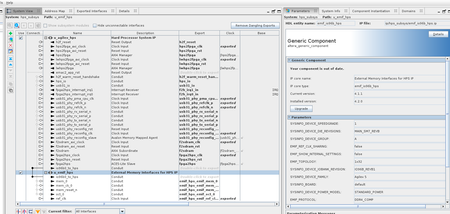
Hi, Altera I am a Dist. FAE in Uniquest Korea. When building the Agilex 5 GHRD on a Linux OS, as you can see, the IPs are recognized as generic components. It would be great if an upgrade could fix this, but all the connections disappear and the design gets completely messed up. How do AEs deal with this goddamn situation? If the GHRD acts like this, there is no point for customers to use it as a reference design. Does anyone know a solution? I've tried copying the folders and creating new components, but I'm still just getting a bunch of red errors. Please let me know a solution.Are there any issues with the portability of Quartus designs?Sorry for bad languages.Thanks. HudsonSolved96Views0likes5Comments
Cyclone V HPS SPI Master: Formula for calculating Tsu(min)/Th(min) from rx_sample_dly and spi_m_clk
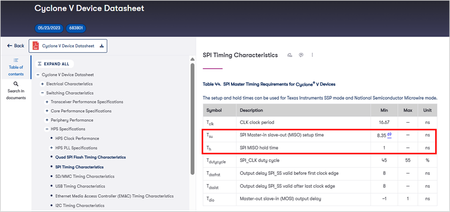
Hello, For the HPS SPI Master on the Cyclone V SoC, verify that the SPI read waveform and register settings are correct. To do this, calculate the MISO setup time and hold time under the operating conditions. Current settings: rx_sample_dly = 1, spi_m_clk = 200 MHz [Background] The Cyclone V Device Datasheet and the Hard Processor System Technical Reference Manual do not contain a formula for determining Tsu (min) from rx_sample_dly and spi_m_clk. In the datasheet, Tsu = 8.35 ns (min) is only shown as a characteristic value under the condition "rx_sample_dly = 1, spi_m_clk = 120 MHz" (Note 69). Also, Th = 1 ns (min) has no note indicating its relationship with rx_sample_dly and spi_m_clk. • [Reference] Cyclone V Device Datasheet → "SPI Timing Characteristics" On the other hand, the datasheet for a newer generation device (such as the Agilex 3) equipped with the same SPI controller has the following expression: • Tsu(min) = 5.0 − (rx_sample_dly × Tspi_ref_clk) [ns] • Th(min) = 1.3 + (rx_sample_dly × Tspi_ref_clk) [ns] • [Reference] Agilex 3 FPGAs and SoCs Device Data Sheet → "HPS SPI Timing Characteristics" [What I want to know] 1. For the HPS SPI Master of the Cyclone V SoC, is there a formula to calculate Tsu (min) from rx_sample_dly and spi_m_clk periods like Agilex 3? If so, please tell me the formula and constant term. 2. Similarly, is there a formula to calculate Th (min) from rx_sample_dly and spi_m_clk periods? Also, please tell me under which condition (rx_sample_dly, spi_m_clk) Th = 1 ns (min) in the data sheet is the value. 3. If there is no official formula, is it correct to apply the same shape as Agilex3 (constant ̇ rx_sample_dly × T) to Cyclone V? If so, please tell me the constant to use. Also, I would like to know if the constant is based on rx_sample_dly = 0, and if 8.35 ns in the data sheet already includes 1 stage of rx_sample_dly. 4. Please tell me Tsu (min) and Th (min) under the current condition (rx_sample_dly = 1, spi_m_clk = 200 MHz). Thank you for your support.Solved132Views0likes4Comments
Introducing the Altera Community AI Responder — Beta
Altera is introducing the AI Responder, an assistant built into the Altera Community to help provide faster, context-aware guidance for Altera product questions. It uses relevant public Altera documentation and Knowledge Database content, with coverage continuing to expand. The AI Responder may provide source references and can hand off complex or out-of-scope questions to an Altera subject-matter expert. As a beta feature, responses may contain errors or omissions, so please review the sources and verify technical guidance against official Altera documentation before implementation. If the response does not fully address your question, add more context and tag ai_responder to continue the discussion. We welcome your feedback as we improve the Community experience.52Views0likes0CommentsStore custom keys on SDM Agilex3
Hi I know it's possible to store encryption and siging keys on the SDM for fpga firmware decryption and authentication, but is it possible to store my own keys on it? I will use the key to decrypt my own software files on the HPS, so I need some way to send the ecrypted software to the SDM then the SDM will use the key to decrypt it and send it back. Is there any documentation or tutorial for this?619Views0likes13CommentsRelease 26.1.1
Version: Release 26.1.1 PRO Quartus Build/TAG: B130/QPDS26.1.1_REL_GSRD_PR Release Date: August 17, 2026 Device Affected: Agilex™ 3, Agilex™ 5, Agilex™ 7, Startix® 10 Release Type: Major release/Binary release Binary Release Path: http://releases.rocketboards.org/2026.08/ Release Page: https://github.com/altera-fpga/gsrd-socfpga/releases/tag/QPDS26.1.1_REL_GSRD_PR Major Features Released Agilex™ 5 XEN Hypervisor 5 System Example Design https://altera-fpga.github.io/rel-26.1.1/virtualization/hypervisors/xen/ug-xen-agx5e-premium-065b/ , https://altera-fpga.github.io/rel-26.1.1/virtualization/hypervisors/xen/ug-xen-agx5e-premium-065a/ Agilex™ 5 RYO OPTE System Example Design Agilex™ 5 Quartus Reference Design using VDS Agilex™ 3 Time-Sensitive Networking (TSN): PHY configuration 2 (RGMII from FPGA HVIO) System Example Design Agilex™ 5 Performance Optimized Baseline SED support Agilex™ 5 DataMover / Bridge and Memory Benchmark System Example Design https://altera-fpga.github.io/rel-26.1.1/embedded-designs/agilex-5/e-series/premium-065a/data-mover/ug-data-mover-agx5e-premium-065a/ Agilex™ 3 support of FreeRTOS Agilex™ 5 Terasic DE25-Nano Board System Example Design149Views2likes0CommentsHow to Generate Altera HAL for HPS?
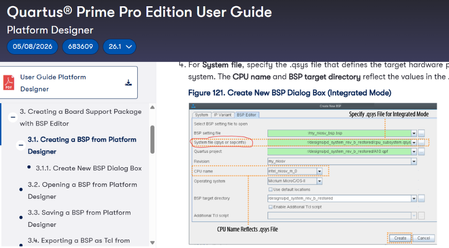
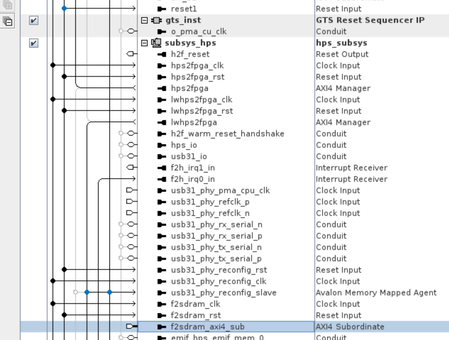
Hi, I am using Quartus 26.1 with the Agilex 5 Modular Development Kit (Device number: A5ED065BB32AE6SR0) and I have a few questions about BSP Generation for Hard Processor System (HPS). For reference I am following the Quartus Prime Pro Edition Version 26.1 User Guide. 1. How do I generate Altera HAL for HPS? When I use the BSP Editor in platform designer, I can only generate the system.h file that only has macros for EMIF, even though other peripherals are also connected to the HPS. How do I generate macros for the H2F bridges and HAL API Files for the HPS? 2. How do I input a SOPCINFO file into the BSP Editor? The Quartus Prime Pro Edition User Guide shows that I should be able to input SOPCINFO file as the system file (see above image) but Quartus only gives me the options of QSYS and IP file (see below image). Thank you for the help!Solved273Views0likes5CommentsAgilex3 ip fragmented packets gets corrupted
Hi I have a problem where the agilex3 HPS is not able to correctly reassemble ip-fragmented packets, I have included two pcaps one that show what the host is sending to the agilex and one that show the reception on the agilex. As you can see in the agilex.pcapng some of the packets gets corrupted in strange ways and gets wrong checksum. I use the DK-A3W135BM16AEA: Agilex® 3 FPGA and SoC C-Series Development Kit and has based my project on this example: https://altera-fpga.github.io/rel-25.3.1/embedded-designs/agilex-3/c-series/gsrd/ug-gsrd-agx3/ Anybody know whats going on here?387Views0likes5Comments2.5G Ethernet Reference Porting inquiries.
Hi, guys~ My customer wants to use the 2.5G Ethernet feature, but unfortunately, they purchased the Agilex5 Premium Kit instead of the Modular Kit. I am currently following the R&D guide with them, but the 88E2110 is not being recognized properly. Which parts should we check? First, I followed below link. And have built the Reference Design boot images. https://altera-fpga.github.io/rel-26.1/embedded-designs/agilex-5/e-series/modular-065b/tsn/sgmii_xcvr_3x2.5G/ug-tsn-sgmii-xcvr-3x2.5G-agilex5/ Second, I regenerated the hardware image after updating the Modular design pinout to match the Premium Kit specs. In the Premium schematic, the 88E2110 PHY reset pin is connected to the FPGA, but there was no control logic applied. So, I added logic to release the reset after 20 ms. Third, in the device tree, I enabled emac0 and disabled emac1 and emac2. Since the soft MDIO logic remains unchanged, the addresses shouldn't have changed. However, while the emac0 logs appear, the PHY is still not being recognized. Please refer to the attached boot log. Why did they use soft MDIO instead of the native EMAC0 MDIO? Is this a characteristic of 2.5G Ethernet?Solved261Views0likes5CommentsF2SDRAM test inquiries.
Hi Guys, I am testing the F2SDRAM bridge. 32 bit address, 256bits data. Due to recurring missing Verilog file errors for the Qsys adapter IP whenever switching PCs, I removed the adapter earlier and am currently testing by directly exporting f2s from the HPS to the top level. I implemented tester logic on the FPGA side to write and read 256-bit data once per transaction (len=0) for 2048 comparisons, but the B channel signal keeps returning 2'b11 (DECERR). I implemented the tester logic on the FPGA side to perform 2,048 read/write comparison cycles with 256-bit data in single-beat transactions (len=0) using a base address of 0x8000_0000. However, I am at a loss because the B channel signal continuously returns 2'b11 (DECERR). Debugging this solely based on the B channel response is quite challenging. For reference, I am currently running this test on an 013b devkit using the GHRD Linux Reference Design, triggering the start signal via Signal Probe after the kernel has fully booted up Could this be an issue with sideband signals or the kernel driver? Gemini suggests that the bridge might be in reset or it could be due to SMMU. I have already disabled SMMU. As expected, learning and applying new technology is always tough. Thank.Solved259Views0likes6Comments