embedded peripheral
37 Topics
Release 26.3
Version: Release 26.3 PRO Quartus Build/TAG: QPDS26.3 B114/QPDS26.3_REL_BASELINE_PR Release Date: October 28, 2026 Device Affected: Agilex® 27 , Agilex® 3, Agilex® 5, Agilex® 7, N5X, Stratix® 10, Arria® 10 Release Type: Major release Binary Release Path: http://releases.rocketboards.org/2026.10/ Release Page: https://github.com/altera-fpga/gsrd-socfpga/releases/tag/QPDS26.3_REL_BASELINE_PR Major Features Released Simics Simulator support for Agilex® 27 device and System Example Design created. https://altera-fpga.github.io/rel-26.3/embedded-designs/agilex-27/common/virtual-platforms/linux-gsrd/ug-linux-gsrd-agilex27-virtual-platforms/ System Example Design to support HPS AMP supporting configurations Linux + FreeRTOS, FreeRTOS+FreeRTOS for Agilex® 5. https://altera-fpga.github.io/rel-26.3/embedded-designs/agilex-5/e-series/premium-065a/amp_bao/ug-amp-bao-agx5e-premium-065a/ Support of Ethernet in Nios V example for Agilex® 3 Atum A3 Nano dev kit using MSGDMA to connect with SDR SDRAM. Reference Design of a DisplayPort video output subsystem for use by the Application Processor for a Linux desktop display HMI use case for Agilex® 5. Improved BareMetal support raising the API abstraction level for Agilex® 5 and Agilex® 3. Support of USB3.1 for Agilex3 and Agilex5 in device mode. https://altera-fpga.github.io/rel-26.3/embedded-designs/agilex-5/e-series/premium-065a/baremetal/ug-baremetal-agx5e-premium-065a/ Re-activated the Zephyr support including driver support of peripherals, examples and BSP generation for Agilex® 5 and Agilex® 3. https://altera-fpga.github.io/rel-26.3/embedded-designs/agilex-5/e-series/premium-065b/gsrd-zephyr/ug-zgsrd-agx5e-premium-065b/ https://altera-fpga.github.io/rel-26.3/embedded-designs/agilex-5/common/virtual-platforms/zephyr-gsrd/ug-zephyr-gsrd-agilex5-virtual-platforms/ Nios V Interfacing with Multi-Rate Ethernet PHY IP. Support of Use Case: mSGDMA IP in FPGA Fabric Connected to F2S bridge, via AXI security bridge (to allow ACE-Lite signals to be adjusted), SGDMA CSR's connected to H2F. HPS FreeRTOS Multicore Support for Agilex® 5. Support of Visual Design Studio (VDS) in all the Agilex® 7 System Example Designs. System Example Design for the Agilex® 5 Terasic DE25-Standard Board. https://altera-fpga.github.io/rel-26.3/embedded-designs/agilex-5/terasic/de25-standard/gsrd/ug-baseline-de25-standard/ Support of Ubuntu running on HPS in Agilex® 5. https://altera-fpga.github.io/rel-26.3/embedded-designs/agilex-5/e-series/premium-065a/ubuntu/ug-ubuntu-agx5e-premium-065a/ Support of Ubuntu running on HPS in Agilex® 5. https://altera-fpga.github.io/rel-26.3/embedded-designs/agilex-5/e-series/premium-065a/docker/ug-docker-agx5e-premium-065a/ Integrate test-suit executable into Yocto recipe in so this get available as part of the Linux file system for Agilex® 5. System Example Design to demonstrate Time-Sensitive Networking (TSN) PHY configuration using RGMII from FPGA HVIO for the Agilex® 5 013B. https://altera-fpga.github.io/rel-26.1.1/embedded-designs/agilex-3/c-series/tsn/rgmii-hvio/ug-tsncfg2-agx3c-dk-rgmii-hvio/ Support of Baseline System Example Design in Agilex® 7 devices. Support of Agilex® 7 HPS GSRD User Guide for I-Series FPGA Development Kit (rev D) https://altera-fpga.github.io/rel-26.3/embedded-designs/agilex-7/i-series/soc/gsrd-revd/ug-gsrd-agx7i-revd-soc/ Cache Coherent Accelerator System Example Design for Agilex® 5.58Views0likes1Comment
Why Generic Component are included in my GHRD?
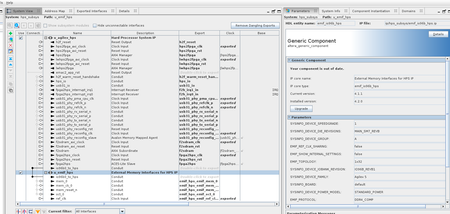
Hi, Altera I am a Dist. FAE in Uniquest Korea. When building the Agilex 5 GHRD on a Linux OS, as you can see, the IPs are recognized as generic components. It would be great if an upgrade could fix this, but all the connections disappear and the design gets completely messed up. How do AEs deal with this goddamn situation? If the GHRD acts like this, there is no point for customers to use it as a reference design. Does anyone know a solution? I've tried copying the folders and creating new components, but I'm still just getting a bunch of red errors. Please let me know a solution.Are there any issues with the portability of Quartus designs?Sorry for bad languages.Thanks. HudsonSolved96Views0likes5Comments
Cyclone V HPS SPI Master: Formula for calculating Tsu(min)/Th(min) from rx_sample_dly and spi_m_clk
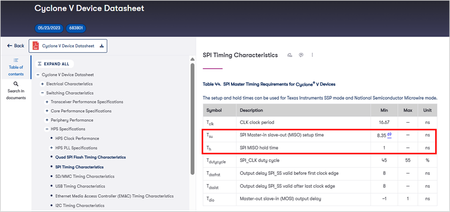
Hello, For the HPS SPI Master on the Cyclone V SoC, verify that the SPI read waveform and register settings are correct. To do this, calculate the MISO setup time and hold time under the operating conditions. Current settings: rx_sample_dly = 1, spi_m_clk = 200 MHz [Background] The Cyclone V Device Datasheet and the Hard Processor System Technical Reference Manual do not contain a formula for determining Tsu (min) from rx_sample_dly and spi_m_clk. In the datasheet, Tsu = 8.35 ns (min) is only shown as a characteristic value under the condition "rx_sample_dly = 1, spi_m_clk = 120 MHz" (Note 69). Also, Th = 1 ns (min) has no note indicating its relationship with rx_sample_dly and spi_m_clk. • [Reference] Cyclone V Device Datasheet → "SPI Timing Characteristics" On the other hand, the datasheet for a newer generation device (such as the Agilex 3) equipped with the same SPI controller has the following expression: • Tsu(min) = 5.0 − (rx_sample_dly × Tspi_ref_clk) [ns] • Th(min) = 1.3 + (rx_sample_dly × Tspi_ref_clk) [ns] • [Reference] Agilex 3 FPGAs and SoCs Device Data Sheet → "HPS SPI Timing Characteristics" [What I want to know] 1. For the HPS SPI Master of the Cyclone V SoC, is there a formula to calculate Tsu (min) from rx_sample_dly and spi_m_clk periods like Agilex 3? If so, please tell me the formula and constant term. 2. Similarly, is there a formula to calculate Th (min) from rx_sample_dly and spi_m_clk periods? Also, please tell me under which condition (rx_sample_dly, spi_m_clk) Th = 1 ns (min) in the data sheet is the value. 3. If there is no official formula, is it correct to apply the same shape as Agilex3 (constant ̇ rx_sample_dly × T) to Cyclone V? If so, please tell me the constant to use. Also, I would like to know if the constant is based on rx_sample_dly = 0, and if 8.35 ns in the data sheet already includes 1 stage of rx_sample_dly. 4. Please tell me Tsu (min) and Th (min) under the current condition (rx_sample_dly = 1, spi_m_clk = 200 MHz). Thank you for your support.Solved132Views0likes4Comments
MSGDMA ST-to-MM: Linux Driver Necessity & F2SDRAM Path Feasibility
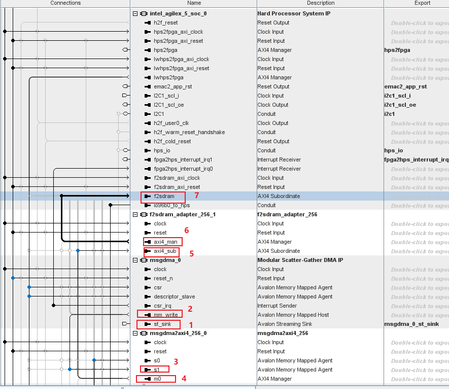
Hello everyone, I am currently working on an MSGDMA implementation. I have verified that I can read the MSGDMA CSR and Descriptor registers via the LWH2F bridge using devmem2. My setup is configured in Streaming-to-Memory-Mapped (ST-to-MM) mode. I have two specific questions regarding this setup: 1、Is configuring the MSGDMA Linux kernel driver a mandatory condition for the hardware to function correctly? Is it possible to bypass the driver and configure the MSGDMA to start data transfer directly using devmem2 (user-space access)? 2、I noticed that some implementations write to the PS-side memory via the FPGA-to-HPS bridge. However, my design utilizes the F2SDRAM link, as indicated by the numbered sequence in the attached diagram. Could you please confirm if this architectural approach is feasible?Solved302Views0likes3CommentsIntroducing the Altera Community AI Responder — Beta
Altera is introducing the AI Responder, an assistant built into the Altera Community to help provide faster, context-aware guidance for Altera product questions. It uses relevant public Altera documentation and Knowledge Database content, with coverage continuing to expand. The AI Responder may provide source references and can hand off complex or out-of-scope questions to an Altera subject-matter expert. As a beta feature, responses may contain errors or omissions, so please review the sources and verify technical guidance against official Altera documentation before implementation. If the response does not fully address your question, add more context and tag ai_responder to continue the discussion. We welcome your feedback as we improve the Community experience.52Views0likes0CommentsStore custom keys on SDM Agilex3
Hi I know it's possible to store encryption and siging keys on the SDM for fpga firmware decryption and authentication, but is it possible to store my own keys on it? I will use the key to decrypt my own software files on the HPS, so I need some way to send the ecrypted software to the SDM then the SDM will use the key to decrypt it and send it back. Is there any documentation or tutorial for this?619Views0likes13CommentsRelease 26.1.1
Version: Release 26.1.1 PRO Quartus Build/TAG: B130/QPDS26.1.1_REL_GSRD_PR Release Date: August 17, 2026 Device Affected: Agilex™ 3, Agilex™ 5, Agilex™ 7, Startix® 10 Release Type: Major release/Binary release Binary Release Path: http://releases.rocketboards.org/2026.08/ Release Page: https://github.com/altera-fpga/gsrd-socfpga/releases/tag/QPDS26.1.1_REL_GSRD_PR Major Features Released Agilex™ 5 XEN Hypervisor 5 System Example Design https://altera-fpga.github.io/rel-26.1.1/virtualization/hypervisors/xen/ug-xen-agx5e-premium-065b/ , https://altera-fpga.github.io/rel-26.1.1/virtualization/hypervisors/xen/ug-xen-agx5e-premium-065a/ Agilex™ 5 RYO OPTE System Example Design Agilex™ 5 Quartus Reference Design using VDS Agilex™ 3 Time-Sensitive Networking (TSN): PHY configuration 2 (RGMII from FPGA HVIO) System Example Design Agilex™ 5 Performance Optimized Baseline SED support Agilex™ 5 DataMover / Bridge and Memory Benchmark System Example Design https://altera-fpga.github.io/rel-26.1.1/embedded-designs/agilex-5/e-series/premium-065a/data-mover/ug-data-mover-agx5e-premium-065a/ Agilex™ 3 support of FreeRTOS Agilex™ 5 Terasic DE25-Nano Board System Example Design149Views2likes0CommentsHow to Generate Altera HAL for HPS?
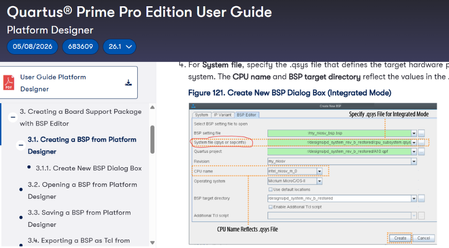
Hi, I am using Quartus 26.1 with the Agilex 5 Modular Development Kit (Device number: A5ED065BB32AE6SR0) and I have a few questions about BSP Generation for Hard Processor System (HPS). For reference I am following the Quartus Prime Pro Edition Version 26.1 User Guide. 1. How do I generate Altera HAL for HPS? When I use the BSP Editor in platform designer, I can only generate the system.h file that only has macros for EMIF, even though other peripherals are also connected to the HPS. How do I generate macros for the H2F bridges and HAL API Files for the HPS? 2. How do I input a SOPCINFO file into the BSP Editor? The Quartus Prime Pro Edition User Guide shows that I should be able to input SOPCINFO file as the system file (see above image) but Quartus only gives me the options of QSYS and IP file (see below image). Thank you for the help!Solved273Views0likes5CommentsAgilex 5/3 FreeRTOS SMP Support
Stable Version: v25.4 Quartus Version: 25.4 Supported devices: Agilex™ 3 and Agilex™ 5 Source : https://github.com/Ignitarium-Technology/freertos-socfpga Branch/Tag: v25.4-SMP Release Date: March 30, 2026 Hello Everyone, FreeRTOS port for A55/A76 HPS now supports SMP. visit the GitHub page for instructions on how to get started. Features and comments Features Agilex3 Agilex5 Agilex3 SMP Agilex5 SMP (A55 x 2 or A76 x 2) Supported features Limitations/ Known issues A55 boot Yes Yes Yes Yes Single core boot, Dual core SMP A76 boot NA Yes NA Yes Single core boot, Dual core SMP QSPI boot Yes Yes Yes Yes SD boot Yes Yes Yes Yes eMMC boot Yes Yes Yes Yes NAND boot No No No No Clk mngr driver Yes Yes Yes Yes API to get clock speed of different blocks Reset mngr driver Yes Yes Yes Yes Peripheral reset assert/de-assert DMA driver Yes Yes Yes Yes Memory to memory transfer Only support memory to memory GPIO driver Yes Yes Yes Yes Write, read and interrupt support Timer driver Yes Yes Yes Yes User defined and free running modes UART driver Yes Yes Yes Yes Full duplex Tx and Rx DMA not supported (Planned for future release I2C driver Yes Yes Yes Yes Master mode write and read Standard and fast modes DMA not supported (Planned for future release I3C driver Yes Yes Yes Yes Master mode write and read i3c and legacy i2c devices IBI not supported (Planned for future release) SPI driver Yes Yes Yes Yes Master mode write and read DMA is not supported QSPI driver Yes Yes Yes Yes QSPI flash read/write/erase NAND driver No No No No SDM mailbox driver Yes Yes Yes Yes SDM commands with SIP_SVC SMMU enable support Yes Yes Yes Yes Static identity mapping for cache coherency SDMMC driver Yes Yes Yes Yes standard and HS speeds SDMMC and eMMC devices Fat FS support Ethernet stack Yes Yes Yes Yes TCP/IP, UDP, ICMP and DHCP IPv4 and IPv6 support USB 2.0 stack NT Yes NT Yes USB mass storage class Tested with a custom board and SOF USB 3.1 stack NT Yes NT Yes USB mass storage operation WDT diver Yes Yes Yes Yes interrupt or reset on timer expiry EDAC support Yes Yes Yes Yes Error injection and detection for EMAC, USB and QSPI blocks OCRAM not supported IOSSM driver Yes Yes Yes Yes Error injection and detection Bridge driver NT Yes NT Yes Enable, Disable Reboot mngr Yes Yes Yes Yes Warm/Cold reboot FPGA manager Yes Yes Yes Yes FPGA configuration Yes: Feature available and tested, No: Feature not available in SDK, NA : Not applicable , NT: Not tested Note: If you find any issues, please raise an issue in the GitHub page. For more support/assistance visit our website .491Views3likes11CommentsUSB Device Issue on Cyclone V / HPS
Hello, Please find below a description of the USB issue we are experiencing with our Cyclone V / HPS board. To test our USB interface, we integrated the TinyUSB library into our existing firmware and enabled FreeRTOS support. Since the Cyclone V is not natively supported, I implemented the missing functions using Altera's hwlib, which we already use in our project (source file attached). The USB is used only in Device mode. I tested the following four configurations: Full-Speed with Slave mode Full-Speed with Simple DMA High-Speed with Slave mode High-Speed with Simple DMA The behavior is identical in all four cases: Connecting our board to a Windows or Linux host is correctly detected. The SETUP transaction is successfully received, and the host receives the device descriptor in response. When the IN transfer complete interrupt is triggered, the USB controller is configured to receive a zero-length packet on OUT0. However, the USB protocol analyzer shows that the device continuously responds with NAK to this packet. The host retries for approximately 5 seconds, but the device keeps responding with NAK. The register values immediately after configuring the reception of the OUT0 packet are: Gotgctl = 0xd00c0 Gintsts = 0x4000020 (PTxFEmp, NPTxFEmp) Gdfifocfg = 0x1f802000 Dctl = 0 Dcfg = 0x8100001 Dsts = 0x18702 Doepctl0 = 0x80008000 Doepint0 = 0 Doeptsiz0 = 0x80000 Grxfsiz = 0x50 After a few milliseconds, I observe that DOEPINT0.NAKINTRPT = 1, which seems to confirm that the device is sending NAKs. However, I do not understand why the OUT packet is not being accepted, since the receive FIFO is not full and both DCTL.GOUTNAKSTS = 0 and DOEPCTL0.NAKSTS = 0.Solved442Views0likes17Comments