SDC_ENTITY_FILE critical warnings
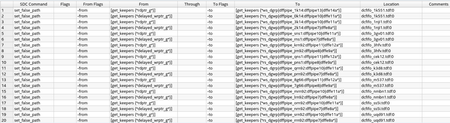
When building a platform designer based system using quartus pro 25.1 I see a number of the following warnings when running the fitter. Critical Warning(22304): SDC_ENTITY_FILE '../../phoenix/DesignFiles/platform_designer/ip/print_sys/pcc3e/pcc2e_print_memory/altera_reset_controller_1924/synth/altera_reset_controller.sdc' was not applied. No matching entity: 'altera_reset_controller' in library: 'altera_reset_controller_1924'. The altera_reset_controller is listed in the altera_reset_controller_1924 library under the quartus design units tab. Given this, why do these warnings occur? Kind regards, GraemeSolved53Views0likes5Comments
Hard reset with USB-Blaster and Quartus
Hello there, I am working on few JTAG operations using Quartus prime standard (v24) with USB-Blaster (cable). After every operation I need to hard reset to perform the next operation. Unless Hard-reset is performed, the data received in TDO is not correct. Is there any command to make sure we do not have to perform hard-reset (Just to note, soft-reset is always performed). A quick response to this would be appreciated. Thanks in advance :) BR, Alkesh111Views0likes7Comments
IOPLL related clock constraints
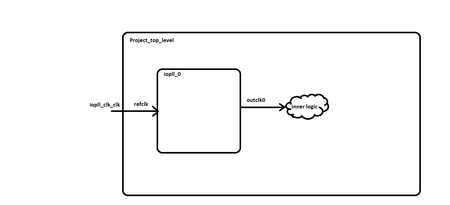
Hello Every one I am struggling with creating clock constraint and need help. I have agilix 10 FPGA design at project level top module I have input "iopll_clk_clk". this input is mapped to clock capable input pin on FPGA and is connected to 50MHz on board clock source. The toplevel module has iopll instantiation as following pcie_ed_iopll_0 iopll_0 ( .refclk (iopll_clk_clk), // input, width = 1, refclk.clk .locked (), // output, width = 1, locked.export .rst (resetip_ninit_done_reset), // input, width = 1, reset.reset .outclk0 (iopll_0_outclk0_clk) // output, width = 1, outclk0.clk ); "iopll_0_outclk0_clk" is supposed to be used as clock input for inner logic only. in Platform designer IOPLL is IP is configured to output only one clock at 300MHz. in the project SDC file I have following constraints #iopll Clock create_clock -period 20 [get_ports iopll_clk_clk] #derive_pll_clocks -create_base_clocks - Tried it but not supported for Agilex 10 create_generated_clock -multiply_by 6 -source [get_ports iopll_clk_clk] -name iopll_0_outclk0 [get_pins iopll_0|iopll_0_outclk0] - this is line 17 Here while compiling the design during fitter stage i see following warning messages. Warning(332174): Ignored filter at intel_rtile_pcie_ed.sdc.terp(17): iopll_0|iopll_0_outclk0 could not be matched with a pin Warning(332049): Ignored create_generated_clock at intel_rtile_pcie_ed.sdc.terp(17): Argument <targets> with value [get_pins {iopll_0|iopll_0_outclk0}] contains zero elements This tells me that the IOPLL clocks are not constrained properly and Quartus wont be able to evaluate clock paths correctly for internally generated 300MHz clock. can you help me in figuring out what am i doing wrong here? How can I correctly constraint that iopll is fed with 50MHz clock and its output is 300MHz clock?188Views0likes15Comments
Realistic values for set_max_skew
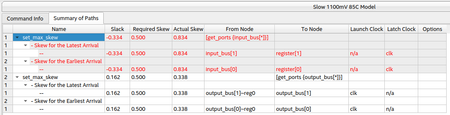
I have a design with asynchronous input and output bus signals. For the input bus signals I do not care how much time it takes from the Input Ports to the first register. For the output signals I also do not care how much time it takes from the last register to the output ports. The only thing that I really care about is, the skew of the bus signals. I have created a very simple dummy design and added sdc design constraints. module top( input clk, input [1:0] input_bus, output reg [1:0] output_bus ); reg [1:0] register; always @(posedge clk) begin register <= input_bus; output_bus <= register; end endmodule create_clock -name clk -period 20 [get_ports clk] set_max_skew -from [get_ports {input_bus[*]}] 0.5 set_max_skew -to [get_ports {output_bus[*]}] 0.5 Timing Analyzer fails. I do not have a lot of experience with SDC constraints and bus timing. My feelfing is, that 0.5ns bus skew is not unrealistic. Is my expectation wrong, or am I doing something wrong?73Views0likes4CommentsJTAG timing violations
Hello Following are my project details LAST_QUARTUS_VERSION "25.1.0 Pro Edition" DEVICE AGIB027R29A1E2VC "Agilex 7" in SDC file - I have create_clock -name {altera_reserved_tck} -period 30 [get_ports {altera_reserved_tck}] set_clock_groups -asynchronous -group {altera_reserved_tck} I am getting timing violation in JTAG path (n/a domain). Lets ignore IOPLL domain violations for this thread. Attached is the timing compilation results for "n/a" path. I need your help in resolving JTAG timing violations. I tried to refer earlier threads on the "JTAG violations" but its not quite helping so opening this thread. thanks64Views0likes6Comments
Minimum pulse width violation on EMIF-HPS
We are observing Minimum pulse width summary violation on three clocks in EMIF. Snapshots of Minimum pulse width violation on each of these clocks are attached. Quartus version: 25.1.1 targeted FPGA: AGFB027R24C2E3V Please share your suggestions.52Views0likes2CommentsCDC violations from DCFIFO
CDC-50007 design rules violation are coming internal from DCFIFO. What is the Altera suggestion for the violation internal to the IP. I can see DC_FIFO has false path constraint embedded in the IP. I am wondering why these violations are coming even when false path constraint there on those paths.33Views0likes1Comment
Setup slack violations?
Hi, I have a design implemented in a Cyclone 10LP device, but I am struggling a bit with the Timing Analyzer. I am using Quartus Prime Lite edition 24.1. The setup-slack is violated for a number of paths, but I need some help interpreting the waveform shown in the attachment. And, looking at the path in Technology Map viewer I also struggle on how to improve the timing. How can I attack the issue? A pointer to relevant documentation is highly appreciated130Views0likes8Comments
TimeQuest Question Relating PLL
I have a design on a DE23-lite board. I use the onboard 50 MHz clock to feed a PLL set to 150 MHz. All registers clock on the PLL. I_clk is the 50 MHz clock. I use the following rule: create_generated_clock -name clk_pll -source [get_ports {I_clk}] -multiply_by 3 [get_pins {pll0|iopll_0|tennm_ph2_iopll|out_clk[0]}] (Yes, the PLL output has that name) Now TimeQuest complains: No paths exist between clock target "pll0|iopll_0|tennm_ph2_iopll|out_clk[0]" of clock "clk_pll" and its clock source. Assuming zero source clock latency. So I looked up the PLL input clock. But if I write: create_generated_clock -name clk_pll \ -source [get_pins {pll0|iopll_0|tennm_ph2_iopll|ref_clk0}] \ -multiply_by 3 \ [get_pins {pll0|iopll_0|tennm_ph2_iopll|out_clk[0]}] the setup slack on I_clk is -7 ns, but no register clocks on this clock. So what to do?84Views0likes4Comments