Forum Discussion

Altera_Forum's avatar
Altera_Forum
Icon for Honored Contributor rankHonored Contributor
9 years ago

up counter needs fixing - confused . simple question

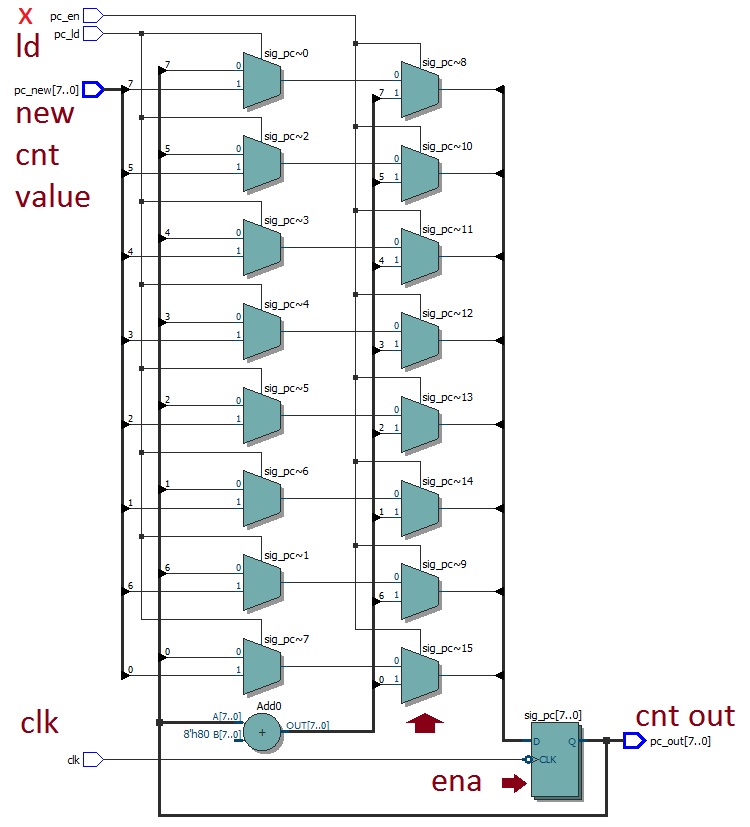
Hi, this is a simple counter with asynch pre-set(not wired in diagram), enable, load and synch add +1. i can't figure the trick to get rid of one extra mux column and use the FF enable (where red arrow is). Do you have any ideas please?

cheers. Pretty sure there's a way to do it....

17 Replies

  • Altera_Forum's avatar
    Altera_Forum
    Icon for Honored Contributor rankHonored Contributor

    the way you guys describe solutions is kinda how you want to synthesizer to design the logic for your needs. I think that's very power full and is gained after years of experience. This one for example :

    --- Quote Start ---

    load enable cnt

    0 0 no change of cnt

    0 1 count up, may not get initialised

    1 0 load value to cnt

    1 1 count up

    --- Quote End ---

    Would you kindly explain this methodology please Kaz? As in how you picture the logic will be for the code you describe and the other way round, how do you describe code to get these states (if it makes sense) ?

    Also one more thing, in the picture I attached the Load input is driving multiple multiplexers. Is there a trick behind the scenes that takes care of the driving capabilities inside the FPGA. As in can one input drive all that logic at one internally? (is my question clear here?)
  • Altera_Forum's avatar
    Altera_Forum
    Icon for Honored Contributor rankHonored Contributor

    --- Quote Start ---

    Also one more thing, in the picture I attached the Load input is driving multiple multiplexers. Is there a trick behind the scenes that takes care of the driving capabilities inside the FPGA. As in can one input drive all that logic at one internally? (is my question clear here?)

    --- Quote End ---

    It is driving muxes because altera registers do not have synchronous inputs, other than D. So synchronous set/reset have to be emulated with logic - hence the muxes.

    Im not exactly sure what your question means - but assuming the design meets timing then this is pretty standard behaviour..
  • Altera_Forum's avatar
    Altera_Forum
    Icon for Honored Contributor rankHonored Contributor

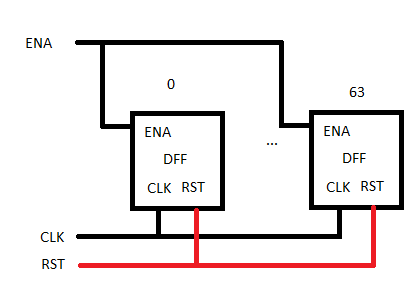
    So lets say we have 64 DFFs (as in picture attached) each requiring a clk, rst and enable in parallel. I guess that's quite a lot of driving current needed right?

    1. how do i measure the actual driving current needed?

    2. is it good practice to connect all 64 (clk, rst and ena) together in parallel like in the picture, and drive them from just one input?

    3. say clk is driven internally from a PLL, can the PLL drive all those FF? can it supply enough current to all? Or is there a limit some where in a datasheet?

    4. say rst is driven from an external pin, can this pin handle the current needed?

    5. transient currents create a lot of noise...

    6. are there any fanout techniques used internally in the FPGA to split signals, like clk, rst and ena, in this case, to say groups of 8?
  • Altera_Forum's avatar
    Altera_Forum
    Icon for Honored Contributor rankHonored Contributor

    --- Quote Start ---

    So lets say we have 64 DFFs (as in picture attached) each requiring a clk, rst and enable in parallel. I guess that's quite a lot of driving current needed right?

    1. how do i measure the actual driving current needed?

    2. is it good practice to connect all 64 (clk, rst and ena) together in parallel like in the picture, and drive them from just one input?

    3. say clk is driven internally from a PLL, can the PLL drive all those FF? can it supply enough current to all? Or is there a limit some where in a datasheet?

    4. say rst is driven from an external pin, can this pin handle the current needed?

    5. transient currents create a lot of noise...

    6. are there any fanout techniques used internally in the FPGA to split signals, like clk, rst and ena, in this case, to say groups of 8?

    --- Quote End ---

    you don't have to worry about electrical level.

    just follow templates and check timing
  • Altera_Forum's avatar
    Altera_Forum
    Icon for Honored Contributor rankHonored Contributor

    Assuming you have connected the FPGA to the board as per the instructions in the data sheet with the correct Vcc and Ground Pins, then current draw wont be a worry as it will always be within the spec on the datasheet.

    There is a power analysis tool that can run your design through to give estimated power draw for your design, but that may be a bit advanced for what you are doing.

    Just be assured that if the design fits in the device and meets timing (and you have designed it to correct correctly with the connected IOs) then it will work.
  • Altera_Forum's avatar
    Altera_Forum
    Icon for Honored Contributor rankHonored Contributor

    thanks for the observations. Quite advanced yes. Was just thinking about it so i asked.

  • Altera_Forum's avatar
    Altera_Forum
    Icon for Honored Contributor rankHonored Contributor

    --- Quote Start ---

    So lets say we have 64 DFFs (as in picture attached) each requiring a clk, rst and enable in parallel. I guess that's quite a lot of driving current needed right?

    1. how do i measure the actual driving current needed?

    2. is it good practice to connect all 64 (clk, rst and ena) together in parallel like in the picture, and drive them from just one input?

    3. say clk is driven internally from a PLL, can the PLL drive all those FF? can it supply enough current to all? Or is there a limit some where in a datasheet?

    4. say rst is driven from an external pin, can this pin handle the current needed?

    5. transient currents create a lot of noise...

    6. are there any fanout techniques used internally in the FPGA to split signals, like clk, rst and ena, in this case, to say groups of 8?

    --- Quote End ---

    Your electrical question was answered, but not the others.

    1: Powerplay power analyzer, as mentioned.

    2: There is no issue with driving all 64 locations as long as the design meets timing.

    3: Yes, the PLL can drive all of them, either using local routing or global routing. As mentioned, you don't have to worry about current.

    4: Same answer.

    5: In the past, simultaneous switching noise, large numbers of physically close I/O pins switching levels simultaneously, could affect pins that weren't switching, potentially glitching the pins not switching. This could still be an issue with older devices, but most newer ones don't have a problem with it (the SSN analysis tool was removed from the Quartus software a while ago).

    6: Absolutely. This is usually necessary for high fanout timing issues (so much fanout that destination logic needs to be placed further and further from the source, causing setup timing issues). The main recommendation is to perform register duplication directly in your HDL code. This gives you the most control. However, Quartus does include a max fanout constraint and a register duplication constraint you can use in the Assignment Editor to do this without altering your code.