Forum Discussion

 New Contributor
Strange issues on FPGA

 Contributor
Hi,
Firstly, could you add the snippets a bit close-up ? It's really hard to see the details, therefore to debug. Regarding the issues:
1) If the Tick_FPGA is staying low, your FSM might be stuck at the IDLE state, waiting for Dio_tick. In the second snippet I see that there's a rapid transition of Dio_tick to 0 and then back to 1, maybe this transition happens when the FSM is not in the IDLE state but in another state. But since there's no state signal in the waveforms, I cannot be sure. Maybe you can add that one and the counter signals to the waveform ?
2) What is DATA in A4 ? data_in or data_out ? If it's data_in, it could be the same as 1), getting the data_valid transition to 0 in another state. But if it's data_out, it should be stuck in the BUSY_1 state indeed, but that shouldn't be the case given that the data_valid is wide enough for the clock to catch.
My idea is that you're stuck at the reset state for the most of the time, and when it's out of that, the FSM barely has time to do anything (I assume A4 is data_in)
 FvM2 years ago
Super Contributor
I agree with above post that shown timing recordings don't give much information to debug the issue, except for the simple fact that the state machine is stuck.
That's not strange but a well-known effect of state machines reading asynchronous input signals without necessary synchronizer chain. If the input changes simultaneous with clock edge, the FSM can jump to an illegal state and possibly never leave it. Scarlet2 years ago
@FvM wrote:
I agree with above post that shown timing recordings don't give much information to debug the issue, except for the simple fact that the state machine is stuck.I've added additional explanations in the previous response.
@FvM wrote:
That's not strange but a well-known effect of state machines reading asynchronous input signals without necessary synchronizer chain. If the input changes simultaneous with clock edge, the FSM can jump to an illegal state and possibly never leave it.Yes, I learned after working with FPGA that if the input changes simultaneously with the clock edge, it can cause errors. That's why I tried adding synchronization to wait for the external signal to stabilize, but it seems to not resolve the issue of not receiving the external data_valid signal.
		data_valid_sync1 <= data_valid;
		data_valid_sync2 <= data_valid_sync1;
- Scarlet2 years ago
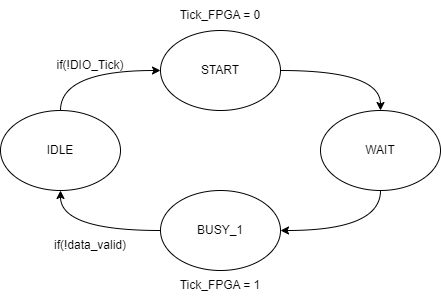
Let me explain the process of this FPGA:
- IDLE: After receiving the DIO_Tick signal, it transitions to the START state.
- START: It sends a low-level Tick_FPGA signal, then enters a delay state (originally using a counter), and transitions to the BUSY state.
- BUSY: It returns the Tick_FPGA signal to high level and waits for the data_valid signal, before going back to IDLE.
(CNVST, BUSY, CS, SCK, and DATA are mainly used to confirm whether the local side has received the Tick_FPGA signal and can be ignored.)
The following is the correct timing:
(This data_valid signal has been modified in both sending and receiving)
@anonimcs wrote:Hi,
Firstly, could you add the snippets a bit close-up ? It's really hard to see the details, therefore to debug. Regarding the issues:
1) If the Tick_FPGA is staying low, your FSM might be stuck at the IDLE state, waiting for Dio_tick. In the second snippet I see that there's a rapid transition of Dio_tick to 0 and then back to 1, maybe this transition happens when the FSM is not in the IDLE state but in another state. But since there's no state signal in the waveforms, I cannot be sure. Maybe you can add that one and the counter signals to the waveform ?
It encounters two issues:
1. Tick_FPGA cannot return to a high level:
Overview of the timing diagram:
Zoom In(LEDs to IO to observe the state):
Here, the Tick_FPGA signal suddenly goes low.
According to the FSM's LEDs I set for each state, it has jump to an illegal state.
2. FPGA does not correctly receive data_valid
It can be seen that the preceding timing is correct, but sometimes data_valid is not received, causing the FPGA to get stuck.
According to the FSM's LED indicators, it is stuck in the BUSY state waiting for data_valid.
I have tried adding synchronization to wait for the external signal to stabilize, but it seems to not resolve the issue:
		data_valid_sync1 <= data_valid;
		data_valid_sync2 <= data_valid_sync1;
@anonimcs wrote:2) What is DATA in A4 ? data_in or data_out ? If it's data_in, it could be the same as 1), getting the data_valid transition to 0 in another state. But if it's data_out, it should be stuck in the BUSY_1 state indeed, but that shouldn't be the case given that the data_valid is wide enough for the clock to catch.
My idea is that you're stuck at the reset state for the most of the time, and when it's out of that, the FSM barely has time to do anything (I assume A4 is data_in)
-> I'm sorry for the confusion. DATA is the signal sent by this FPGA to another FPGA using the Tick_FPGA signal to drive the ADC's SPI DATA.
This FPGA's data is transmitted in parallel (originally, I intended to use serial, but the code I wrote didn't meet expectations; that's another issue). Due to the large number of channels required for 12 bits, I used SPI's DATA for confirmation.
	input wire [11:0] data_in,
	output reg [11:0] data_out,
I really can't find a way to solve these two problems, so I'm hoping to get some help.
- FvM2 years ago
Hi,
we see that unexpected state enters on DIO_Tick edge. Where is this signal originated? Guess it's also asynchronous and needs synchronization.- Scarlet2 years ago
@FvM wrote:Hi,
we see that unexpected state enters on DIO_Tick edge. Where is this signal originated? Guess it's also asynchronous and needs synchronization.DIO_Tick comes from the DIO card of the PC.
I found that both of these issues may stem from errors in receiving external signals. I suspect that the data_valid is causing the FSM to jump to an illegal state, leading to the incorrect Tick_FPGA signal.
In designing the FPGA to receive external signals, I'm not experienced enough, which has led to unexpected errors even in simple state machines.
Currently, I have resolved the timing issues related to external signal processing.
- anonimcs2 years ago
@Scarlet wrote:Here, the Tick_FPGA signal suddenly goes low.
According to the FSM's LEDs I set for each state, it has jump to an illegal state.
It's always good to add a default state to prevent (and more importantly recover from) these as much as possible. In your case statement, just try adding a state such as:
default: state <= IDLE; // and maybe re-set the LEDsAnd with different clock domains considered, it might help to widen the data_valid pulse, I can see that it is one clock period wide in the current implementation. Not sure if that's sth you can adjust tho
- Scarlet2 years ago
@anonimcs wrote:It's always good to add a default state to prevent (and more importantly recover from) these as much as possible. In your case statement, just try adding a state such as:
default: state <= IDLE; // and maybe re-set the LEDsI tried adding a default state, but it didn't seem to make much difference, so I decided not to include it later.
@anonimcs wrote:And with different clock domains considered, it might help to widen the data_valid pulse, I can see that it is one clock period wide in the current implementation. Not sure if that's sth you can adjust tho
It can be adjusted. Initially, the data_valid pulse was only sent after the data was confirmed.
To avoid having a data_valid pulse that was too narrow, some changes were made.
Currently, the local FPGA sets data_valid to 0 upon receiving the Tick_FPGA signal, and it returns to 1 only after the data transmission is complete, like this:


