Forum Discussion

Altera_Forum Honored Contributor
8 years agoHonored ContributorSPI Slave Timing Constraint Question
Hi,
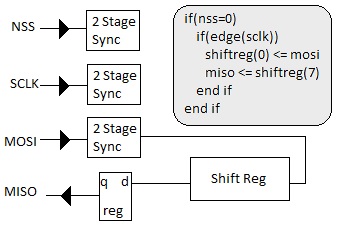
I have designed an spi slave component and am having problems working out the best/correct way of creating timing constraints for the interface. A quick description of my component: The input nss sclk and mosi signals are sunk to an internal clk domain running faster than the max spi clock freq. I am evaluating the nss and sclk edges and shift in data from the mosi signal and shift data back out on the miso signal. (see attached diagram) I am not sure how to constrain this interface to pass timing. As I am syncronising the incoming signals to an internal clock via 2 registers I was thinking I should false path from the input pins to the internal register stage as they are crossing clock domains. At the same time I am concerned that the relationship between sclk and mosi/miso is important and I want the fitter to know to to place the registers in a way that maintains the relationship. I am also unsure how to describe the relationship required for my miso output signal which needs to maintain a setup/hold relationship to sclk. Here is roughly what I am thinking (note these are not correct sdcs): describe the incoming spi signal relationships:
create_clock -name {virtual_sclk} -period $period_sclk
set_input_delay -clock virtual_sclk -max $maxdelays
set_input_delay -clock virtual_sclk -min $mindelays //false path option
set_false_path -from to
// or max delay
set_max_delay -from to $somedelayset_output_delay -clock {virtual_sclk} -max/min $max/mindelays 5 Replies
 Altera_Forum
Hi James,
Why are you not using the sclk to clock your data ? This clock is synchronous with your other signals and you will not have to add the double registers. In this case, your constraint file will be very simple. Jerome- Altera_Forum
Hmm thats a good question. When starting out I thought this method seemed to better fit with the data flow control I have surrounding the slave component. It also required less asynchronous design and less handshaking with the internal clock domain. When nss and sclk are idle I would be using control signals to update buffers etc. rather than clocking them per normal synchronous design. On the upside it would increase the max spi freq the component could support.
I am putting together another slave component with the spi sclk directly controlling the shifting as per your suggestion. But for the sake of argument would the timing constraints I have suggested constrain the original design? James - Altera_Forum
Actually an SPI slave where all the inputs are synchronised with a double register-chain doesn't need to be constrained. The
will do. As the miso is clocked by a higher frequency clock aset_false_path -from -to *
is OK too. The same reasoning applies for the case of an SPI Master (reversing the directions of the false paths)set_false_path _from * -to miso - Altera_Forum--- Quote Start --- I am putting together another slave component with the spi sclk directly controlling the shifting as per your suggestion. But for the sake of argument would the timing constraints I have suggested constrain the original design? James --- Quote End --- IMO the so-called SPI clock isn't a real clock as it isn't continuous. The original author should have called it Strobe.
- Altera_Forum--- Quote Start --- Actually an SPI slave where all the inputs are synchronised with a double register-chain doesn't need to be constrained. --- Quote End --- My concern is that be cutting all the spi paths you cant guarantee the fitter is going to place the registers in a repeatable way. I believe as long as the internal clk is a lot faster than the spi clock like 10x, its not going to be a problem but as the freq increases you might get one fit work and one fit not work. --- Quote Start --- IMO the so-called SPI clock isn't a real clock as it isn't continuous. The original author should have called it Strobe. --- Quote End --- Yes from the FPGAs internal point of view its not a true clock but from the spi data point of view it is a clock. IMO I would prefer the hdl signals to match the standard interface signal names but in the end the naming is negligible.