Forum Discussion

 Contributor
Cyclone V SoC 5CSXC6 Series GXB Utilization and Limitations
 2 months ago
Hi Brian,
Thank you for the update.
Just to clarify, the legacy database I referred to is our internal database for legacy devices. Unfortunately, there is limited information available regarding this wrong data issue. Based on the available info, I believe it was originally initiated from a customer-reported case.
You are also correct that the placement rules are enforced within Quartus. Since these rules are built into the tool, they cannot be overridden through a TCL command.
I apologize for any inconvenience this may cause.
 Regular Contributor
Hi,
Based on my understanding, you have questions regarding GX channel utilization in Cyclone V devices when the PCIe Hard IP is used. Please see the responses below.
Q1: Can all 6 TX/RX GXB channels be used when the PCIe Hard IP is enabled?
Answer: No. In all configurations, the PCIe Hard IP consumes the following resources:
- The PCIe data lanes themselves (x1, x2, or x4 → corresponding number of XCVR channels)
One additional XCVR channel for the CMU PLL, which is required by the PCIe Hard IP to generate the transmit reference clock
As a result, from the total of 6 XCVR channel pairs:
- After PCIe lanes and the CMU PLL are allocated, only 4 GX pairs remain
- If one of these remaining channels is also used for a CMU PLL, then only 3 XCVR pairs are available for user designs
Q2: Does the CMU PLL use CH5, and does that leave one extra channel for the PCIe Hard Core?
Answer: No. The CMU PLL is not fixed to CH5.
In Cyclone V devices:
- Only the channel PLLs in CH1 and CH4 can be reconfigured to operate in CMU PLL mode
Q3: What PCIe + custom GXB combinations are supported on a 6‑channel device?
Answer: The supported combinations depend on PCIe lane width and CMU PLL placement. Please refer to Figures 4‑5 through 4‑8 in the Cyclone V Device Handbook, Volume 2: Transceivers for the valid PCIe and custom GXB channel usage scenarios.
 Contributor
Q2: Does the CMU PLL use CH5, and does that leave one extra channel for the PCIe Hard Core?
Answer: No. The CMU PLL is not fixed to CH5.
In Cyclone V devices:
Only the channel PLLs in CH1 and CH4 can be reconfigured to operate in CMU PLL mode
I made a mistake on the number I do mean CH4 (0-5).
Q2' ) Based on the document: CMU PLL will use CH"""4""" and do this simply means there will be one extra for PCIe Hard-Core?
Based on Q2' it simply occupied 4+1.
Q2b) In order for custom protocol to run, a CMU PLL is required but due to hard PCIe CH1 already used by PCIe hard core while CH4 had forced to generate PLL clock for PCIe hard core.
So even there are 2 GXB remains; there is no way to feed in a custom protocol that is not PCIe speed i.e. PCIe GEN1 is 2.5Gbps?
Q2c) if not wrongly read from handbook; The GXB is split into up and bottom. Hence, the group can either [up + bottom] or individual [up | bottom] but either combine nor mix also require PLL to function?
Q3) If possible can the device simply feed by a Gbps/2 reference clock and then it simply disregard the needs of CMU PLL?
Additional info: I do more reading on the handbook it does clearly mentioned that the device is able to use fPLL to create the required clock rather than CMU PLL.
Based on the above information, I am still not sure the possibilities of using all GXB channel even there could be crossing between bottom and top group.
Thanks,
Brian
- CheepinC_altera4 months ago
Hi,
Regarding your latest question, if you are using PCIe ×2 as shown in Figure 4‑5, the transceiver resources would be allocated as follows by default:
- CH4: CMU PLL
- CH1: Master PCIe channel
- CH0: PCIe channel
With this allocation, there are no remaining CMU PLLs available for the other channels within the same bank.
As a possible workaround, you may consider using fPLL(s) to drive the remaining channels. However, whether this approach is supported and can be successfully placed depends on the specific design constraints and routing availability. In this scenario, two fPLLs would be required (1 for bottom 3 channels and another for top 3 channels).
To determine feasibility, I recommend creating a simple test design and running it through a Quartus Fitter compilation to verify whether the placement and routing can be successfully achieved.
Please let me know if you have any concerns or need further clarification.
Thank you.
- CheepinC_altera4 months ago
Hi Brian,
Thanks for your update, and apologies for any confusion.
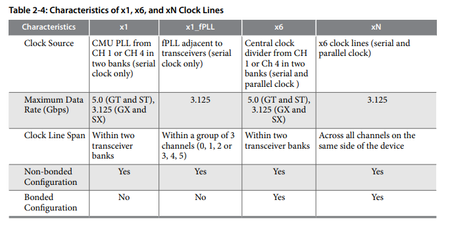
Based on the Cyclone V Device Handbook Volume 2: Transcievers -> Table 2-4: Characteristics of x1, x6, and xN Clock Lines, each fPLL can only drive a group of three channels (0–2 or 3–5). This is due to the fPLL clock line span is within a group of 3 channels (0, 1, 2 or 3, 4, 5).
Since the remaining channels are CH2, CH3, and CH5 (spanning both groups), two fPLLs would be required to cover them.
Please let me know if you have any further questions.
Thank you.
- BrianSune_Froum4 months ago
CheepinC_altera
I will get back to you after testing
CheepinC_alteraQuick fitting test shows:
PCIe X2 GEN 1 (max speed on this device) + Custom x2 protocol < (3.125Gbps)
Can be placed on [Ch0+Ch1(Ch4)] + [Ch3,Ch5]
Total GXB usage 4
So simply speaking
The maximum possible GXB can only be 5 and never 6?
I still don't get it: Why channel 4 cannot be used as TRX when CMU PLL is placed.
Aren't the internal function block supposed to be stand alone?
Meantime, from the above test result:For PCIe x4 the expected Ch5 can be placed by fPLL.
So the best cases are Total of 5 TxR channels?Additional placement view info:
You can see it is completely empty for use but why CMU use case make if unusable?
Meantime the GXB TX use case shows a very distinct placement.
It is very "Counterthinking" on this fitter idea!!!
Thanks,Brian
- BrianSune_Froum4 months ago
A bit hard to understand on:
"However, whether this approach is supported and can be successfully placed depends on the specific design constraints and routing availability. In this scenario, it is likely that two fPLLs would be required (1 for bottom 3 channels and another for top 3 channels), but this cannot be confirmed upfront."
What do you mean constraint so you do mean there is constraint that can force or make it routable?
And what do you mean routing availability?
Two fPLLs is due to what bases and how about the x1 xN configuration?
The device had been years over decade aren't these configuration possibilities are very well documented?Thanks,
Brian


