Forum Discussion

 Contributor
Cyclone IV drop in replacement confirmations
 5 days ago
Hi Brian,
Agree on the long-term point. Bench power-up alone does not prove lifetime stress. The goal is to stay inside the documented connection / reservation rules, not only “it boots today.”
Q: Need more clarification on this: tri-state w/o pull-up or?
A: Yes. On the density where that ball is GPIO:
- In Quartus, reserve that pin specifically as "As inputs that are tri-stated" (no weak pull-up, no bus-hold). In the .pin file that shows up as RESERVED_INPUT.
- On the board, hard-tie it to 2.5 V (same net as VCCA for the density that needs that ball as power). Per AN 592 / unused-pin guidelines: RESERVED_INPUT may be connected to a high or low on the board.
- So, external hard-tie to 2.5 V + FPGA pin = input tri-stated, no pull-up. Not floating tri-state.
The Quartus migration + RESERVED_INPUT (tri-state, no pull-up) + hard-tie to 2.5 V guidance follows Altera’s published migration and unused-pin connection rules. It is the supported way to keep the pinout legal across densities. It is not a guarantee of long-term electrical behavior for a continuous 2.5 V level on a GPIO that sits in a 1.8 V (VCCIO) bank (for example with SSTL-18 / HSTL-18 on that bank). Absolute VI ≤ 3.6 V and a successful board bring-up do not by themselves prove lifetime margin.
 Regular Contributor
Hi Brian,
These two devices should not be treated as drop-in replacements in this board condition. Cyclone IV supports vertical migration within the same package, but the migration devices must have compatible dedicated input pins, configuration pins, and power pins.
You can select migration devices in Quartus and check the Pin Migration view for pins whose functions change. The Fitter uses the selected migration-device list to restrict the design to compatible pins; pins that are power pins on one device should not be treated as usable user I/O across the migration path.
Reference: Device Migration Planning, AN 592: Cyclone IV Design Guidelines.
Maybe just for your information, I saw an old documentation, Quartus® II Handbook mentioning below statement:
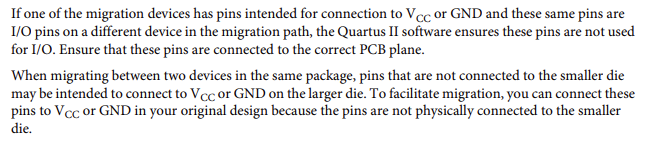
Regards,
Aqid
 Contributor
The table I attached is from the "Pin Migration view".
Yes datasheet Larger die -> smaller die migrate.
Which is understandable from the idea of 1.8V / 1.5V VCCIO minimum requirements so 1.2Vcore/GND is always treaded as input / HI-Z and does not contradicts the voltage requirements.
But the issue we are discussing is VCCA in that table which larger die have more PLL power pins.
So drop-in migration have no clear details on such.
3.6V is maximum input but VCCIO aka 1.8V vs 2.5Vcca fixed power pin require Altera to response the proper drop-in design/treatment.
Thanks,
Brian
- AqidAyman_Altera11 days ago
Hi Brian,
I really apologies for the delay answer. Our suggestion on how to treat this migration are:
1- Hard-tie it to 2.5 V on the board, and do not use it as functional I/O on the other density (reserve as input / unused).
2- On the voltage point: recommended VI goes up to 3.6 V, so 2.5 V is inside that absolute DC range.
Preferred options if the bank must stay 1.8 V: drop that density from the migration set, raise that bank’s VCCIO to 2.5 V if the whole bank allows it, or replan so the remapped power ball is not in an active 1.8 V bank.
Regards,
Aqid- BrianSune_Froum11 days ago
AqidAyman_Altera
TBH: real HW testing is not going to tell it will break but long term consideration on those pin are more likely what we trying to concern and prevent.1- Hard-tie it to 2.5 V on the board, and do not use it as functional I/O on the other density (reserve as input / unused).
Q: Need more clarification on this: tri-state w/o pull-up or ?
Preferred options if the bank must stay 1.8 V: drop that density from the migration set, raise that bank’s VCCIO to 2.5 V if the whole bank allows it, or replan so the remapped power ball is not in an active 1.8 V bank.
I think this is impossible on SSTL or HSTL 1v8 where the output still requires to run from VCCIO supply.So after long period of time someone who's claim the datasheet with wrong table referring is a b.s. and yet the migration table from Quartus is not 100% best option from first place only a suboptimal way to mix from low to high density.
- AqidAyman_Altera5 days ago
Hi Brian,
Agree on the long-term point. Bench power-up alone does not prove lifetime stress. The goal is to stay inside the documented connection / reservation rules, not only “it boots today.”
Q: Need more clarification on this: tri-state w/o pull-up or?
A: Yes. On the density where that ball is GPIO:
- In Quartus, reserve that pin specifically as "As inputs that are tri-stated" (no weak pull-up, no bus-hold). In the .pin file that shows up as RESERVED_INPUT.
- On the board, hard-tie it to 2.5 V (same net as VCCA for the density that needs that ball as power). Per AN 592 / unused-pin guidelines: RESERVED_INPUT may be connected to a high or low on the board.
- So, external hard-tie to 2.5 V + FPGA pin = input tri-stated, no pull-up. Not floating tri-state.
The Quartus migration + RESERVED_INPUT (tri-state, no pull-up) + hard-tie to 2.5 V guidance follows Altera’s published migration and unused-pin connection rules. It is the supported way to keep the pinout legal across densities. It is not a guarantee of long-term electrical behavior for a continuous 2.5 V level on a GPIO that sits in a 1.8 V (VCCIO) bank (for example with SSTL-18 / HSTL-18 on that bank). Absolute VI ≤ 3.6 V and a successful board bring-up do not by themselves prove lifetime margin.


