User Profile

HTolentino
 New Contributor
Joined 2 years ago


User Widgets
Contributions
Re: Test stimulus for FPGA validation
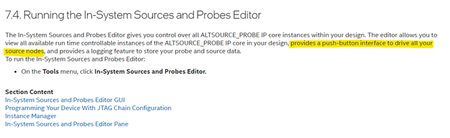
Hello sstrell and ShengN_Intel, Thank you for the reply. My problem with ISSP is that if I want to change the sources, I have to do it manually change it bit by bit. I have 16 bit input that changes every clock cycle which presents a challenging task. I looked at the link ShenN provided and I think I am right to assume that the GUI only allows a direct push button approach. What I am really looking for is a way for Quartus to take in a test stimuli in some sort of file format like a text file. I brought up the In content memory editor because I saw a tutorial about it. https://www.youtube.com/watch?v=YI34AoA74_c At first I brushed it off, but upon looking at it more yesterday I think it actually makes sense. Essentially, the test stimuli can be stored in a ROM, then an up counter (connected to the address of the ROM) calls the data/stimuli stored in the ROM. It kind of reminds of a processor reading an instruction set. So this way, I think we can just write in the MIF file and test it. Please let me know if I misunderstood something. Thank you. -htolentino3.1KViews0likes0CommentsTest stimulus for FPGA validation
Hello, I am trying to do test validation for my project and was wondering how to implement a test stimulus. I want to make clear I am not wanting to functionally verify such as using a testbench for ModelSim - as I have already done this. What I want to see is if the signals actually behave the same way after being implemented in the FPGA My intuition is using SignalTap as it allows us to track signals on an FPGA. However, my only experience with it is seeing push buttons and triggers. Even the ISSP, if I recall correctly, requires manual tuning of the signals bit by bit using force commands - I dont think this is really efficient for large scale. My code is a finite state machine that relies on certain inputs and is synchronous to a clock. Is providing a test stimulus something simple I am missing or does require some script or something? PS - I notice that there is a system memory content editor but I dont know if this is what I really want. Thank youSolved3.3KViews0likes7CommentsRe: SDRAM without HPS
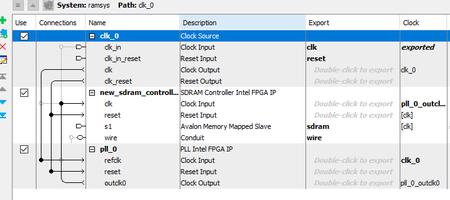
Hello thank you for the reply, just to clarify, the agent you mentioned is the SDRAM controller IP right? In Platform designer I instantiated the SDRAM controller with the PLL. This block design is called RAMSYS. At the moment, RAMSYS has SDRAM wait request as the output port. In my top level design (host), I connected this output to an interconnect which I used to determine if I can proceed with reading or writing. I undestand wait request behaves a certain way based on the inputs of the controller . It also seems it is dependent on some timing based on the figure before. My confusion is that the clock cycle difference from read and write are different. Even though write cycle provided the necessary inputs (data/address/read enable), same as the read cycle, it still deasserts wait request longer than write. If it is indeed based on some sort of timing, can I assume it would be some static timing based if the inputs arrive at the same clock cycle? I realized that my host (state machine code) depends on the wait request while the agent (SDRAM controller) depends on the inputs from the host. I confused myself even further as it looks this looks like a feedback loop. At the end of the day, I really dont know whos really reponsible for wait request. I understand you made a note on this ... " When the host sees waitrequest, logic in the host would know to continue asserting the control signals. waitrequest can be any length needed. It doesn't matter whether it's a read or a write. It's up to whatever is controlling it, the interconnect or the agent. Again, the waveform is illustrative to explain how the signaling works, not how every design must work. " In bold you note that the wait request is controlled by the agent and the one controlling it...isnt the one controlling it the host?. OVerall it seems like I am going backwards as I dont even know which really controls who. I will continue reading on it and I understand if this question is off tangent the original problem. Thank you. -htolentino1.9KViews0likes1CommentRe: SDRAM without HPS
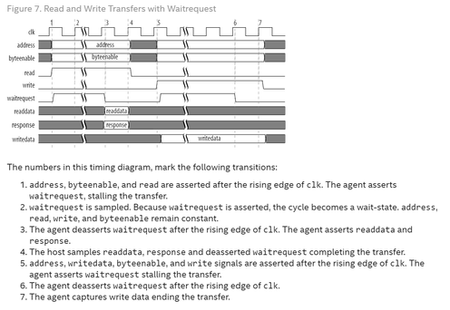
Hello thank you for the link. Ive had the chance to look at this before but was confused about it. I guess now is the best chance to ask about it. Just for reference for the pictures - https://www.intel.com/content/www/us/en/docs/programmable/683091/22-3/typical-read-and-write-transfers.html First, I wanted to ask what the vertical squigly lines. Second, In the context above Who is the host. Who is agent? In this picture it seems my top level custom logic is the M/Master/Host while the SDRAM controller is the S/Slave/Agent However, I think based on the reading and writing example I think the host is the controller while the agent is the actual external SDRAM. Next are some assumpltions. Please correct any assumptions I have: -steps 1 - 4 are READING -5 - 6 are for WRITING. -The order of reading or writing first doesnot matter. ' -The memory have something initially or was written data before which is why it is able to READ first. For READING. Clock cycle 1 : the host sends data/address/read..........the agent asserts wait request Clock cycle 2 : the host receives wait request = 1, thereby latching the data/address/read. Clock cycle 3: the host still latch data/address/read.......the agents deasserts wait request Clock cycle 4: the host receives wait request = 0, thereby finally sampling data/address/read. Overall, wait request = 1 for only 2 clock cycles. On the other hand, wait request for writing is much longer even though it seems the step is the same as the reading. It says on step 6 the wait request deasserts after the rising edge of the clk but the which rising edge it choose seems random. If we look at the reading part, the wait request becomes 0 immediately after the host spends a clock cycle to register it as 1. But in the writing part it takes way longer I apologize if I am making too many assumptions and complicating something that is simple. Please let me know any concerns or comments. I appreciate everyone as usual. -htolentino2KViews0likes0CommentsRe: SDRAM without HPS
Hello. I apologize for the late reply. At the moment @sstrell was right about the sdc and and my lack of pin assignment. I was finally able to see the signals i wanted in signal tap after putting in pre synthesis. Currently I am able to see some sort of correct semblance on the waveform but for some reason it is not quite right. I am certain it is my finite state machine code or something but I am still trying to find the problem functionally. I wanted to see if I can get the waveform right before posting it. I think my next problem is regarding SDRAM wait request. I coded it the address/data to latch when it is high and only change the data/address when it is low as suggested,. On the other hand I cant predict when SDRAM will be high or not. Is this something completely random or is there some kind of timing it follows so we can predict when SDRAM wait request will be low. At the moment, I see this SDRAM wait request as some annoying enable signal. I wonder if this is completely natural in the memory interface. Is it alright if I can work on it a bit longer before following up? I apologize again for the delay. But Thank you for the replies. -htolentino2KViews0likes0CommentsSDRAM without HPS
Hello, I am using a DE1-SOC cyclone v board. I am trying to read and write into/from my 64Mb SDRAM without using the NIOS hps. I understand that this topic has been mentioned at https://community.intel.com/t5/Intel-Quartus-Prime-Software/Sdram/m-p/174628#M43315 However, after going to terasic and downloading DE1_SoC_SDRAM_RTL_Test on the DE1_SOC system CD I found it difficult to understand. First, I mainly code in VHDL so I have a hard time translating the verilog example. Next, there are a lot of attached components which I assume is part of the debugging process. Is there a simple way to confirm reading and writing in SDRAM with a simple wrapper code? I just assume that controller from the platform designer deal with all the nitty gritty and the "conduit" wires deal with the controller interacting with the SDRAM. 1) Is there going to be complex timing I have to consider in order to read and write from SDRAM? 2) How can we verify that it is working, I tried using signal tap but there are so many weird signals; and signals I want such as counters are not in the list. Also ISSP seems kind of too simplistic. The code I have is simple, I have the platform designer component wrapped as "ramsys" and I just have a top level design called SDRAM. In the top level, I simply toggled the Read and write enable by a counter. Likewise, the address follows a counter. Note: I just have a random FF because I was messing with it to see if the signal can appear in signaltap. Is this process correct? Or am I too naive? Thank you ---================================================================== library ieee; use ieee.std_logic_1164.all; use ieee.numeric_std.all; use ieee.std_logic_unsigned.all; --use work.pcg.all; entity sdram is port( CLOCK_50: IN STD_LOGIC; SW: IN STD_LOGIC_VECTOR(9 downto 0); ------------------SDRAM--------------------------- DRAM_ADDR: OUT STD_LOGIC_VECTOR(12 downto 0); DRAM_BA: OUT STD_LOGIC_VECTOR(1 downto 0); DRAM_CAS_N: OUT STD_LOGIC; DRAM_CKE: OUT STD_LOGIC; DRAM_CLK: OUT STD_LOGIC; DRAM_CS_N: OUT STD_LOGIC; DRAM_DQ: INOUT STD_LOGIC_VECTOR(15 downto 0); DRAM_RAS_N: OUT STD_LOGIC; DRAM_WE_N: OUT STD_LOGIC; DRAM_LDQM,DRAM_UDQM: OUT STD_LOGIC ); end sdram; architecture main of sdram is TYPE STAGES IS (ST0,ST1); SIGNAL BUFF_CTRL: STAGES:=ST0; ---------------------------test signals---------------------------- --signal counter : integer range 0 to 1000; --signal test: std_logic:='0'; --signal testdata: std_logic_vector(7 downto 0):="00000000"; --signal Xpos,Ypos: integer range 0 to 799:=0; ---------------------------sync----------------------------- signal BUFF_WAIT: std_logic:='0'; signal VGAFLAG: std_logic_vector(2 downto 0); ------------------vga---------------------------------- SIGNAL CLK100: STD_LOGIC; ------------------sdram-------------------------------- SIGNAL SDRAM_ADDR: STD_LOGIC_VECTOR(24 downto 0):= (others => '0'); SIGNAL SDRAM_ADDR_CTR: STD_LOGIC_VECTOR(24 downto 0) := (others => '0'); SIGNAL SDRAM_BE_N: STD_LOGIC_VECTOR(1 downto 0); SIGNAL SDRAM_CS: STD_LOGIC; SIGNAL SDRAM_RDVAL,SDRAM_WAIT:STD_LOGIC; SIGNAL SDRAM_RE_N,SDRAM_WE_N: STD_LOGIC; attribute syn_keep: boolean; SIGNAL SDRAM_READDATA: STD_LOGIC_VECTOR(15 downto 0); attribute syn_keep of SDRAM_READDATA : signal is true; SIGNAL SDRAM_WRITEDATA: STD_LOGIC_VECTOR(15 downto 0); SIGNAL DRAM_DQM : STD_LOGIC_VECTOR(1 downto 0); component ramsys is port ( clk_clk : in std_logic := 'X'; -- clk reset_reset_n : in std_logic := 'X'; -- reset_n wire_addr : out std_logic_vector(12 downto 0); -- addr wire_ba : out std_logic_vector(1 downto 0); -- ba wire_cas_n : out std_logic; -- cas_n wire_cke : out std_logic; -- cke wire_cs_n : out std_logic; -- cs_n wire_dq : inout std_logic_vector(15 downto 0) := (others => 'X'); -- dq wire_dqm : out std_logic_vector(1 downto 0); -- dqm wire_ras_n : out std_logic; -- ras_n wire_we_n : out std_logic; -- we_n sdram_address : in std_logic_vector(24 downto 0) := (others => 'X'); -- address sdram_byteenable_n : in std_logic_vector(1 downto 0) := (others => 'X'); -- byteenable_n sdram_chipselect : in std_logic := 'X'; -- chipselect sdram_writedata : in std_logic_vector(15 downto 0) := (others => 'X'); -- writedata sdram_read_n : in std_logic := 'X'; -- read_n sdram_write_n : in std_logic := 'X'; -- write_n sdram_readdata : out std_logic_vector(15 downto 0); -- readdata sdram_readdatavalid : out std_logic; -- readdatavalid sdram_waitrequest : out std_logic -- waitrequest ); end component ramsys; component FF_test is port( Clk :in std_logic; Q : out std_logic_vector(15 downto 0); D :in std_logic_vector(15 downto 0) ); end component; signal counter : std_logic_vector(7 downto 0) := (others => '0'); signal counter0 : std_logic_vector(7 downto 0) := (others => '0'); signal s_Q : std_logic_vector(15 downto 0) := (others => '0'); --========================================= begin u0 : ramsys port map ( clk_clk => CLOCK_50, -- clk.clk reset_reset_n =>'1', -- reset.reset_n wire_addr => DRAM_ADDR, -- wire.addr wire_ba => DRAM_BA, -- .ba wire_cas_n => DRAM_CAS_N, -- .cas_n wire_cke => DRAM_CKE, -- .cke wire_cs_n => DRAM_CS_N, -- .cs_n wire_dq => DRAM_DQ, -- .dq wire_dqm => DRAM_DQM, -- .dqm wire_ras_n => DRAM_RAS_N, -- .ras_n wire_we_n => DRAM_WE_N, -- .we_n sdram_address => SDRAM_ADDR, -- sdram.address sdram_byteenable_n => SDRAM_BE_N, -- .byteenable_n sdram_chipselect => SDRAM_CS, -- .chipselect sdram_writedata => SDRAM_WRITEDATA, -- .writedata sdram_read_n => SDRAM_RE_N, -- .read_n sdram_write_n => SDRAM_WE_N, -- .write_n sdram_readdata => SDRAM_READDATA, -- .readdata sdram_readdatavalid => SDRAM_RDVAL, -- .readdatavalid sdram_waitrequest => SDRAM_WAIT -- .waitrequest ); u1 : FF_test port map ( clk => clk100, Q => s_Q, D => SDRAM_READDATA ); DRAM_LDQM<=DRAM_DQM(0); DRAM_UDQM<=DRAM_DQM(1); DRAM_CLK<=CLK100; SDRAM_CS<='1'; SDRAM_BE_N<="00"; process(clk100) begin if rising_edge(clk100) then if(counter0 <= "00000111") then SDRAM_WE_N<='0'; SDRAM_RE_N<='1'; counter0 <= counter0 + '1'; elsif(counter0 > "00000111") then SDRAM_WE_N<='1'; SDRAM_RE_N<='0'; counter0 <= counter0 + '1'; elsif (counter0 > "00001111") then counter0 <= (others => '0'); end if; end if; end process; process(clk100) begin if rising_edge (clk100) then case BUFF_CTRL is when st0=>------------WRITE if (SDRAM_WAIT='0')then if (SDRAM_RE_N ='1' and SDRAM_WE_N = '0') then SDRAM_WRITEDATA(7 downto 0)<= counter; counter <= counter + '1'; SDRAM_ADDR<= SDRAM_ADDR_CTR; SDRAM_ADDR_CTR <= SDRAM_ADDR_CTR + '1'; if SDRAM_ADDR_CTR = "000000000000000000000111" then counter <= (others => '0'); SDRAM_ADDR_CTR <= (others => '0'); end if; end if; end if; when st1=>-----------READ if (SDRAM_RE_N ='0' and SDRAM_WE_N = '1') then IF(SDRAM_WAIT='0')THEN SDRAM_ADDR<= counter; END IF; end if; end case; end if; end process; end main;2.2KViews0likes11Comments