operating system
21 Topics
Inquiry on CVE-2026-98432 Patch Schedule, Custom Backport Support, and PSIRT Vulnerability Policy
Hello Altera Support Team, One of our key customers is currently preparing compliance documentation (including EU Cyber Resilience Act / security audit requirements) and inquired about the status and handling policy for Linux kernel vulnerability CVE-2026-98432 (IPv4 TCP use-after-free, CVSS 9.8). We verified that in the upstream Linux kernel, this vulnerability was resolved in the 6.18.56 stable release by replacing kfree() with kfree_rcu() in inet_sock_destruct() (net/ipv4/af_inet.c) and tcp_v4_reqsk_destructor() (net/ipv4/tcp_ipv4.c). However, on the current `socfpga-6.18.37-lts` branch in `github.com/altera-fpga/linux-socfpga` (used in GSRD 26.3), both functions still use kfree(). To provide an official response to our customer, please confirm the following three items: Patch Plan & Release Schedule for CVE-2026-98432 - Is there a plan to include the fix for CVE-2026-98432 in `linux-socfpga` / GSRD? - If yes, in what form will it be delivered (e.g., rebasing to upstream 6.18.56 or later in the next GSRD release, or a patch update on top of 26.3), and what is the estimated release timeline? Support Scope for Customer-Applied Backport via Yocto Layer - Until an official Altera kernel update is available, our customer plans to backport the upstream 6.18.56 patch onto `socfpga-6.18.37-lts` via their custom Yocto layer. - Does Altera recommend this approach, and will applying this upstream network-stack patch impact Altera's official technical support scope for SoC hardware and Altera IP drivers? Altera Security Vulnerability (PSIRT) Management & Upstream Sync Policy - Where are official security advisories (PSIRT) for GSRD and `linux-socfpga` published? (Is it managed exclusively via the Altera Product Security Advisories portal, or is there a separate mailing list/feed for `linux-socfpga`?) - What is Altera's standard cadence and SLA/lead time for integrating upstream Linux LTS security patches into `linux-socfpga` and GSRD releases? (Our customer requires this policy description as official evidence for their vulnerability management framework.) Thank you in advance for your prompt review and confirmation. Best regards, Hudson32Views0likes2Comments
MSGDMA ST-to-MM: Linux Driver Necessity & F2SDRAM Path Feasibility
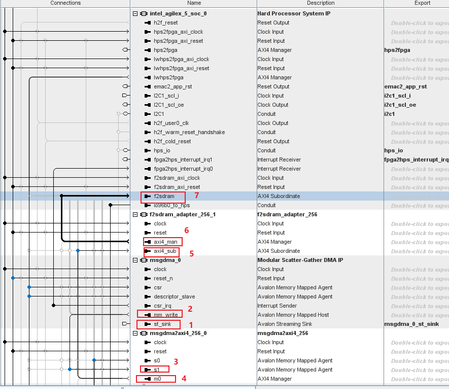
Hello everyone, I am currently working on an MSGDMA implementation. I have verified that I can read the MSGDMA CSR and Descriptor registers via the LWH2F bridge using devmem2. My setup is configured in Streaming-to-Memory-Mapped (ST-to-MM) mode. I have two specific questions regarding this setup: 1、Is configuring the MSGDMA Linux kernel driver a mandatory condition for the hardware to function correctly? Is it possible to bypass the driver and configure the MSGDMA to start data transfer directly using devmem2 (user-space access)? 2、I noticed that some implementations write to the PS-side memory via the FPGA-to-HPS bridge. However, my design utilizes the F2SDRAM link, as indicated by the numbered sequence in the attached diagram. Could you please confirm if this architectural approach is feasible?Solved302Views0likes3Comments
Agilex 5/3 FreeRTOS SDK Release
Stable Version: v26.1.1 Quartus Version: 26.1.1 Supported devices: Agilex™ 3 and Agilex™ 5 Source: https://github.com/Ignitarium-Technology/freertos-socfpga Branch/Tag: v26.1.1 Release Date: October 9, 2026 Hello Everyone, A new version of the FreeRTOS SDK for Agilex 5/3 is now available. This release contains some fixes, along with UHS-1(SDR12/25/50) support for SD/eMMC. Visit the GitHub repository for instructions on how to get started. Features and Comments Feature Agilex3 Agilex5 Agilex3 SMP Agilex5 SMP Supported Features Limitations / Known Issues A55 boot Yes Yes Yes Yes Single-core boot, Dual-core SMP, Quad-core SMP (Agilex 5) A76 boot NA Yes NA Yes Single-core boot, Dual-core SMP, Quad-core SMP QSPI boot Yes Yes Yes Yes eMMC boot NT Yes NT Yes SD boot NT Yes NT Yes NAND boot No No No No Clock Manager Yes Yes Yes Yes API to get clock speed of different blocks Reset Manager Yes Yes Yes Yes Peripheral reset assert/de-assert DMA driver Yes Yes Yes Yes Memory-to-Memory, Memory-to-Peripheral and Peripheral-to-Memory GPIO driver Yes Yes Yes Yes Write, read and interrupt support Timer driver Yes Yes Yes Yes User-defined and free-running modes UART driver Yes Yes Yes Yes Full-duplex TX and RX I2C driver NT Yes NT Yes Master/Slave mode, standard and fast modes QSPI driver Yes Yes Yes Yes QSPI flash read/write/erase I3C driver NT Yes NT Yes Master mode, I3C and legacy I2C devices SPI driver NT Yes NT Yes Master/Slave mode write and read NAND driver No No No No SDM Mailbox driver Yes Yes Yes Yes SDM commands with SIP_SVC SMMU support Yes Yes Yes Yes Static identity mapping for cache coherency SDMMC driver Yes Yes Yes Yes Standard and HS HS, and UHS-I (SDR12/25/50) speeds, SDMMC and eMMC devices, FATFS support Ethernet stack Yes Yes Yes Yes TCP/IP, UDP, ICMP, DHCP, IPv4 and IPv6 USB 2.0 stack NT Yes NT Yes USB mass storage class Tested with a custom board and SOF USB 3.1 stack Yes Yes Yes Yes USB mass storage operation WDT driver Yes Yes Yes Yes Interrupt or reset on timer expiry EDAC support Yes Yes Yes Yes Error injection and detection for EMAC, USB and QSPI blocks OCRAM not supported IOSSM driver Yes Yes Yes Yes Error injection and detection Bridge driver Yes Yes Yes Yes Enable/Disable bridges Reboot Manager Yes Yes Yes Yes Warm/Cold reboot FPGA Manager Yes Yes Yes Yes FPGA configuration Legend: Yes: Feature available and tested No: Feature not available in SDK NA: Not applicable NT: Not tested Note: If you find any issues, please raise an issue on the GitHub repository.103Views2likes1CommentIntroducing the Altera Community AI Responder — Beta
Altera is introducing the AI Responder, an assistant built into the Altera Community to help provide faster, context-aware guidance for Altera product questions. It uses relevant public Altera documentation and Knowledge Database content, with coverage continuing to expand. The AI Responder may provide source references and can hand off complex or out-of-scope questions to an Altera subject-matter expert. As a beta feature, responses may contain errors or omissions, so please review the sources and verify technical guidance against official Altera documentation before implementation. If the response does not fully address your question, add more context and tag ai_responder to continue the discussion. We welcome your feedback as we improve the Community experience.52Views0likes0CommentsAgilex 5/3 FreeRTOS SMP Support
Stable Version: v25.4 Quartus Version: 25.4 Supported devices: Agilex™ 3 and Agilex™ 5 Source : https://github.com/Ignitarium-Technology/freertos-socfpga Branch/Tag: v25.4-SMP Release Date: March 30, 2026 Hello Everyone, FreeRTOS port for A55/A76 HPS now supports SMP. visit the GitHub page for instructions on how to get started. Features and comments Features Agilex3 Agilex5 Agilex3 SMP Agilex5 SMP (A55 x 2 or A76 x 2) Supported features Limitations/ Known issues A55 boot Yes Yes Yes Yes Single core boot, Dual core SMP A76 boot NA Yes NA Yes Single core boot, Dual core SMP QSPI boot Yes Yes Yes Yes SD boot Yes Yes Yes Yes eMMC boot Yes Yes Yes Yes NAND boot No No No No Clk mngr driver Yes Yes Yes Yes API to get clock speed of different blocks Reset mngr driver Yes Yes Yes Yes Peripheral reset assert/de-assert DMA driver Yes Yes Yes Yes Memory to memory transfer Only support memory to memory GPIO driver Yes Yes Yes Yes Write, read and interrupt support Timer driver Yes Yes Yes Yes User defined and free running modes UART driver Yes Yes Yes Yes Full duplex Tx and Rx DMA not supported (Planned for future release I2C driver Yes Yes Yes Yes Master mode write and read Standard and fast modes DMA not supported (Planned for future release I3C driver Yes Yes Yes Yes Master mode write and read i3c and legacy i2c devices IBI not supported (Planned for future release) SPI driver Yes Yes Yes Yes Master mode write and read DMA is not supported QSPI driver Yes Yes Yes Yes QSPI flash read/write/erase NAND driver No No No No SDM mailbox driver Yes Yes Yes Yes SDM commands with SIP_SVC SMMU enable support Yes Yes Yes Yes Static identity mapping for cache coherency SDMMC driver Yes Yes Yes Yes standard and HS speeds SDMMC and eMMC devices Fat FS support Ethernet stack Yes Yes Yes Yes TCP/IP, UDP, ICMP and DHCP IPv4 and IPv6 support USB 2.0 stack NT Yes NT Yes USB mass storage class Tested with a custom board and SOF USB 3.1 stack NT Yes NT Yes USB mass storage operation WDT diver Yes Yes Yes Yes interrupt or reset on timer expiry EDAC support Yes Yes Yes Yes Error injection and detection for EMAC, USB and QSPI blocks OCRAM not supported IOSSM driver Yes Yes Yes Yes Error injection and detection Bridge driver NT Yes NT Yes Enable, Disable Reboot mngr Yes Yes Yes Yes Warm/Cold reboot FPGA manager Yes Yes Yes Yes FPGA configuration Yes: Feature available and tested, No: Feature not available in SDK, NA : Not applicable , NT: Not tested Note: If you find any issues, please raise an issue in the GitHub page. For more support/assistance visit our website .490Views3likes11CommentsUSB Device Issue on Cyclone V / HPS
Hello, Please find below a description of the USB issue we are experiencing with our Cyclone V / HPS board. To test our USB interface, we integrated the TinyUSB library into our existing firmware and enabled FreeRTOS support. Since the Cyclone V is not natively supported, I implemented the missing functions using Altera's hwlib, which we already use in our project (source file attached). The USB is used only in Device mode. I tested the following four configurations: Full-Speed with Slave mode Full-Speed with Simple DMA High-Speed with Slave mode High-Speed with Simple DMA The behavior is identical in all four cases: Connecting our board to a Windows or Linux host is correctly detected. The SETUP transaction is successfully received, and the host receives the device descriptor in response. When the IN transfer complete interrupt is triggered, the USB controller is configured to receive a zero-length packet on OUT0. However, the USB protocol analyzer shows that the device continuously responds with NAK to this packet. The host retries for approximately 5 seconds, but the device keeps responding with NAK. The register values immediately after configuring the reception of the OUT0 packet are: Gotgctl = 0xd00c0 Gintsts = 0x4000020 (PTxFEmp, NPTxFEmp) Gdfifocfg = 0x1f802000 Dctl = 0 Dcfg = 0x8100001 Dsts = 0x18702 Doepctl0 = 0x80008000 Doepint0 = 0 Doeptsiz0 = 0x80000 Grxfsiz = 0x50 After a few milliseconds, I observe that DOEPINT0.NAKINTRPT = 1, which seems to confirm that the device is sending NAKs. However, I do not understand why the OUT packet is not being accepted, since the receive FIFO is not full and both DCTL.GOUTNAKSTS = 0 and DOEPCTL0.NAKSTS = 0.Solved442Views0likes17Comments
Agilex 5E HPS and Linux
Hi. 1. Is there a simple method to run two Linux systems on HPS, i.e.: Linux 1 - 2xA55 and Linux 2 - 2xA76 with different sets of peripherals? 2. Is it possible to use one Ethernet port by these two Linux systems. 3. Is there a simple method for communication between these two Linux systems?612Views0likes8Comments2.5G Ethernet Reference Porting inquiries.
Hi, guys~ My customer wants to use the 2.5G Ethernet feature, but unfortunately, they purchased the Agilex5 Premium Kit instead of the Modular Kit. I am currently following the R&D guide with them, but the 88E2110 is not being recognized properly. Which parts should we check? First, I followed below link. And have built the Reference Design boot images. https://altera-fpga.github.io/rel-26.1/embedded-designs/agilex-5/e-series/modular-065b/tsn/sgmii_xcvr_3x2.5G/ug-tsn-sgmii-xcvr-3x2.5G-agilex5/ Second, I regenerated the hardware image after updating the Modular design pinout to match the Premium Kit specs. In the Premium schematic, the 88E2110 PHY reset pin is connected to the FPGA, but there was no control logic applied. So, I added logic to release the reset after 20 ms. Third, in the device tree, I enabled emac0 and disabled emac1 and emac2. Since the soft MDIO logic remains unchanged, the addresses shouldn't have changed. However, while the emac0 logs appear, the PHY is still not being recognized. Please refer to the attached boot log. Why did they use soft MDIO instead of the native EMAC0 MDIO? Is this a characteristic of 2.5G Ethernet?Solved261Views0likes5Comments
Stratix 10 HPS LED example
Can someone suggest a basic HPS project with PIO for LED control. Need the complete flow of building the project from scratch. How to assign the HPS pins in Quartus. How to add uboot along with fpga pof file in QSPI flash. How to load linux in emmc.Solved709Views0likes19Comments
Arria 10 HPS - DMA EMAC reset issue
Hello, We are bring-up the custom Arria 10 board, we have some issue with HPS GMAC in U-Boot. Arria 10 connect to SFP (1 G Ethernet) , our interface is : HPS EMAC0 → FPGA GMII-to-SGMII Converter → SFP (SGMII PHY) We are working without MDC/MDIO , in fixed mode. During our testing we performed ping and after this we read register 0xFF801000 and we received value 0x00020101( Last bit DMA_BUS_MODE.SWR = 1 instead of the 0). We checked : The input clock of 125 MHz by oscilloscope - looks ok. Reset Manager: 0xFFD05024 = 0xFF7FBEBE (EMAC0 is released from reset). Bridge is working. GMII-to-SGMII registers are accessible Device tree addresses were verified agaonst the .sopcinfo file Looking forward to your response, thanks in advance.Solved147Views0likes5Comments