general
26 Topics
HyperRAM Hyperbus options for Agilex
In migrating a Xilinx design : We are looking to use a A5E A 007 B23B device with a NIOS-V or other RISCV soft core. Because we need to use the HSIO pins for ~ 20 pairs of LVDS, and the entireHSIO bank (96 wide) having to be at 1.3V to support LVDS mean that we cannot use the internal LPDDR4 memory controller. Please confirm my understanding - that although the 96 wide I/O bank can be split into two functional sub banks (2A, 2B etc) (to support say, LPDDR4(16 bit), and something else , that we CANNOT split the VCCIO-BANK between the two sub banks ? (to have 1.1V for LPDDR4 and 1.3V for LVDS) The projects do not need much memory- a 64 Mbit HyperRAM device hanging from 1.8V HVIO would do the job (perhaps max clock 125 MHz on HVIO ?) What instantiable cores do ALtera have in the war chest for HyperRAM? There is a 3rd party Hyperbus controller IP but we wont want to spend $10,000 on it, as moving from a cheaper Xilinx device to a less competitive Altera device is already a big job and we do not think it deserves having that much more money spent on it. (Efinix have a free Hyperbus core, Xilinx have a free Hyperbus core....) Regards Glen.Solved126Views0likes4Comments
Introducing the Altera Community AI Responder — Beta
Altera is introducing the AI Responder, an assistant built into the Altera Community to help provide faster, context-aware guidance for Altera product questions. It uses relevant public Altera documentation and Knowledge Database content, with coverage continuing to expand. The AI Responder may provide source references and can hand off complex or out-of-scope questions to an Altera subject-matter expert. As a beta feature, responses may contain errors or omissions, so please review the sources and verify technical guidance against official Altera documentation before implementation. If the response does not fully address your question, add more context and tag ai_responder to continue the discussion. We welcome your feedback as we improve the Community experience.18Views0likes0Comments
NIOS SDK SBOM/FOSS info
Hi, Regarding CRA, more and more customers are approaching us with inquiries about FOSS (Free/Libre Open Source Software). Do we have FOSS information or a SBOM (Software Bill of Materials) for the NIOS SDK that we can share with customers? Br, Korbinian525Views0likes6Comments
Ashling RISC Free IDE fails to download ELF file
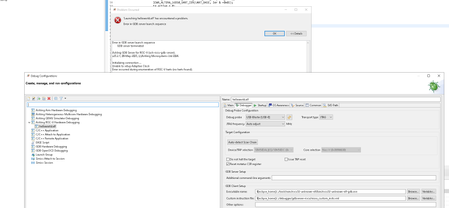
Hello ALTERA NIOSV Experts, I have been trying to execute an application using a NIOSV CPU with the Ashling RISC Free IDE. The problem is that when trying to download the elf file to a MAX10 ALTERA Development board i see an error message saying that the AShling IDE cannot determine the JTAG clock speed. I have added a Screen shot showing this event. Can anyone please suggest a solution to try ? I am currently using an ALTERA USB Blaster to connect but i have just ordered a USB Blaster II as i believe that can connect at faster clock speeds and is also more reliable. Thanks for any help,763Views0likes14Commentsgdb server problem when debugging
Hello, I'm running Quartus12.0sp2 on a windows 11 computer and I want to use the nios 2 eclipse tools to build, run and debug. Building and running works, but I encounter a problem with debugging via usb blaster. I get the error message 'Error starting gdbserver - see console for details'. If I start nios2-gdb-server.exe manually, I get the error message that two .dll files are missing: 'jtag_client.dll' and 'cygwin1.dll'. Both are present in some subfolders of c:/altera/12.0sp2. This behaviour does not change when I start eclipse or gdbserver from the NiosII command shell. Funnily, there is also a file 'nios2-gdb-server-fs2.exe' in the installation path, which seems to run. I tried tricking, by renaming this file into 'nios2-gdb-server.exe'. If I do so, the error message disappears, but the debugging process stops when trying to download the .elf file, at the step 'Launching: Stop processor if running'. I found an old discussion about a similar problem in the forum: Win7-Problem with NIOS-II debugger, can't start gdbserver | Altera Community - 224719 but there's also no clear solution for me. Has anyone else encountered a similar problem? Or can anyone explain what's the difference between 'nios2-gdb-server.exe' and 'nios2-gdb-server-fs2.exe'? Or does know where I have to change a Path such that gdb-server can find the .dll files? I'm quite lost and would appreciate any help. Thanks, Timo141Views0likes2Comments
LPDDR4 not available in NIOSV/g linker script - Agilex-5, Quartus 26.1 Pro
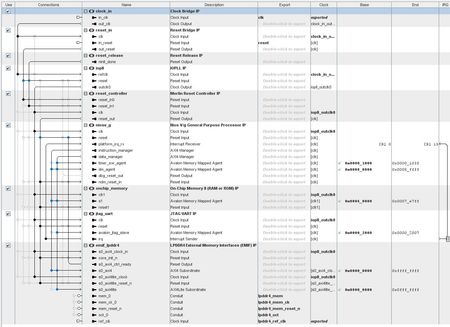
Hello, I have a simple design for Agilex 5, using NIOS V/g and EMIF IP with LPDDR4 memory. I have the NIOS V instruction and data manager ports connected to the EMIF IP. Design compiles Ok. But when I create a BSP, in the linker section, there is not a memory device for the LPDDR4. In this thread, a similar problem seems to be mentioned - issue-with-bsp-creation-for-nios-vm-using-lpddr4-on-agilex-5-quartus-24-1--24-3 Does it mean that Address Span Extender IP must be used in order to have the LPDDR4 show in the linker script section, as an available memory device?Solved366Views0likes7CommentsWhere is FreeRTOS-Plus-TCP Design
Hello, Can someone show or share me the link or design data regarding "FreeRTOS-Plus-TCP" mentioned in Nios V Processor SW Dev. HB? https://docs.altera.com/r/docs/743810/25.3.1/nios-v-processor-software-developer-handbook/enabling-freertos-plus-tc Thank you.Solved298Views0likes7Comments
NIOS V: Systick based timeouts not available when using internal timer
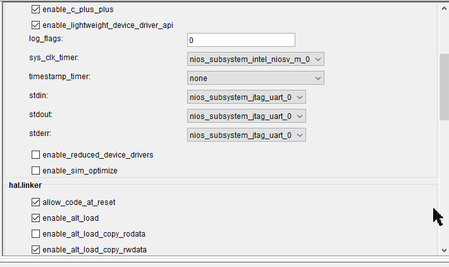
Hello, We are using Quartus 25.1 Standard. I came across something, which I would consider a but in the BSP generated HAL files, or at least a major limitation in the usage of NIOS V. System Setup: NIOS V + JTAG UART NIOS V in internal Timer as Sys_clk_timer BSP Setting: Problems: The JTAG UART drivers have a timeout functionality based on the systick interrupt to avoid getting stuck, in case there is not JTAG UART connected, so the internal buffer fills up. --> see altera_avalon_jtag_uart_timeout() This used to work fine with: NIOS II Setup (using external Timer) NIOS V Setup with external Timer block as sys_clk_timer But when using the NIOS V internal as sys_clk_timer the JTAG UART timeout does not trigger and when calling alt_printf it gets stuck in altera_avalon_jtag_uart_write /* * No OS present: Always wait for data to be removed from buffer. Once * the interrupt routine has removed some data then we will be able to * insert some more. */ while (out == sp->tx_out && sp->host_inactive < sp->timeout) Analysis When I check the initialization routine of the JTAG UART altera_avalon_jtag_uart_init by stepping through with the debugger, I realize, the alarm is not setup: /* * No OS present: Always wait for data to be removed from buffer. Once * the interrupt routine has removed some data then we will be able to * insert some more. */ while (out == sp->tx_out && sp->host_inactive < sp->timeout) This is because the alt_ticks_per_second() returns 0 During the main() function alt_ticks_per_second() is correctly set to 10 (which is my setting from the BSP) The root cause, is the initialization order in alt_sys_init() within the generated alt_sys_init.c file: void alt_sys_init( void ) { ALTERA_AVALON_TIMER_INIT ( NIOS_SUBSYSTEM_TIMER_0, nios_subsystem_timer_0); ALTERA_AVALON_JTAG_UART_INIT ( NIOS_SUBSYSTEM_JTAG_UART_0, nios_subsystem_jtag_uart_0); ALTERA_AVALON_SPI_INIT ( NSC3_SUBSYSTEM_0_ADC_SPI, nsc3_subsystem_0_adc_spi); ALTERA_AVALON_SYSID_QSYS_INIT ( NIOS_SUBSYSTEM_SYSID_NIOS, nios_subsystem_sysid_nios); ALTERA_AVALON_UART_INIT ( NIOS_SUBSYSTEM_UART_IP, nios_subsystem_uart_ip); INTEL_NIOSV_M_INIT ( NIOS_SUBSYSTEM_INTEL_NIOSV_M_0, nios_subsystem_intel_niosv_m_0); } _alt_tick_rate is initalized to 0 per default and gets set duing alt_sysclk_init(), called from the INTEL_NIOSV_M_INIT Macro As seen above. The INTEL_NIOSV_M_INIT Macro is called last within alt_sys_init. Hence all other modules do see _alt_tick_rate = 0. Hence assume there is no sys tick timer present. Hence all sys tick based alarms are disabled. NOTE: The ALTERA_AVALON_TIMER_INIT Macro is called first. Which appears to be correct IMHO, so the Timer module works as sys tick timer @ Altera: Please advise on this issue. Is there any possibility to change the alt_sys_init initialization order? best regards FabianSolved166Views0likes4CommentsAhsling RiscFree IDE 25.1.1: Unresolved inclusion
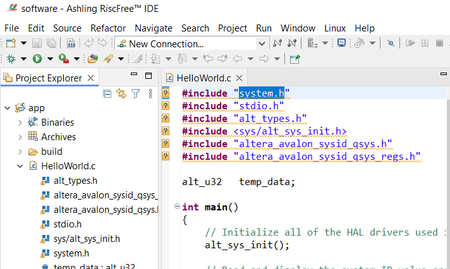
Hello, I'm making Nios V test project for Agilex 5 (Arrow AXE5000 Devkit), following instructions in AN 985 Nios V Processor Tutorial. It works basically, I can download and run Nios application on the target. Source window is marking all include files as "unresolved" although the project compiles fine. I can manually add links to all missing includes (most from /bsp/inc folders, some from riscfree/toolchain/riscv32-unknown-elf) to the app tree to resolve the issue. But apparently there's something wrong with the import Cmake project flow. Am I missing a step in the instructions? Regards FrankSolved387Views0likes5CommentsUnable to transmit out of 16550 Compatible UART
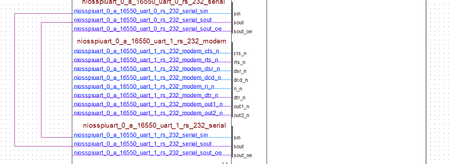
Hi I am following the example of the 16550 Compatible UART in the Embedded peripherals IP User Guide and using the provided code I am not seeing any data in the loopback configuration. Software is Quartus Prime Lite 18.1 Any idea or suggestions is greatly appreciated. I'm not sure if I need to configure any registers?122Views0likes5Comments