No valid license for Nios processor
I tried to compile example designs on Altera’s websit. If the design includes a Nios processor, I’d get the following error. Do I need to request a separate license patch for Nios processor? Error(23714): Can not generate programming files for your current project because you do not have a valid license. Visit the Intel FPGA Self-Service Licensing Center at https://licensing.intel.com Warning(115005): Unlicensed IP: "Nios V/g General Purpose Processor Intel FPGA IP (6AF7 018C)" Warning(115004): Unlicensed encrypted design file: "/home/alin84/quartus_example/top_restored/hw_g/qdb/_compiler/top/auto_fab_0/23.4.0/final/1/netlist.model" Warning(115004): Unlicensed encrypted design file: "/home/alin84/quartus_example/top_restored/hw_g/qdb/_compiler/top/auto_fab_0/23.4.0/final/1/names.model" Warning(115004): Unlicensed encrypted design file: "/home/alin84/quartus_example/top_restored/hw_g/qdb/_compiler/top/root_partition/23.4.0/final/1/netlist.model" Warning(115004): Unlicensed encrypted design file: "/home/alin84/quartus_example/top_restored/hw_g/qdb/_compiler/top/root_partition/23.4.0/final/1/names.model"5Views0likes1Comment
Nios-V on Cyclone IV
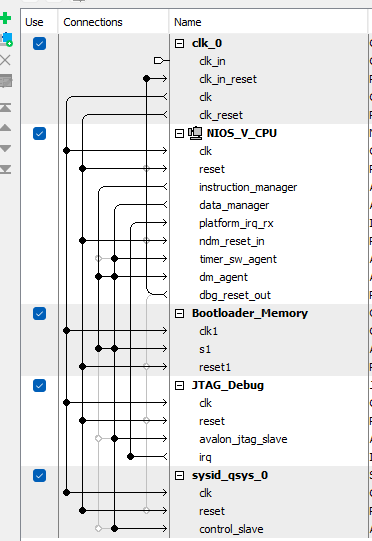
Hi all Trying to get a NÌOS-V running on Cyclone IV using, just the basics. Using Quartus 25.1. Just as a test I added just the neccessary components and the sysid as shows in the picture below. Quartus project was compiled without any errors. Moving on to the application, created a bsp with the sopcinfo file created by Quartus using the command : niosv-bsp --create --sopcinfo=iwis_top.sopcinfo --type=hal software/bsp/settings.bsp Then created the application using the command : niosv-app --bsp-dir=software/bsp --app-dir=software/app --srcs=software/app The application compiles with "empty" main file, but if I try to add system.h and altera_avalon_sysid_qsys to use alt_avalon_sysid_qsys_test() it failes with error "Unknown reference to alt_avalon_sysid_qsys_test". Should not this work right right out of the box ?27Views0likes2Comments
Correct way to use mSGDMA with a NIOSV/m processor on a MAX10 FPGA
Greetings all ALTERA Experts, Can somebody please provide some guidance (e.g. links to example designs and App notes etc.) showing how to implement an mSGDMA based system using a NIOSV/m processor on a MAX10 FPGA? The first problem is where to find the best and most up to date Documentation and any example designs actually using the mSGDMA. With clear descriptions of how the data and control flow works, hopefully describing how descriptors are created and then used by the mSGDMA IP cores. Another area of concern is how to wire up mSGDMA IP cores correctly in a Qsys platform (to both data and descriptor memory etc.), and with both the prefetcher and burst mode enabled. I want to use one mSGDMA with an AVALON MM -> AVALON ST flow and a second for AVALON ST -> AVALON MM Flow. Then the next area of concern is how to write a HAL based driver with the NIOSV/m processor to interact with mSGDMA IOP cores. Thanks for any help, Dr Barry H109Views0likes14CommentsUnable to load Ashling Riscfree NiosV libraries
Hello, I have been trying to make Ashling Riscfree for NiosV debugging work on our Linux system with Quartus v23.1; I have installed RIscFree together with Quartus from the all-in-one data package. Whenever I start RiscFree, Eclipse loads but I see none of the actual plugins for NiosV. This is the .log I see in my workspace: !SESSION 2026-02-13 14:16:09.472 ----------------------------------------------- eclipse.buildId=unknown java.version=20.0.1 java.vendor=Eclipse Adoptium BootLoader constants: OS=linux, ARCH=x86_64, WS=gtk, NL=en_US Command-line arguments: -os linux -ws gtk -arch x86_64 -clean -data /home/laboratorio/workspace_niosv !ENTRY org.eclipse.cdt.core 4 0 2026-02-13 14:22:56.805 !MESSAGE FrameworkEvent ERROR !STACK 0 org.osgi.framework.BundleException: Exception in org.eclipse.cdt.core.CCorePlugin.stop() of bundle org.eclipse.cdt.core. at org.eclipse.osgi.internal.framework.BundleContextImpl.stop(BundleContextImpl.java:895) at org.eclipse.osgi.internal.framework.EquinoxBundle.stopWorker0(EquinoxBundle.java:1046) at org.eclipse.osgi.internal.framework.EquinoxBundle$EquinoxModule.stopWorker(EquinoxBundle.java:376) at org.eclipse.osgi.container.Module.doStop(Module.java:660) at org.eclipse.osgi.container.Module.stop(Module.java:521) at org.eclipse.osgi.container.ModuleContainer$ContainerStartLevel.decStartLevel(ModuleContainer.java:1893) at org.eclipse.osgi.container.ModuleContainer$ContainerStartLevel.doContainerStartLevel(ModuleContainer.java:1768) at org.eclipse.osgi.container.SystemModule.stopWorker(SystemModule.java:275) at org.eclipse.osgi.internal.framework.EquinoxBundle$SystemBundle$EquinoxSystemModule.stopWorker(EquinoxBundle.java:208) at org.eclipse.osgi.container.Module.doStop(Module.java:660) at org.eclipse.osgi.container.Module.stop(Module.java:521) at org.eclipse.osgi.container.SystemModule.stop(SystemModule.java:207) at org.eclipse.osgi.internal.framework.EquinoxBundle$SystemBundle$EquinoxSystemModule$1.run(EquinoxBundle.java:226) at java.base/java.lang.Thread.run(Thread.java:1623) Caused by: java.lang.NullPointerException: Cannot invoke "org.eclipse.core.runtime.content.IContentTypeManager.removeContentTypeChangeListener(org.eclipse.core.runtime.content.IContentTypeManager$IContentTypeChangeListener)" because the return value of "org.eclipse.core.runtime.Platform.getContentTypeManager()" is null at org.eclipse.cdt.internal.core.model.CModelManager.shutdown(CModelManager.java:1378) at org.eclipse.cdt.core.model.CoreModel.shutdown(CoreModel.java:1156) at org.eclipse.cdt.core.CCorePlugin.stop(CCorePlugin.java:375) at org.eclipse.osgi.internal.framework.BundleContextImpl$3.run(BundleContextImpl.java:875) at org.eclipse.osgi.internal.framework.BundleContextImpl$3.run(BundleContextImpl.java:1) at java.base/java.security.AccessController.doPrivileged(AccessController.java:571) at org.eclipse.osgi.internal.framework.BundleContextImpl.stop(BundleContextImpl.java:867) ... 13 more Root exception: java.lang.NullPointerException: Cannot invoke "org.eclipse.core.runtime.content.IContentTypeManager.removeContentTypeChangeListener(org.eclipse.core.runtime.content.IContentTypeManager$IContentTypeChangeListener)" because the return value of "org.eclipse.core.runtime.Platform.getContentTypeManager()" is null at org.eclipse.cdt.internal.core.model.CModelManager.shutdown(CModelManager.java:1378) at org.eclipse.cdt.core.model.CoreModel.shutdown(CoreModel.java:1156) at org.eclipse.cdt.core.CCorePlugin.stop(CCorePlugin.java:375) at org.eclipse.osgi.internal.framework.BundleContextImpl$3.run(BundleContextImpl.java:875) at org.eclipse.osgi.internal.framework.BundleContextImpl$3.run(BundleContextImpl.java:1) at java.base/java.security.AccessController.doPrivileged(AccessController.java:571) at org.eclipse.osgi.internal.framework.BundleContextImpl.stop(BundleContextImpl.java:867) at org.eclipse.osgi.internal.framework.EquinoxBundle.stopWorker0(EquinoxBundle.java:1046) at org.eclipse.osgi.internal.framework.EquinoxBundle$EquinoxModule.stopWorker(EquinoxBundle.java:376) at org.eclipse.osgi.container.Module.doStop(Module.java:660) at org.eclipse.osgi.container.Module.stop(Module.java:521) at org.eclipse.osgi.container.ModuleContainer$ContainerStartLevel.decStartLevel(ModuleContainer.java:1893) at org.eclipse.osgi.container.ModuleContainer$ContainerStartLevel.doContainerStartLevel(ModuleContainer.java:1768) at org.eclipse.osgi.container.SystemModule.stopWorker(SystemModule.java:275) at org.eclipse.osgi.internal.framework.EquinoxBundle$SystemBundle$EquinoxSystemModule.stopWorker(EquinoxBundle.java:208) at org.eclipse.osgi.container.Module.doStop(Module.java:660) at org.eclipse.osgi.container.Module.stop(Module.java:521) at org.eclipse.osgi.container.SystemModule.stop(SystemModule.java:207) at org.eclipse.osgi.internal.framework.EquinoxBundle$SystemBundle$EquinoxSystemModule$1.run(EquinoxBundle.java:226) at java.base/java.lang.Thread.run(Thread.java:1623) I have tried making a "clean" run of RiscFree, by using the following custom .sh: #!/bin/bash # --- Definizione Percorsi --- # Usiamo il percorso che hai indicato tu nei messaggi precedenti export QUARTUS_INSTALL_DIR=/opt/intelFPGA_pro/Quartus23.1 export QUARTUS_ROOTDIR=$QUARTUS_INSTALL_DIR/quartus export NIOSV_HOME=$QUARTUS_INSTALL_DIR/niosv # --- Configurazione Ambiente --- # Aggiungiamo i binari di Quartus e Nios V al PATH export PATH=$QUARTUS_ROOTDIR/bin:$NIOSV_HOME/bin:$PATH # Variabili fondamentali per i plugin Ashling export RISCV_JET_PATH=$NIOSV_HOME/bin # --- Risoluzione problemi grafici MobaXterm/X11 --- export NO_AT_BRIDGE=1 # Se l'interfaccia dovesse apparire vuota o nera, prova a cambiare 0 con 1 qui sotto export SWT_GTK3=0 # --- Avvio IDE --- echo "Inizializzazione ambiente Nios V e avvio RiscFree..." cd $QUARTUS_INSTALL_DIR/riscfree/RiscFree/ ./RiscFree -clean -data ~/workspace_niosv & But this has changed absolutely nothing. It is impossible to see NIOS V or Ashling RiscFree integration in the RiscFree environment. What could be the issue? I will now add a few infos about our system. uname -r : 5.15.0-139-generic cat /etc/os-release: NAME="Ubuntu" VERSION="20.04.6 LTS (Focal Fossa)" ID=ubuntu ID_LIKE=debian PRETTY_NAME="Ubuntu 20.04.6 LTS" VERSION_ID="20.04" HOME_URL="https://www.ubuntu.com/" SUPPORT_URL="https://help.ubuntu.com/" BUG_REPORT_URL="https://bugs.launchpad.net/ubuntu/" PRIVACY_POLICY_URL="https://www.ubuntu.com/legal/terms-and-policies/privacy-policy" VERSION_CODENAME=focal UBUNTU_CODENAME=focal I am worried JAVA might be causing issues but I have not been able to solve them.69Views0likes5CommentsAshlingRISCFree IDE Build system: 'source directory does not appear to contain CMakeLists.txt"
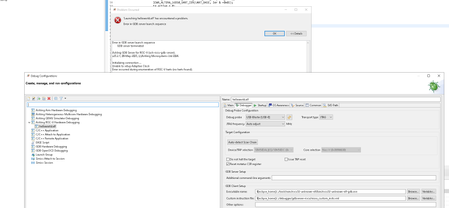
Hello Altera Gurus, I am now having much trouble building my projects with the AshlingRISCFree IDE using a NIOSV/m processor on a MAX10 FPGA targeted at a MAX10 Development kit. I am using Quartus Standard edition 25.1 on a Windows 10 PC. The process i am following is this: I created an FPGA top level System Verilog file for a new MAX10 Project. created a Qsys Platform which has a NIOSV/m processor connected to a onchip RAM for program storage and a onchip RAM for the DMA data. Added one mSGDMA engine for transmit data operations Added a second mSGDMA engine for receivedata operations Added two RAM onchip memories for the DMA decsriptors and wired up everything created the address map and interrupt mapping saved and generated the Qsys platform In the top level SV file is loopback the Tx -> RX for the two mSGDMAs Used the niosv-bsp-editor in a niosv console to created a BSP using the Qsys sopcinfo file Generated the BSP, created a simple C main application to configure the mSGDMAs and NIOSV/ m processor etc. Imported both the HAL_BSP and HAL_APP folders using: 'Import NIOS-V CMake Project... In the AshlingRSICFree IDE i can successfully run a 'Build all' and compile the HAL_BSP. BUT When i select the hal_app folder and try to build the Project i get these error messages: 17:37:20 Buildscript generation: hal_app::Default in D:\VAREX_mSGDMA_Eval\software\hal_app\build\Default cmake -DCMAKE_EXPORT_COMPILE_COMMANDS:BOOL=ON -G "Unix Makefiles" "D:\\VAREX_mSGDMA_Eval\\software\\hal_app" CMake Warning: Ignoring extra path from command line: "D:\VAREX_mSGDMA_Eval\software\hal_app" CMake Error: The source directory "D:/VAREX_mSGDMA_Eval/software/hal_app" does not appear to contain CMakeLists.txt. Specify --help for usage, or press the help button on the CMake GUI. Problems : Description Resource Path Location Type CMake Error: The source directory "D:/VAREX_mSGDMA_Eval/software/hal_app" does not appear to contain CMakeLists.txt. hal_app de.marw.cdt.cmake.core.internal.CMakeErrorParser CMake Problem cmake exited with status 1. See CDT global build console for details. hal_app de.marw.cdt.cmake.core.internal.BuildscriptGenerator Buildscript Generation Problem Looking at the hal_bsl folder i can see the CMakeLists.txt is present, it is not present (automatically anyway) in the hal_app folder. I assume it would be if it was part of the BSP generate flow, but it ins't there so i assumed it shouldn't be there (in the hal_app folder i mean). Even if i add it manually then try to do a project build again i then see an error message saying the CmakeCache.txt file has not been created. This seems like a big tools flow mess to me. The Project is automatically setup to use a CMake Compile and CMake Build flow. But its not working. I am trying to use the AshlingRISC IDE GDB Debugger to load my ELF file to the NIOSV processor to allow me to debug my project, but of course because i can't even build it this is impossible. I have tried using niosv cli commands to build my ELF file ...and they seem to work, which means the AshlingRISC IDE is the culprit in the failed IDE build process: Here are my NIOSV cli commands : mSGDMA Test: $ niosv-app --bsp-dir=D:/VAREX_mSGDMA_Eval/software/hal_bsp --app-dir=D:/VAREX_mSGDMA_Eval/software/hal_app --srcs=D:/VAREX_mSGDMA_Eval/software/hal_app/msgdma_loopback.c $ cmake -S D:/VAREX_mSGDMA_Eval/software/hal_app -B D:/VAREX_mSGDMA_Eval/software/hal_app/build -G "Unix Makefiles" -DCMAKE_BUILD_TYPE=Debug $ make -j4 -C D:/VAREX_mSGDMA_Eval/software/hal_app/build After i try and fail to do a project build i can also no loner clean this project, it gets stuck in red with the same error. The only way i can get it back to the start state is : File -> Restart ...this is not great !! Does anybody know why i get these errors and how to fix them please ? : Here i have also linked to an older post here in the knowledge base Claiming that "This problem is fixed starting with the Intel® Quartus® Prime Pro Edition Software version 21.4. and later". This appears to be NOT the case though :) Why does CMake Error: The source directory "<project_directory>/intel_niosv_m_0_EXAMPLE_DESIGN" does not contain CMakeLists.txt. when compiling the Nios® V processor application in Command Line Interface? | Altera Community - 338917 NOTE: I have attached 3 screenshots, 2 show the output from the NIOSV CLI when i run the 3 compile commands. The third one shows what happens when i try to load the ELF file which was created after the 3 Compilation steps run to completion. It looks like the GDB debugger detects the NIOSV/m processor (the 1 hard message) and then promptly crashed during part of the boot process. Does anybody have any ideas about why that might be and what is going on please ? Thanks for any help, Dr Barry H49Views0likes5CommentsNIOS V/g - peripherals under 2GB Peripheral Region
Hello, I am trying to clarify the information provided in the following KB: Why are the peripherals under 2gb peripheral region still cached by the NIOS V/g Does the above KB recommends to have non-cacheable peripheral regions above the 2GB address - that is, non-cacheable space starts from address 0x80000000, or any address above that? Thank you, D.Solved27Views0likes2Comments
NIOS does not start after SW download (timing issue?)
Hi, Recently I got an old Arria V design to update. It is in Quartus II 15.0 containing the following main components (in Qsys design): NIOS II soft processor 2x UniPHY DDR3 RAM controller (soft version, not hard), 72 bit wide data running at 400MHz clock (800Mb/s) 2x Triple Speed Ethernet with 4x SGDMA The design uses only 40k ALMs out of 190k so it fits well but I have timing issues (slack) on pll_afi_clk for one or both DDR3 controllers. I can reduce it by a lot of fine tuning on synthesizer and fitter settings but when I change a bit in the design timing results go wrong and tuning has to be started again. Both FW and SW are downloaded to SRAM by ByteBlaster. I found when the slacks are big (>0.1ns) NIOS never starts after downloading the SW. When it is small or completely eliminated, NIOS starts in most of the cases (but not always). Is this normal for such a design, or am I doing something wrong? I have never seen such behaviour before. Can this timing issue affect the NIOS processor on such a way or should I search in another direction to solve the problem?193Views0likes16CommentsAshling RISC Free IDE fails to download ELF file
Hello ALTERA NIOSV Experts, I have been trying to execute an application using a NIOSV CPU with the Ashling RISC Free IDE. The problem is that when trying to download the elf file to a MAX10 ALTERA Development board i see an error message saying that the AShling IDE cannot determine the JTAG clock speed. I have added a Screen shot showing this event. Can anyone please suggest a solution to try ? I am currently using an ALTERA USB Blaster to connect but i have just ordered a USB Blaster II as i believe that can connect at faster clock speeds and is also more reliable. Thanks for any help,191Views0likes9Comments
Nios V/c interrupt controller
According to the reference manual the Nios V Compact Microcontroller has an optional interrupt controller. When I instantiate the Nios V/c Compact Microcontroller IP in the Platform Designer I see no irq_ext/platform_irq inputs. Is there a way to include the optional Interrupt Controller in the IP-component from the IP library delivered with the Quartus Platform Designer? Thanks in advance.Solved33Views0likes3CommentsDK-DEV-AGI027-RA: JTAG chain broken after Nios V Hello, FPGA recovery fails
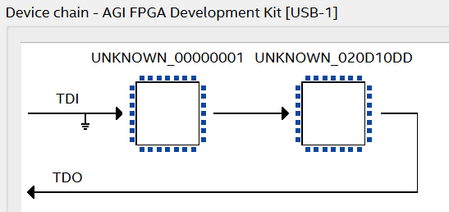
Hello, I am using the following board and host environment: Board: Agilex 7 FPGA I-Series Development Kit, DK-DEV-AGI027-RA Serial number: 8100604 Quartus Prime Pro: 25.3.1 Host OS: Windows 11 Pro Before this issue, the board was working normally with CXL ED and PCIe designs. Issue summary After successfully running a modified version of the "Nios V Hello" tutorial design (SOF + ELF) on this kit, Quartus Programmer can no longer detect the JTAG chain reliably. "Auto Detect" fails, and the JTAG Chain Debugger reports unknown devices and possible JTAG signal issues. Steps and observations 1. I modified the Nios V Hello tutorial design (SOF + ELF), including pin assignments and power management & SmartVID assignments, to match DK-DEV-AGI027-RA. Programming completed successfully, and I confirmed the expected "Hello" output. After that first run, I attempted to download an updated SOF, but Quartus Programmer "Auto Detect" failed. JTAG Chain Debugger screenshot: Programmer/Debugger log: !Error: JTAG chain problem detected !Error: TDI connection to the first detected device UNKNOWN_00000001 might be shorted to GND !Error: The TCK and TMS connections to the device before the first detected device UNKNOWN_00000001 might have a problem !Info: Detected 2 device(s) !Info: Device 1: UNKNOWN_00000001 !Info: Device 2: UNKNOWN_020D10DD Recovery attempts and results 2. Connected an external USB-Blaster II to J10, set SW8.3 = ON, and completed MAX10 recovery successfully. 3. Set SW8.3 = OFF to attempt FPGA recovery. Quartus Programmer Auto Detect still failed. 4. Loaded the predefined fpga_recovery.cdf and attempted to program AVSTX8.pof, but it failed with: Error(209062): Flash Loader IP not loaded on device 2 Error(209012): Operation failed 5. Set SW8.2 = ON to remove the FPGA from the JTAG chain, then successfully programmed AVSTX8.pof into QSPI. 6. Set SW8.2 = OFF again, but Auto Detect still failed. 7. Removed the external USB-Blaster II and tried the embedded JTAG interface. Auto Detect still failed. Questions. Are there additional recommended steps beyond MAX10 recovery and programming the recovery POF to QSPI (for example, specific switch combinations, a required full power-cycle sequence, or other board-level recovery steps)? If MAX10 recovery completes but JTAG remains broken on both external and embedded JTAG, does this suggest a likely hardware issue (JTAG path, FPGA, or related circuitry) that requires RMA? Is there anything in the Nios V Hello tutorial flow that could plausibly cause this condition (for example, power management settings, pin assignments, or JTAG-related settings)? If needed, I can share additional logs, exact switch settings, and any other diagnostics you recommend. Thanks.155Views0likes10Comments