embedded applications layer
84 Topics
Dual Port Nios V BSP error
I've created a Nios V qsys with dual port onchip memory in Quartus Pro 26.1 True dual port, first port connected to instruction manager, second - to data manager. Base addresses automatically assigned the same to both. But i'am unable to create the BSP due to memory regions overlapping error! Of course the addresses are same - its the same physical onchip memory! Any solytion, please? Regards, Vlad.282Views0likes9Comments
Mailbox Client HAL API: Erroneous behavior in flash erase boundary checks (Agilex 3 / Nios V)
Hi, I am currently working on an Agilex 3 platform using the Nios V in Quartus Prime Pro 25.3. I discovered unexpected behavior in the Mailbox Client HAL API when trying to erase 32K blocks of flash. In the file intel_mailbox_client_flash.c in function mailbox_client_flash_erase_block: The function receives a dynamic block_size as an argument but ignores it during the boundary check, relying instead on the global dev_info->region_info.block_size. Because it checks against the maximum hardware block_size (i.e., 64K) instead of the actual block_size parameter passed to the function, it mistakenly blocks legitimate erase commands at the final sectors of the region. Below is the code snippet: int mailbox_client_flash_erase_block(intel_mailbox_client* fd, int block_offset, int block_size) { if(block_offset < 0 || block_offset > dev_info->region_info.region_size - dev_info->region_info.block_size || (block_offset & (SZ_4K - 1)) != 0) { return -EINVAL; } } I suggest changing the boundary check to use the local block_size parameter that was explicitly passed to the function: if(block_offset < 0 || block_offset > dev_info->region_info.region_size - block_size || (block_offset & (SZ_4K - 1)) != 0) { return -EINVAL; } A similar logic flaw exists in the caller function mailbox_client_flash_erase. The input validation check uses the static hardware block size (dev_info->region_info.block_size) instead of taking the requested length into account. I suppose this check should prevent out-of-bounds erases in the first place, so checking if there is one 64K block left in the flash is actually pointless. int mailbox_client_flash_erase(intel_mailbox_client* fd, int offset, int length) { if(offset < 0 || offset > dev_info->region_info.region_size - dev_info->region_info.block_size) { return -EINVAL; } } I suggest using: if(offset < 0 || offset > dev_info->region_info.region_size - length) { return -EINVAL; } Any feedback on this behavior would be appreciated. Thanks!43Views1like2CommentsIntroducing the Altera Community AI Responder — Beta
Altera is introducing the AI Responder, an assistant built into the Altera Community to help provide faster, context-aware guidance for Altera product questions. It uses relevant public Altera documentation and Knowledge Database content, with coverage continuing to expand. The AI Responder may provide source references and can hand off complex or out-of-scope questions to an Altera subject-matter expert. As a beta feature, responses may contain errors or omissions, so please review the sources and verify technical guidance against official Altera documentation before implementation. If the response does not fully address your question, add more context and tag ai_responder to continue the discussion. We welcome your feedback as we improve the Community experience.21Views0likes0Comments
Ashling RISC Free IDE fails to download ELF file
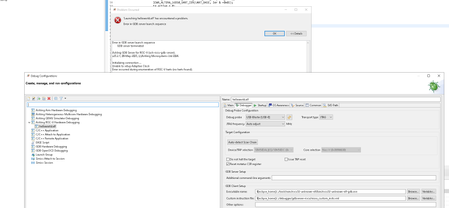
Hello ALTERA NIOSV Experts, I have been trying to execute an application using a NIOSV CPU with the Ashling RISC Free IDE. The problem is that when trying to download the elf file to a MAX10 ALTERA Development board i see an error message saying that the AShling IDE cannot determine the JTAG clock speed. I have added a Screen shot showing this event. Can anyone please suggest a solution to try ? I am currently using an ALTERA USB Blaster to connect but i have just ordered a USB Blaster II as i believe that can connect at faster clock speeds and is also more reliable. Thanks for any help,773Views0likes14Comments
Multiple NIOS V Implementation
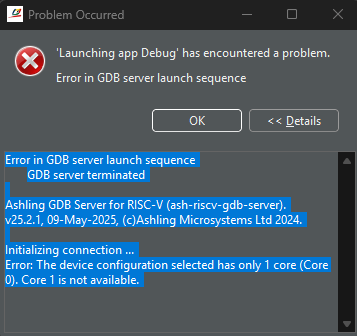
Hi, I was looking at the NIOS V Processor Reference Manual. I could not find the max instantiations you can implement on a FPGA. I see many designs online of Nios II Multiprocessors. Can I make the assumption that it is the same as the Nios II and you can implement multiple instantiations of NIOS V on the same FPGA, as long as the hardware logic space (alm), memory, etc can support the design. Lastly, is there any examples online for this? I see examples like https://www.intel.com/content/www/us/en/support/programmable/support-resources/design-examples/horizontal/exm-multi-nios2-hardware.html and https://www.intel.com/content/www/us/en/design-example/714531/cyclone-v-creating-multiprocessor-nios-ii-systems-design-example.html and https://www.youtube.com/watch?v=O54sJjSjq60 Thanks!Solved2.2KViews0likes12Commentsnot able to use multiple niosV cores at the same time
when I run ultiple niosV cores at the same time im not able to acess each of them even though i am able to detect them , i am faced with even though detecting gives me and i am unable to use the cores likewise this is my file on platform designer280Views1like7Comments
Implementing many Nios® V cores on Agilex™ 7
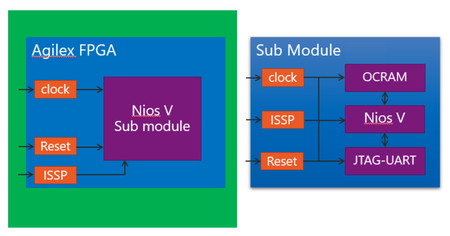
Table of Contents Introduction Environment Configuration (HW) Configuration (SW) Mass Implementation Multicore Debugging Conclusion Note: This article is an English translation of this Japanese article by Macnica. Please refer to the original article for updates. Introduction The attention to RISC-V has been increasing year by year, and it seems that many manufacturers are developing based on RISC-V. The Nios® V I use this time is also one of the RISC-V based processors, and it is a softcore processor developed by Intel. This article is an experimental article about implementing Nios® V to the limit on Agilex™ 7, thinking about doing something interesting with RISC-V. Environment This time, since we are using Intel FPGA and Nios® V, we will use the following: Intel® Quartus® Prime Pro Edition Software Version 22.2 for Windows Ashling* RiscFree* IDE for Intel® FPGAs We will use the following for Agilex™ 7: Agilex™ 7 FPGA F-Series Development Kit (P-Tile and E-Tile) Configuration (HW) This time, to implement many Nios® V, we have created a submodule with Nios® V, and are instancing that module in the top level. The configuration of the submodule includes: Nios® V/m processor On Chip RAM JTAG-UART These three are the minimum requirements for operation confirmation. The top level includes: CLK Reset Submodule (Nios® V) ISSP Reset You may not be familiar with ISSP, but understand that we are using HW logic with ISSP to toggle the Reset because the development kit used this time does not have a reset button for FPGA. The block diagram of this configuration is as follows. (Orange is Bridge, and purple is IP, color-coded.) In this configuration, the On chip RAM for Nios® V execution memory is generated with 128kByte. For details, please refer to the capture of the Platform Designer in "Mass Implementation". This time, since we will not perform a standalone operation confirmation, we have constructed it to only run the elf file in RAM with a debugger without considering detailed settings such as Reset Vector or Boot methods for each Nios® V. Configuration (SW) The software is a simple program that outputs to the JTAG console. Since we implement multiple Nios® V, it is better to write the program so that the outputs from different cores can be distinguished. Please refer to the final outputs at the end of section Multicore Debugging. Mass Implementation This configuration is created in Platform Designer. Since we only need to instance the submodules in the top level, we are lucky that the top level remains clean, although it took time to generate. First, let's check with only one Nios® V. As explained earlier, it appears that only one Nios® V submodule is implemented in the Platform Designer system. Below is the top level system diagram (the red frame is the Sub module). This is the Sub Module (the red frame is Nios® V/m processor). The compilation result is below. Even though we used 128kB Onchip RAM, it is still only 1% utilized. Next, let's try with 10 units. To make it easier later, we have created a submodule that implements 10 submodules and instance it in the top level. Below is the compilation result. Roughly, the RAM block usage is 1% per Sub module. Let's go bold and implement 100 units. We barely managed to implement it! It's okay to implement 100 units!! Although we think we can implement a few more, as the RAM resources are over 90%, we will settle with 100 units for now. Multicore Debugging Finally, I would like to write about debugging when implementing multiple units. For the Nios® V development environment, we use Ashling* RiscFree* IDE for Intel® FPGAs introduced in Chapter 2. It can be downloaded together with Intel® Quartus® installer, so please install it together. Here, I will omit the steps for launching Ashling* RiscFree* IDE for Intel® FPGAs and importing the project. The build process was referenced from the article below: Development Procedure for Nios® V Projects using Ashling* RiscFree* IDE for Intel® FPGAs After you have built the projects, first create a Debug configuration for each CPU. You can select which CPU to create for from the Core selection in the Debugger tab, as shown below. After setting and creating the Debug configuration for each CPU, group them with Launch Group to execute them simultaneously. This completes the Debug configuration. Next, prepare the console output destination. This time, due to screen display limitations, we will display the output in each Nios® V command shell. Launch the Nios® V command shell for each CPU and execute the following command: #juart-terminal -c <change for each CPU> -d <device number> -i <instance number> juart-terminal -c 1 -d 0 -i 0 With this command, each Command shell will be linked to the JTAG console. (The last number in Core selection corresponds to the argument of -i.) Select the Group created earlier and press Debug. By default, it will break at the start of the main function, so you can add breakpoints, check register and variable values for each source to debug. The execution result this time is shown below. We captured the situation where the JTAG console is running simultaneously. Conclusion This time, I implemented many Nios® V just for fun, but it took a lot of time for tasks such as compilation time and Platform Designer hierarchy design. It was quite difficult for an article started with a light heart. However, since I think there are few people who actually perform this configuration, I hope you will find the multicore debugging part helpful. Notices & Disclaimers Intel technologies may require enabled hardware, software or service activation. No product or component can be absolutely secure. Your costs and results may vary. © Intel Corporation. Intel, the Intel logo, and other Intel marks are trademarks of Intel Corporation or its subsidiaries. Other names and brands may be claimed as the property of others. The products described may contain design defects or errors known as errata which may cause the product to deviate from published specifications. Current characterized errata are available on request. Intel disclaims all express and implied warranties, including without limitation, the implied warranties of merchantability, fitness for a particular purpose, and non-infringement, as well as any warranty arising from course of performance, course of dealing, or usage in trade. Nios is a trademark of Intel Corporation or its subsidiaries.2.9KViews0likes2Comments
NIOS II "Verify failed" for on-chip memory 128k
Hello! I'm using a Cyclone 10LP FPGA 10CL055YU484I7G FPGA. I have a 11k size program for NIOS II. I have a large on chip RAM (because I have a larger program which I want to use later) of 128k. Everything compiles and links OK. But when I try to download the program I get a "Verify failed between address 0x20000 and 0x2FFFF". The 128K memory is located 0x20000 to 0x3FFFF If I reduce the RAM to 32K, for example, everything works great!!. The initialize memory content option is turned on for the memory The BOOT RAM starts at 0x00000 If I download a bigger program (117k), I still get the same error. Thanks267Views0likes3CommentsWhere is FreeRTOS-Plus-TCP Design
Hello, Can someone show or share me the link or design data regarding "FreeRTOS-Plus-TCP" mentioned in Nios V Processor SW Dev. HB? https://docs.altera.com/r/docs/743810/25.3.1/nios-v-processor-software-developer-handbook/enabling-freertos-plus-tc Thank you.Solved321Views0likes7CommentsNiosV and juart-terminal
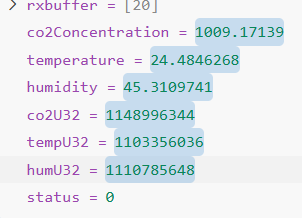
I had a project which works fine under niosII. I upgrade all the project with niosv and all seems fine except printing values in juart-terminal. Here is the main code : #include <stdio.h> #include "system.h" #include "altera_avalon_pio_regs.h" #include <altera_avalon_i2c.h> #include <unistd.h> #include <string.h> int main() { //* ALT_AVALON_I2C_DEV_t *i2c_dev; //pointer to instance structure alt_u8 txbuffer[20]; alt_u8 rxbuffer[20]; float co2Concentration = 0; float temperature = 0; float humidity = 0; alt_u32 co2U32 = 0; alt_u32 tempU32 = 0; alt_u32 humU32 = 0; ALT_AVALON_I2C_STATUS_CODE status; i2c_dev = alt_avalon_i2c_open("/dev/i2c"); //Ouverture du périphérique i2c et récupération d'un pointeur if (NULL==i2c_dev) { printf("Error: Cannot find /dev/i2c\n"); return 1; } //set the address of the device using alt_avalon_i2c_master_target_set(i2c_dev,0x61); //Définition de l'adresse du composant adressé 0x61 pour le SCD30 txbuffer[0]=0x00; txbuffer[1]=0x10; txbuffer[2]=0x00; txbuffer[3]=0x00; txbuffer[4]=0x81; //Remplissage du buffer pour configurer le SDC30 en Continous measurement status=alt_avalon_i2c_master_tx(i2c_dev,txbuffer, 5,ALT_AVALON_I2C_NO_INTERRUPTS); //Envoi du buffer au composant if (status!=ALT_AVALON_I2C_SUCCESS) return 1; //FAIL while(1) { txbuffer[0]=0x02; txbuffer[1]=0x02; //Remplissage du buffer pour déterminer si les données sont prêtes alt_avalon_i2c_master_tx(i2c_dev,txbuffer, 2,ALT_AVALON_I2C_NO_INTERRUPTS); //Envoi du buffer au composant rxbuffer[1]=0x00; usleep(3000); // Il faut attendre au moins 3ms avant de demander la réponse alt_avalon_i2c_master_rx(i2c_dev,rxbuffer, 3,ALT_AVALON_I2C_NO_INTERRUPTS); //Récupération de la réponse du composant si rxbuffer[1]==0x01 alors les données sont prêtes if(rxbuffer[1]==0x01) { txbuffer[0]=0x03; txbuffer[1]=0x00; //Remplissage du buffer pour la lecture des données alt_avalon_i2c_master_tx(i2c_dev,txbuffer, 2, ALT_AVALON_I2C_NO_INTERRUPTS); //Envoi du buffer de lecture et récupération des données usleep(3000); //Wait 3ms before data available alt_avalon_i2c_master_rx(i2c_dev,rxbuffer, 18,ALT_AVALON_I2C_NO_INTERRUPTS); //Read datas co2U32 = (alt_u32)((((alt_u32)rxbuffer[0]) << 24) | (((alt_u32)rxbuffer[1]) << 16) | (((alt_u32)rxbuffer[3]) << 8) | ((alt_u32)rxbuffer[4])); tempU32 = (alt_u32)((((alt_u32)rxbuffer[6]) << 24) | (((alt_u32)rxbuffer[7]) << 16) | (((alt_u32)rxbuffer[9]) << 8) | ((alt_u32)rxbuffer[10])); humU32 = (alt_u32)((((alt_u32)rxbuffer[12]) << 24) | (((alt_u32)rxbuffer[13]) << 16) | (((alt_u32)rxbuffer[15]) << 8) | ((alt_u32)rxbuffer[16])); memcpy(&co2Concentration, &co2U32, sizeof(co2Concentration)); memcpy(&temperature, &tempU32, sizeof(temperature)); memcpy(&humidity, &humU32, sizeof(humidity)); } printf("---------------------------------------------------------\n"); printf("SCD30\n"); printf("Concentration de CO2 : %f ppm\n",co2Concentration); printf("Température : %.1f °C\n",temperature); printf("Humidité relative : %.1f %% \n",humidity); usleep(500000); } } I put a breakpoint just before the printf and the values are good : but when i print the values in the juart-terminal : I can't figure out why the printf does not work as i expect. Someone could help me to understand this problem ? Thanks EricSolved525Views0likes14Comments