Altera_Forum Honored Contributor
10 years agoHonored ContributorTimequest unconstrained paths clock summary
Hello and good morning from Germany.
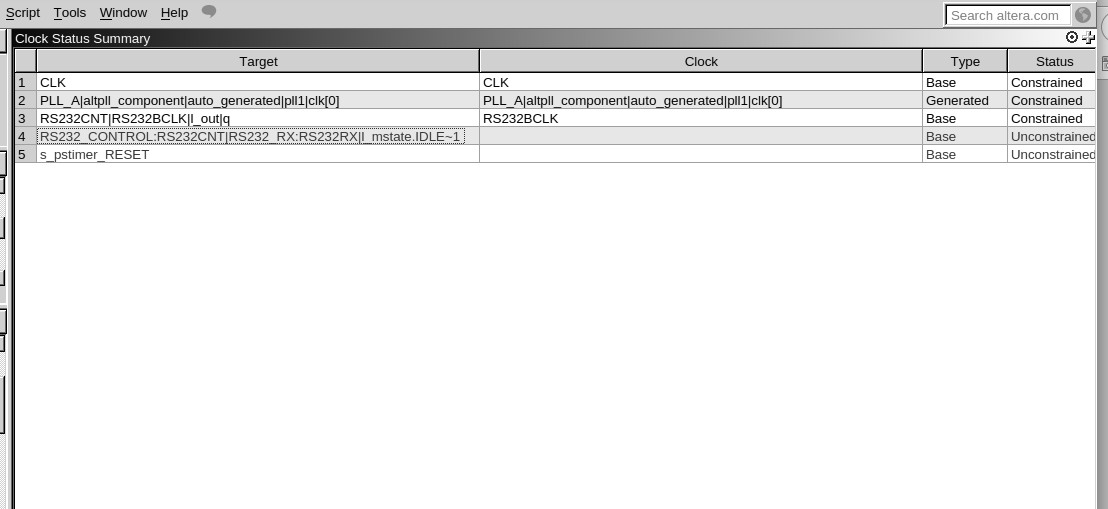
i have got a problem with the timequest Analyser tool. In the following code you can see my first test of the RS232 Interface. It works but if i start the timequest tool, the timequest tool said: RS232_CONTROL:RS232CNT|RS232_RX:RS232RX|l_mstate.IDLE~1 is a clock. But it isn't a clock. Whats happen? could you please help me?
library ieee;
use ieee.std_logic_1164.all;
use ieee.numeric_std.all;
entity RS232_RX is
    generic(    CLK_MUL: natural := 6;
            BITS: natural := 8;
            STOPBIT: natural range 0 to 1 := 0);
    port(        RESET: in bit;
            NDATA: in bit; -- new data
            READY: out bit; -- ready for new data
            BCLK: in bit;
            databit: in bit_vector(BITS-1 downto 0);
            DO: out bit);
end RS232_RX;
architecture STRUCT of RS232_RX is
    type state is (IDLE, START, SEND, STOP);
    signal l_databit: bit_vector(BITS-1 downto 0);
    signal iclk: bit := '0';
    signal l_mstate: state;
    signal l_obit: bit := '1'; --idle bit
    signal l_ready: bit := '0';
begin
P1:     process(BCLK,RESET,databit,NDATA,l_ready)
    variable v_counter: integer range 0 to CLK_MUL := 0; --integer
    variable v_bcnt: integer range 0 to BITS-1 := 0; --integer rang 0 bis BITS;
    variable vcnt_stbbit: integer range 0 to 1 := STOPBIT; --anzahl der stopbits
    begin
        if RESET='1' then
            l_mstate <= IDLE; --set the machine to start.
            v_counter := 0; -- reset v_counter
            l_ready <= '1'; --set ready to not ready for new data i am in the process.
        elsif NDATA = '1' and l_ready = '1' then --new data?
                l_databit <= databit; --nur bei reset zuweisen
                l_mstate <= START;
                l_ready <= '0';
        elsif BCLK'event and BCLK='0' then
            if v_counter=0 then
                v_counter := CLK_MUL-1;
                case l_mstate is
                    when IDLE => null;
                        l_mstate <= IDLE; --set the machine to start.
                    when START =>
                        l_obit <= '0';
                        l_mstate <= SEND;
                        v_bcnt := BITS-1;
                        vcnt_stbbit := STOPBIT;
                    when SEND =>
                        l_obit <= l_databit(0);
                        l_databit <= '0' & l_databit(BITS-1 downto 1);
                        if v_bcnt = 0 then
                            l_mstate <= STOP;
                        else
                            v_bcnt := v_bcnt -1;
                        end if;
                    when STOP =>
                        l_obit <= '1';
                        if vcnt_stbbit = 0 then
                            l_mstate <= IDLE;
                            l_ready <= '1'; --ready for new data
                        else
                            vcnt_stbbit := vcnt_stbbit-1;
                        end if;
                end case;
            else
                v_counter := v_counter - 1;
            end if;
        end if;
    end process P1;
PO:     process(l_obit,l_ready)
    begin
        READY <= l_ready;
        DO <= l_obit;
    end process PO;
end STRUCT;