Forum Discussion

 Occasional Contributor
flash programmer issue
 1 year ago
Thank you for your reply!
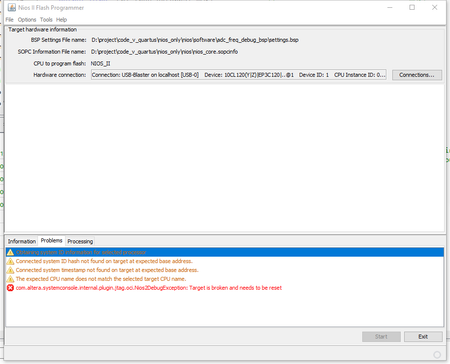
In this thread, I was told the flash M25P64 is not compatible: https://community.intel.com/t5/Nios-V-II-Embedded-Design-Suite/Target-is-broken-and-needs-to-be-reset/td-p/1688694
Corrently, I did the following experiments:
experiment 1: program sof file to FPGA successfully, and FPGA works as expected output.
experiment 2: click Auto Detect button on Quartus-->Tools --> Programmer, digital signal could be observed on the data pin of the connection from FPGA to flash, but not clock on the clk pin from FPGA to flash.
experiment 3: convert sof file to jic file, and add jic file to Quartus-->Tools --> Programmer, and click start button. no digital signal on the data pin of FPGA and flash connection, no clk was sent out from the SPI of FPGA and flash as well. Failed was seen on Programmer tools. no more information was seen.
From those above experiments, I guess FPGA was not successfully started or initialized?

 New Contributor
Hi,
Since a .sof file is intended only for configuring the FPGA, it will successfully program the FPGA itself but cannot be used to program an external Flash device. To load a Flash device that’s wired to the FPGA’s dedicated configuration pins, you must convert the .sof into either a .pof or .jic file. If that conversion isn't supported, it often means the specific Flash device (OPN) you selected isn’t officially supported. Aside from Intel’s EPCS/EPCQ families, the full list of supported third-party Flash memories for Cyclone 10 LP devices is documented under : Table 4 - Supported Third Party Configuration Devices : https://www.intel.com/content/www/us/en/support/programmable/support-resources/design-guidance/configuration-support.html#intel-config-devices
Regards,
Divya

 Super Contributor
if I remember right, M25P64 is fully compatible with EPCS64, even uses the same silicon ID 0x16.

