Forum Discussion

 Contributor
Ashling RISC Free IDE fails to download ELF file

 New Contributor
Hi Dr Barry H,
Given that 'Auto-detect Scan Chain' is working well, JTAG access is not broken. A second look at the error message suggests Ashling RiscFree is unable to communicate with the Nios V core, which can happen if the core is the being held in reset state (or otherwise not running/responding).
To further analyse the issue, could you please collect and share the following:
1. Share low level probe logging file generated by Ashling RiscFree:
In the 'Debugger' tab of the launch configuration, add the following to 'Additional command-line arguments' field.
--probe-log-level 7 --probe-log-path <path\to\store\log\file>Then re-launch the debug session. A log file (*.bin) should be generated at the specified location; please share that file.
2. Share 'jtagconfig' output:
From the Nios V shell, please run:
jtagconfig -d…and share the full output.
Regards,
Rejeesh
 drbarryh8 months ago
Hello Rajeesh,
Thanks for the extra help. I will try this out. I Have discovered one problem was that the Windows 10 PC i was working with had Norton 360 AV installed, and even though it never reported any blocking events, ad all logs appeared to suggest it was not interfering with the debugger and Compiler, i must have been doing something., because today i uninstalled it all, rebooted, and tried running the debugger again, and it got a lot further:
Here is the log now :Ashling GDB Server for RISC-V (ash-riscv-gdb-server).
v25.2.1, 09-May-2025, (c)Ashling Microsystems Ltd 2024.
Initializing connection ...
Unable to setup Adaptive Clock
Connected to target device with IDCODE 0x31050dd using USB-Blaster-2 (2) via JTAG at adaptive speed.
Info : Active Harts Detected : 1
Info : Core[0] Hart[0] halted
Info : [0] System architecture : RV32
Info : [0] Debug version : v1.00
Info : [0] Number of hardware breakpoints available : 1
Info : [0] Number of program buffers: 8
Info : [0] Number of data registers: 2
Info : [0] Memory access -> Program buffer
Info : [0] Memory access -> Abstract access memory
Info : [0] CSR & FP Register access -> Abstract commands
Waiting for debugger connection on port 63780.
Press 'Q' to Quit.
Got a debugger connection from 127.0.0.1 on port 63780.
Then from the Debug Terminal i see this and it crashes:
GNU gdb (GDB) 13.2
Copyright (C) 2023 Free Software Foundation, Inc.
License GPLv3+: GNU GPL version 3 or later <http://gnu.org/licenses/gpl.html>
This is free software: you are free to change and redistribute it.
There is NO WARRANTY, to the extent permitted by law.
Type "show copying" and "show warranty" for details.
This GDB was configured as "--host=x86_64-w64-mingw32 --target=riscv32-unknown-elf".
Type "show configuration" for configuration details.
For bug reporting instructions, please see:
<https://www.gnu.org/software/gdb/bugs/>.
Find the GDB manual and other documentation resources online at:
<http://www.gnu.org/software/gdb/documentation/>.
For help, type "help".
Type "apropos word" to search for commands related to "word".
Warning: Instruction specification contains imm field
Warning: Instruction specification contains imm field
Warning: Instruction specification contains imm field
...Then it crashes ...ends up here :
void break_operation (void) {
#ifdef ALT_CPU_HAS_DEBUG_STUB
NIOSV_EBREAK();
#else // ALT_CPU_HAS_DEBUG_STUB
while(1) ;
#endif // ALT_CPU_HAS_DEBUG_STUB
}
Main never opens.....i assume something in the build went wrong but not sure what or why because it seemed to build OK.
LINUX BUILDS: I have also tried building your designs on my UBUNUT PC, and after doing all the configurations for the linux tools and the environment setup, get the following error messages from the Ashling IDE, i assume something is still not quite right in the Linux project configuartion, how do i tell it where the CMakecache.txt file is please ?:
Compile log from Ubuntu 24.04:
Description Resource Path Location Type
File CMakeCache.txt does not exist, unable to build project bsp CMakecache.txt Problem could not load cache bsp C/C++ Problem
Project 'bsp' has no explicit encoding set bsp /bsp No explicit project encoding
Project 'app_iperf' has no explicit encoding set app_iperf /app_iperf No explicit project encoding
File '/home/drbarryh/VAREX_Projects/25.1std_max10_package/software/bsp/build/default/compile_commands.json' was not created in the build. Your workbench will not know all include paths and preprocessor defines. bsp org.eclipse.cdt.jsoncdb.core.CompileCommandsJsonParser JSON compilation database
Thanks, Dr Barry H
- drbarryh8 months ago
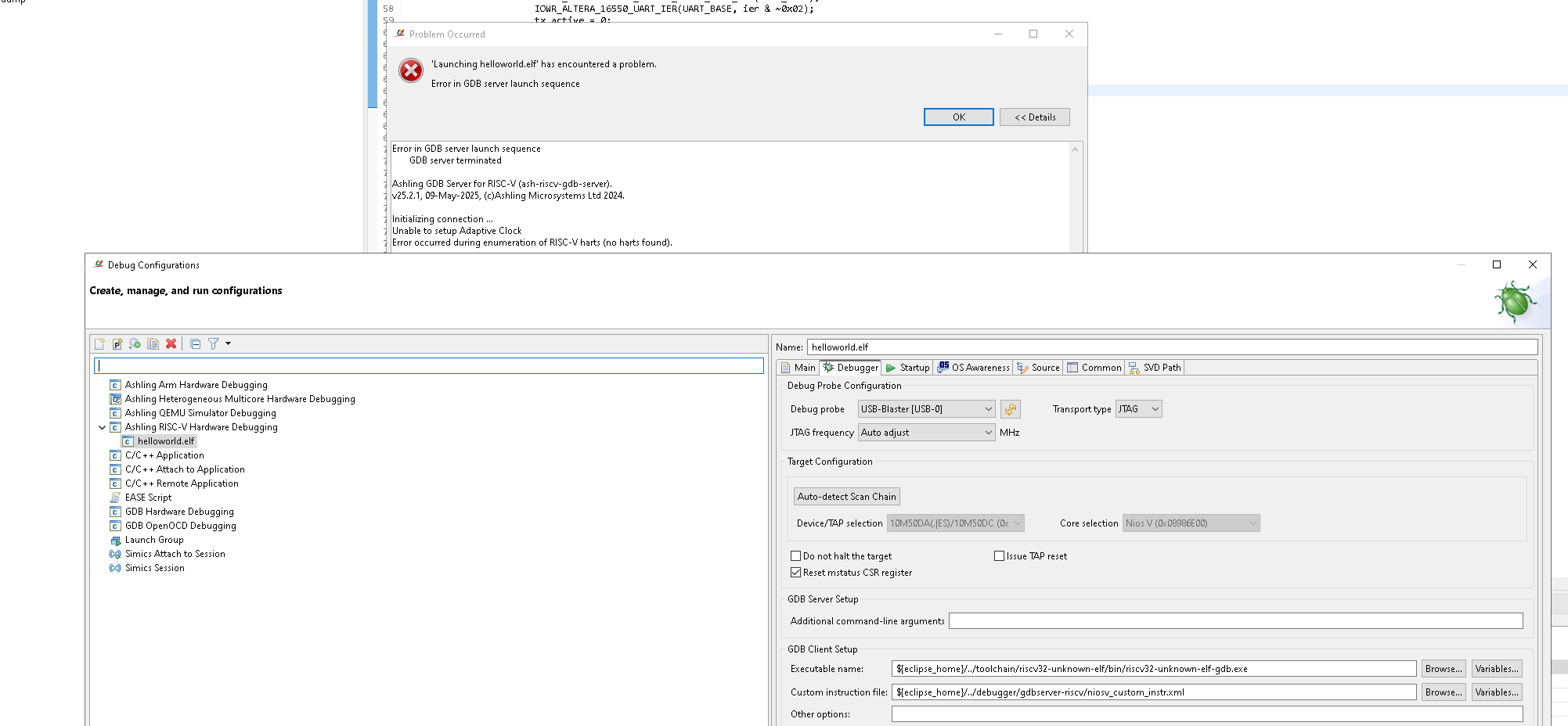
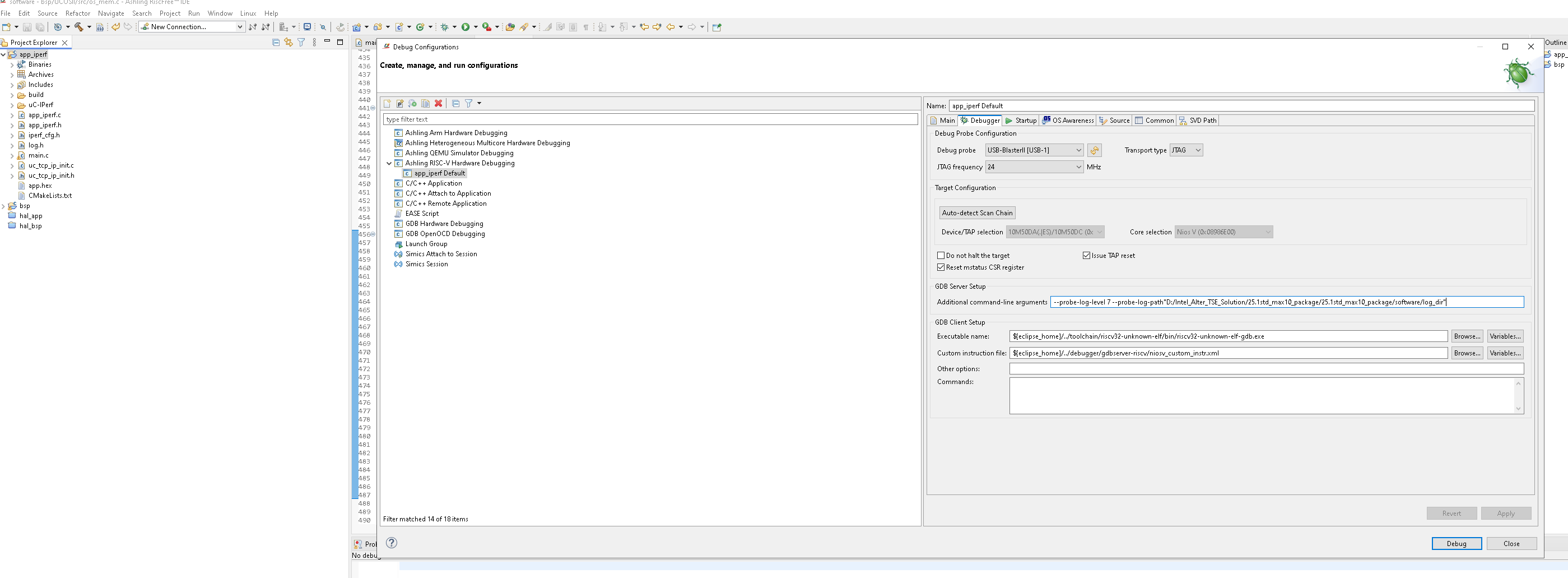
Hi Rajeesh, I was trying to follow your instructions for generating a level 7 log file but i got an error message and the gdb failed to run. Here is the exact command line i put in the In the 'Debugger' tab of the launch configuration, in the 'Additional command-line arguments' field. The Directory D:/Intel_Alter_TSE_Solution/25.1std_max10_package/25.1std_max10_package/software/log_dir does exist, i created it myself ::
--probe-log-level 7 --probe-log-path "D:/Intel_Alter_TSE_Solution/25.1std_max10_package/25.1std_max10_package/software/log_dir"
Error in GDB server launch sequence
Ashling GDB Server for RISC-V (ash-riscv-gdb-server).
v25.2.1, 09-May-2025, (c)Ashling Microsystems Ltd 2024.
Setting probe log level to 0x7.
Error: Error: Cannot open probe log file in specified/default directory: d:\intel_alter_tse_solution\25.1std_max10_package\25.1std_max10_package\software
Ashling GDB Server for RISC-V (ash-riscv-gdb-server).
v25.2.1, 09-May-2025, (c)Ashling Microsystems Ltd 2024.
Setting probe log level to 0x7.
Error: Error: Cannot open probe log file in specified/default directory: d:\intel_alter_tse_solution\25.1std_max10_package\25.1std_max10_package\software
I have attached a screenshot which shows the debugger setup page
Can you please take a look and see what the problem is here ?
Thanks, Dr Barry H
- drbarryh8 months ago
Hi Rajessh,
I have a couple of questions to ask you about the MAX10 designs.
Q1: Am i intended to use the tcl script bsp_script_original.tcl which is located here: \25.1std_max10_package\software to build an Ashling IDE project from scratch ?
If yes would i run it from the Software Directory in a NIOSV console ?
Q2: During sending this command : $ niosv-download -g -r software/app_iperf/build/app_iperf.elf -c 1
I see the following suspicious looking messages:
INFO: Starting gdb. Running "riscv32-unknown-elf-gdb -batch -ex set non-stop on -ex set arch riscv:rv32 -ex set remotetimeout 60 -ex target extended-remote localhost:64265 -ex monitor swreset 1 1 -ex load software/app_iperf/build/app_iperf.elf -ex set $mstatus &= ~(0x00000088) -ex continue&".
The target architecture is set to "riscv:rv32".
warning: No executable has been specified and target does not support
determining executable automatically. Try using the "file" command.
warning: No executable has been specified and target does not support
determining executable automatically. Try using the "file" command.
Program received signal SIGINT, Interrupt.
0x00000004 in ?? ()
Invalid reset option
Are these messages (in bold) meant to be there and the NIOSV CPU can recover from the SIGINT and this invalid reset option and the warning about the missing executable file ? I am not that familiar with this flow so can you explain what is going on please ?
Thanks, Dr Barry H
 LiangYuG_Altera8 months ago
Hi Dr Barry H,
Q1: Am i intended to use the tcl script bsp_script_original.tcl which is located here: \25.1std_max10_package\software to build an Ashling IDE project from scratch ?
If yes would i run it from the Software Directory in a NIOSV console ?It is not mandatory, you can straight away use the provided bsp folder.
The bsp_script_original.tcl is needed only when you wished to generate a 2nd bsp folder.
(It will be exactly the same as the provided bsp folder, so this action is not mandatory.)Q2: During sending this command : $ niosv-download -g -r software/app_iperf/build/app_iperf.elf -c 1
Are these messages (in bold) meant to be there and the NIOSV CPU can recover from the SIGINT and this invalid reset option and the warning about the missing executable file ? I am not that familiar with this flow so can you explain what is going on please ?Starting from beginning,
warning: No executable has been specified and target does not support determining executable automatically. Try using the "file" command.
In a normal gdb debugging session, it is common to use "file" followed by "load" command. This is necessary for debugging session. On the other hand, the niosv-download is simplified to execute run session (load & run the ELF, debug is not included). Thus, the gdb "file" command is optimized away.
Program received signal SIGINT, Interrupt.
0x00000004 in ?? ()
Invalid reset optionThe Nios V processor can recover from the SIGINT & Invalid reset option.
The invalid reset option is benign, and you may ignore it.Regards,
Liang Yu
- drbarryh8 months ago
Hello Rajeesh, Some good news on the TSE because i got the tow ALTERA designs to run and connect to a Raspberry PI5 last night. The iperf3 test connected and ran now with no problems, as i caould also see in Wireshark with it completing the 3 way handshake and then continuing on with some tests, although it did keep reporting 0 bytes transferred and so the results was not what i expected. But at least it connected over the MAX10 board + TSE + MARVELL PHY. The Simple Server application also ran and i was able to control the MAX10 boards LEDS, so a good outcome.
Now onto what we actually need. We are trying to fit our design into a MAX10 10M16 part if possible. We actually only need to be able to send UDP packets and we can do without an OS. Basically what we need is to be able to send packets of data in Ethernet Frames with a UDP payload. A minimal approach is what we need:
- Be able to initialize the MARVEL PHY over MDIO
- Be able to write data to a FIFO, encapsulate the data in an Ethernet Frame + UDP payload and send it to a PC using the TSE
- Be able to detect when a frame has been received by the TSE and offload it to our own FIFO + processing logic
- We don't really need DHCP because we intend to hard code IP addresses and MAD Destination addresses
- Be able to fit into a fairly small MAX10 FPGA (such as a 10M16)
Can you please assist us to hack / remodel your design to make it fit this specification please ?
Thanks, Dr Barry H
- BoonBengT_Altera5 months ago
Moderator
Dear Customer,
As clarification has been provided and with no further inquiries during this period, we would step back and allow the community to assist with any future follow-up questions.
Thank you for engaging with us!Best regards,
Altera Technical Support