Forum Discussion

 Honored Contributor
SGDMA data output issue
Hi,
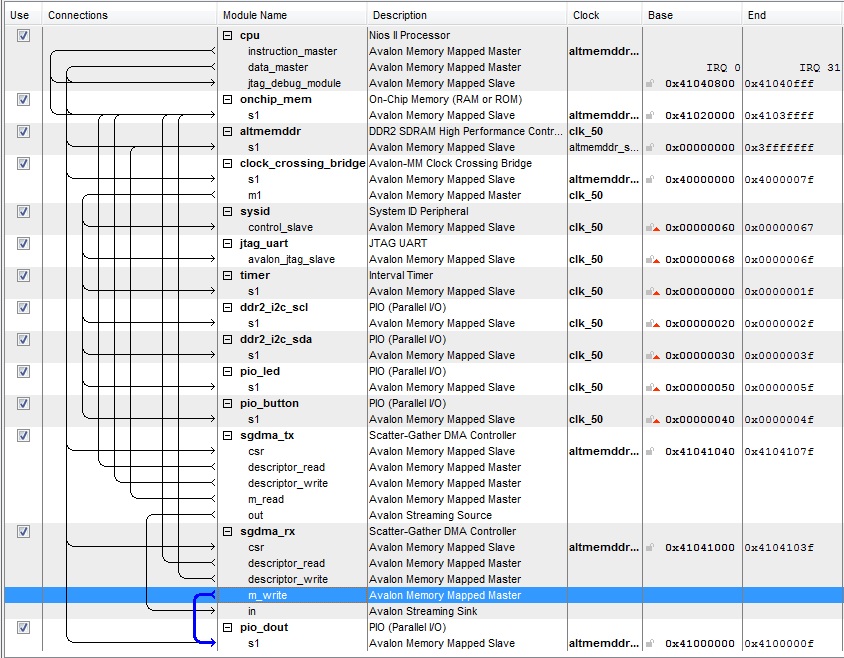
I just started to learn using sgdma to transfer data from DDR2. I have the sopc attached and please give me some idea if that is correct. Another issue is that I do not understand how dma communicate between Nios and hardware. I used to use PIO and IOWR and the data is shown on the pio pin. However, I am not able to find some pin related to this dma. Should I add some other component such as fifo? Please give me some hint on this. Thanks16 Replies
 Altera_Forum
I would highly recommend using the HDL driver that comes with the SGDMA. You can find the APIs in the SGDMA user guide.
- Altera_Forum
Hi BadOmen,
Thanks a lot for your advice. But could you please go in more details about it? I have read the document and the sgdma seems working through the program below. But still how can I send the data to the hardware? Should I wire some pio to the sgdma? If possible can you show me some diagram/function call to get the data back to the hardware? Thanks! This is the program: int main() { int i; // int timeout=0; for (i=0;i<1000;i++) // buf initialization buf[i]=i%256; desc=(alt_sgdma_descriptor *)ONCHIP_MEM_BASE; // redefine the base address ? // ***************** open sgdma_tx ********************// sgdma_tx_dev=alt_avalon_sgdma_open(SGDMA_TX_NAME); if(!sgdma_tx_dev) { printf("ERROR: can't open TX SGDMA"); return -1; } // ***************** open sgdma_rx ********************// sgdma_rx_dev=alt_avalon_sgdma_open(SGDMA_RX_NAME); if(!sgdma_rx_dev) { printf("ERROR: can't open RX SGDMA"); return -1; } // ***************** reset RX SGDMA ********************// IOWR_ALTERA_AVALON_SGDMA_CONTROL(SGDMA_RX_BASE,ALTERA_AVALON_SGDMA_CONTROL_SOFTWARERESET_MSK); IOWR_ALTERA_AVALON_SGDMA_CONTROL(SGDMA_RX_BASE,0x0); // ***************** reset TX SGDMA ********************// IOWR_ALTERA_AVALON_SGDMA_CONTROL(SGDMA_TX_BASE,0); // Why these two are different here? IOWR_ALTERA_AVALON_SGDMA_CONTROL(SGDMA_TX_BASE,0xFF); // ***************** register rx callback ********************// alt_avalon_sgdma_register_callback( sgdma_rx_dev, (alt_avalon_sgdma_callback) &sgdma_rx_isr, // ? (alt_u16) ALTERA_AVALON_SGDMA_CONTROL_IE_DESC_COMPLETED_MSK | ALTERA_AVALON_SGDMA_CONTROL_IE_CHAIN_COMPLETED_MSK | ALTERA_AVALON_SGDMA_CONTROL_IE_GLOBAL_MSK, 0 ); // ***************** construct a descriptor for ST to MM transfer ********************// alt_avalon_sgdma_construct_stream_to_mem_desc( &desc[0], &desc[1], rx_payload, 0, 0 ); // ***************** construct a descriptor for MM to ST transfer ********************// alt_avalon_sgdma_construct_mem_to_stream_desc( &desc[2], &desc[3], (unsigned int*) buf, (256), 0, 1, 1, 0 ); // ***************** start sgdna_rx ********************// alt_avalon_sgdma_do_async_transfer(sgdma_rx_dev, &desc[0]); // ***************** start sgdna_tx ********************// alt_avalon_sgdma_do_sync_transfer(sgdma_tx_dev, &desc[2]); } - Altera_Forum
- Altera_Forum
Why don't you connect tx/rx to ddr and look like my easy to test. Use the main.c (rename .doc to .c) program I include and give a try.
Sean - Altera_Forum
I would use the "DMA" and not the "SGDMA" The DMA is much easier to work with. The only reason for using the SGDMA is if you want the DMA engine to start working on another transfer immediately after completing another bulk data transfer.
Both of those DMAs have HAL drivers so you don't have to worry about accessing the DMA hardware directly, that's the purpose of the software driver. - Altera_Forum--- Quote Start --- Why don't you connect tx/rx to ddr and look like my easy to test. Use the main.c (rename .doc to .c) program I include and give a try. Sean --- Quote End --- Thanks Sean! I will try it. But still it seems I did not know how to output the data to FPGA. Could you explain it for me?
- Altera_Forum--- Quote Start --- I would use the "DMA" and not the "SGDMA" The DMA is much easier to work with. The only reason for using the SGDMA is if you want the DMA engine to start working on another transfer immediately after completing another bulk data transfer. Both of those DMAs have HAL drivers so you don't have to worry about accessing the DMA hardware directly, that's the purpose of the software driver. --- Quote End --- I may have to use sgdma 'cause the required throughput is really high. Anyway I will try the dma core and get back to you soon.
- Altera_Forum
This is starting to sound like using a PIO would be a bad idea. If for example the memory holding the data becomes blocking you might have an idle cycle between accesses to the PIO. Sounds more like FIFOs would be your best best with the DMA operating faster than the FIFOs can be drained to protect against underflow.
While you are looking at DMAs you might want to evaluate this one: http://www.alterawiki.com/wiki/modular_sgdma It's a SGDMA only with a much simplier programming model (to software it looks like the regular DMA with a FIFO buffering descriptors internally). - Altera_Forum
1. Get your block done SOPC Builder with pin assigments.
2. Flash sof file 3. Use Nios IDE, C compiler to run simulate in real-time with hardware. Like, BadOmen shows you the link, but my main.c program should work on any sgdma to sdram memory. Sean. - Altera_Forum--- Quote Start --- 1. Get your block done SOPC Builder with pin assigments. 2. Flash sof file 3. Use Nios IDE, C compiler to run simulate in real-time with hardware. Like, BadOmen shows you the link, but my main.c program should work on any sgdma to sdram memory. Sean. --- Quote End --- Hi sean, Sorry but when I said my problem of hardware output, I mean I want to actually see the data on some specific pin of FPGA (like GPIO in DE3). Your program works really great and it also works with my ddr2. Still, the data is generated inside the Nios (alt_u32 create_test_data). Could you let me know how to dump the data to some pins on FPGA? Thanks a lot!