Forum Discussion

 Honored Contributor
LookUp Tables
Hello, I want to implement sine and cosine signals in vhdl to check a part of my code but i don't know how to initialize these sin and cos signals? please tell me what is the way to do it?
i have read that it is possible through LUT but i don't know what LUT is ???12 Replies
 Altera_Forum
A lut is a ROM containing all of the Sin Values - so for a table of sin(x) - x is the address to the ROM.
- Altera_Forum
Hi! I have the same project.I want to create sin-signal for tests, but it's an error when I put negative numbers into .mif file. Insted of negative numbers Questa show me zeros.
How Can I solve this problem? Main code:
Testbench:module single_rom ( addr, clk, q ); //input input addr ; input clk; output signed q; //ip-cores rom_ip rom_ip_component ( .address (addr), .clock (clk), .q (q)); endmodule
Contents of .mif file:`timescale 1 ps/ 1 ps module single_rom_tb(); // test vector input registers reg addr; reg clk; // wires wire signed q; // assign statements (if any) single_rom i1 ( // port map - connection between master ports and signals/registers .addr(addr), .clk(clk), .q(q) ); //clk initial begin clk = 0; forever# 10 clk = ~clk; end //beginning address initial addr = 7'h00; //loop always begin @(posedge clk) if (addr >= 7'h64) addr = 7'h0; else addr = addr + 7'h1; end endmodule
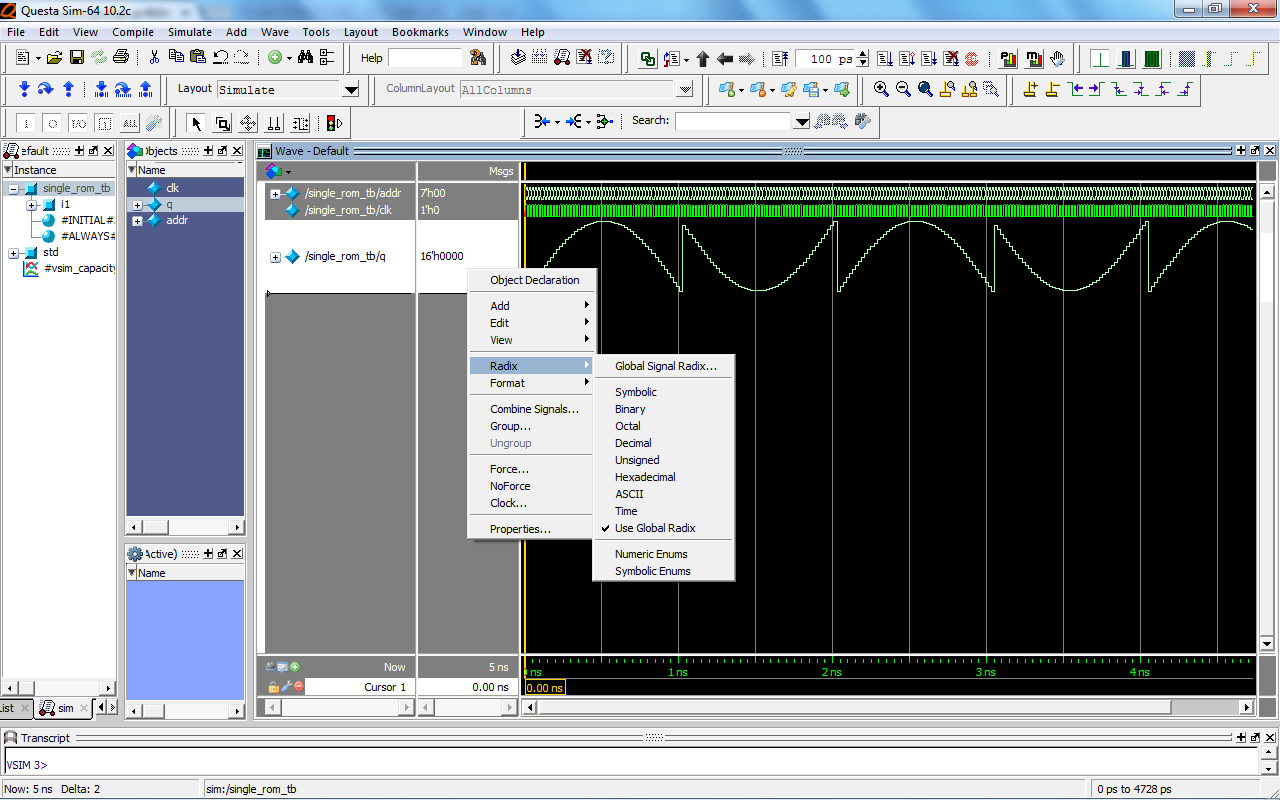
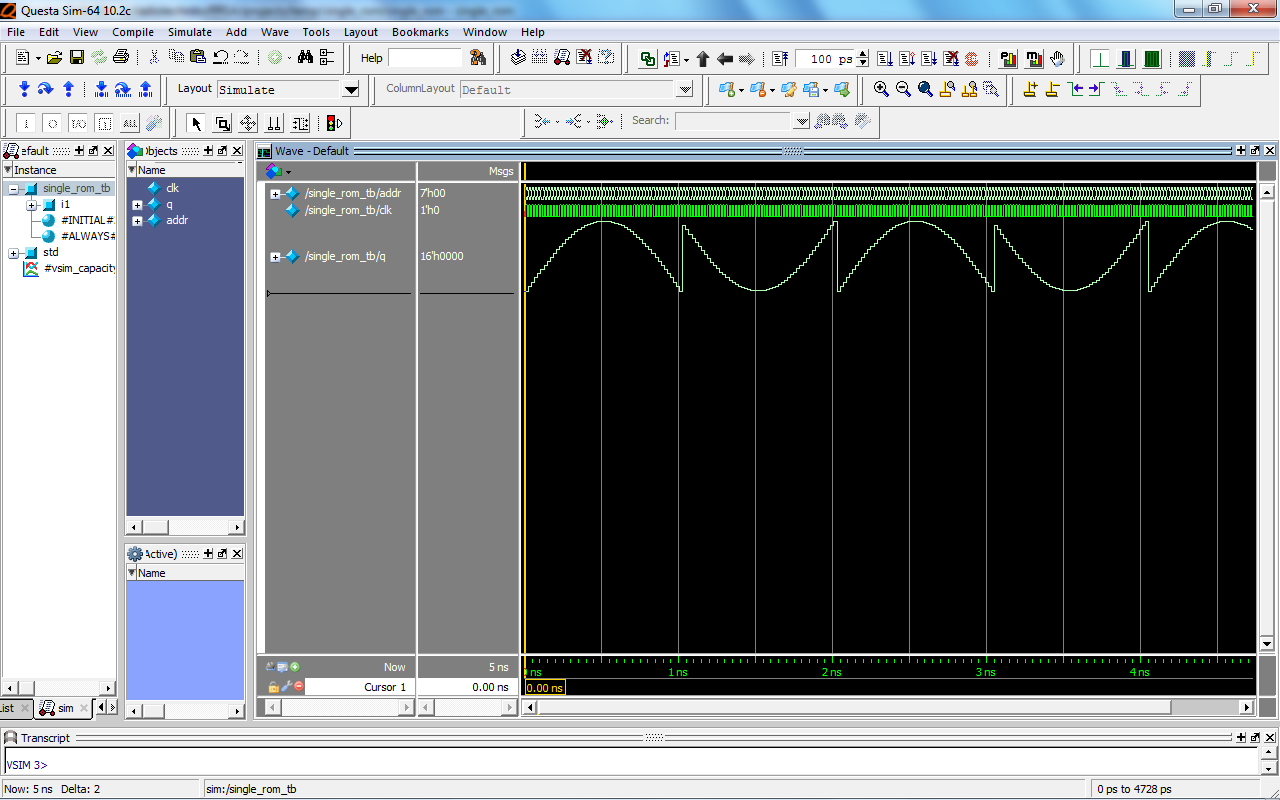
Picture, you can see zeros instead of negative numbers: http://s7.hostingkartinok.com/uploads/thumbs/2014/11/03327b0a1b3e6e4dc3e1dd541e47935d.png (http://hostingkartinok.com/show-image.php?id=03327b0a1b3e6e4dc3e1dd541e47935d)WIDTH=16; DEPTH=110; ADDRESS_RADIX=UNS; DATA_RADIX=DEC; CONTENT BEGIN 0 : 0; 1 : 5; 2 : 15; 3 : 80; 4 : 345; 5 : 656; 6 : -1; 7 : -2; 8 : -3; 9 : -4; 10 : -5; 11 : -6; 12 : 20886; 13 : 22430; 14 : 23885; 15 : 25247; 16 : 26508; 17 : 27665; 18 : 28713; 19 : 29648; 20 : 30465; etc - Altera_Forum
I don't about your tools habits but you can convert negative numbers to positive (bit equivalent):
e.g. for n bits negative values (signed) data = data + 2^n - Altera_Forum--- Quote Start --- I don't about your tools habits but you can convert negative numbers to positive (bit equivalent): e.g. for n bits negative values (signed) data = data + 2^n --- Quote End --- Thank's for your answer, but I did it and I got the following picture it Questa. I can't submit it like a signed number. In radix I use decimal, but it also ansigned. How can i transform it into unsigned? http://s7.hostingkartinok.com/uploads/images/2014/11/504de2f5c58eae37f09eb5c10191f761.png (http://hostingkartinok.com/show-image.php?id=504de2f5c58eae37f09eb5c10191f761)
- Altera_Forum
Not sure if this will fix your problem, but try replacing the "signed" declarations with "integer" in your main code and testbench.
- Altera_Forum
I did it, but it didn't fix my problem.
http://s7.hostingkartinok.com/uploads/images/2014/11/c82d65b2ad13d7b4b3412aaadc4a4fce.png (http://hostingkartinok.com/show-image.php?id=c82d65b2ad13d7b4b3412aaadc4a4fce) - Altera_Forum
sorry, can you show me how to do it, i don't understand.
- Altera_Forum
You are displaying the wave form as hexadecimal. Change the draw type to "signed". Right click -> radix -> signed
- Altera_Forum
no changes, yesterday I wrote about it, but massage didn't post.
I also try -radix signal q signed. - Altera_Forum
I want to create a sin, so the best way (as I understand) is to make nco (I need digital sin-wave). Please, can you advice me some examples about implementation nco in verilog.