User Profile

XNguy4
 New Contributor
Joined 6 years ago


User Widgets
Contributions
Re: 10G transceiver in S10MX
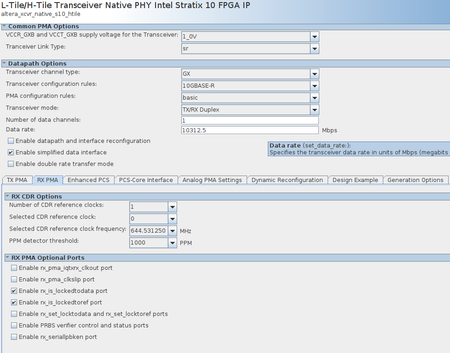
Hi, Thank for your reply. Do you refer lane as channel? I modify the example design to support 4 channels, each channel 10G. I also tested the design with QSFP28 Port 0 and Port 1, but neither worked properly. I already tested the network with an Arria 10 board beforehand. So I am pretty sure it was not the network issue. My approach (B) is based on the document you have sent. The Intel S10MX board only provide QSFP reference clock of 644.5312 MHz. That's why I modified the ref_clk settings in the PHY, ATX, and fPLL module to 644 MHz. PHY setting: modifychange CDR reference clock ATX PLL setting: modify PLL auto mode reference clock altera_xcvr_atx_pll_ip atx_pll_inst( .pll_refclk0(ref_clk_clk), .tx_serial_clk(tx_serial_clk), .pll_locked(atx_pll_locked) ); fPLL setting: modify PLL integer mode reference clock pll fpll_inst ( .pll_refclk0 (ref_clk_clk), .pll_cal_busy (), .outclk_div2 (core_clk_156), // 156.25MHz clock .outclk_div1 (core_clk_312), // 312.50MHz clock .pll_locked (core_pll_locked) ); Top-level file module altera_eth_top # ( parameter NUM_CHANNELS = 4, parameter DEVICE_FAMILY = "Stratix 10" )( input wire CLK_SYS_100M_P, input wire CLK_DDR4_COMP_P, input wire refclk_zqsfp0_p, input wire refclk_zqsfp1_p, input wire CPU_RESETN, output wire [NUM_CHANNELS-1:0] zqsfp0_tx_p, input wire [NUM_CHANNELS-1:0] zqsfp0_rx_p, output wire [NUM_CHANNELS-1:0] zqsfp1_tx_p, input wire [NUM_CHANNELS-1:0] zqsfp1_rx_p, output zqsfp0_1v8_modsel_l , output zqsfp0_1v8_reset_l , input zqsfp0_1v8_modprs_l , output zqsfp0_1v8_lpmode , input zqsfp0_1v8_int_l, output zqsfp1_1v8_modsel_l , output zqsfp1_1v8_reset_l , input zqsfp1_1v8_modprs_l , output zqsfp1_1v8_lpmode , input zqsfp1_1v8_int_l, inout zqsfp_s10_i2c_sda , output zqsfp_s10_i2c_scl ); wire ninit_done; assign zqsfp1_1v8_lpmode = 1'b0; assign zqsfp1_1v8_modsel_l = 1'b0; assign zqsfp1_1v8_reset_l = 1'b1; //CPU_RESETN && ~ninit_done; assign zqsfp0_1v8_lpmode = 1'b0; assign zqsfp0_1v8_modsel_l = 1'b0; assign zqsfp0_1v8_reset_l = 1'b1; // CPU_RESETN && ~ninit_done; assign zqsfp_s10_i2c_sda = 1'bz; assign zqsfp_s10_i2c_scl = 1'bz; wire core_clk_312; // LED wire [NUM_CHANNELS-1:0] block_lock_n; wire [NUM_CHANNELS-1:0] tx_ready_export_n; wire [NUM_CHANNELS-1:0] rx_ready_export_n; // debug clock wire core_clk_156; wire core_pll_locked_n; wire atx_pll_locked_n; wire [NUM_CHANNELS-1:0] avalon_st_rxstatus_valid_156; wire [NUM_CHANNELS-1:0][39:0] avalon_st_rxstatus_data_156; wire [NUM_CHANNELS-1:0][6:0] avalon_st_rxstatus_error_156; wire csr_rst_n; wire tx_rst_n; wire rx_rst_n; wire [NUM_CHANNELS-1:0] block_lock; wire [NUM_CHANNELS-1:0] tx_ready_export; wire [NUM_CHANNELS-1:0] rx_ready_export; wire core_pll_locked; wire atx_pll_locked; wire csr_clk; assign csr_clk = CLK_SYS_100M_P; assign block_lock_n = ~block_lock; assign tx_ready_export_n = ~tx_ready_export; assign rx_ready_export_n = ~rx_ready_export; assign core_pll_locked_n = ~core_pll_locked; assign atx_pll_locked_n = ~atx_pll_locked; // Reset Release module reset_release reset_release_inst( .ninit_done (ninit_done) ); altera_eth_10g_mac_base_r #( .NUM_CHANNELS(NUM_CHANNELS), .DEVICE_FAMILY(DEVICE_FAMILY) ) dut_inst ( .csr_clk (csr_clk), .csr_rst_n (CPU_RESETN && ~ninit_done), .core_clk_312 (core_clk_312), .tx_rst_n (CPU_RESETN && ~ninit_done), .rx_rst_n (CPU_RESETN && ~ninit_done), .ref_clk_clk (refclk_zqsfp1_p), .core_clk_156 (core_clk_156), // csr interface .csr_read (1'b0), .csr_write (1'b0), .csr_writedata (32'b0), .csr_readdata (), .csr_address (16'b0), .csr_waitrequest (), .tx_ready_export (tx_ready_export), .rx_ready_export (rx_ready_export), .block_lock (block_lock), .tx_serial_data (zqsfp1_tx_p), .rx_serial_data (zqsfp1_rx_p), .core_pll_locked (core_pll_locked), .atx_pll_locked (atx_pll_locked), .avalon_st_rxstatus_valid_156 (avalon_st_rxstatus_valid_156), .avalon_st_rxstatus_data_156 (avalon_st_rxstatus_data_156), .avalon_st_rxstatus_error_156 (avalon_st_rxstatus_error_156) ); endmodule Thanks2KViews0likes0Comments10G transceiver in S10MX
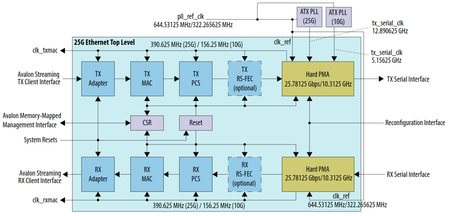
Hi, I am bringing up the transceiver in the Stratix 10 MX development kit using both approaches below APPROACH (A) I followed the 25G Ethernet Intel Stratix 10 FPGA IP User Guide. My implementation steps: 1) Generate the example design 10/25G Ethernet Intel Stratix 10 2) Change the top-level, QSF, and SDC files corresponding to the S10MX board (using the golden example file from HERE) 3) Connect the transceiver reference clock to 644.53125 clock source. I tested with QSFP Port 0 and 1 at 10G mode, and always received RX_MAC error, i.e. l1_rx_error = 0x3 or 0x4 APPROACH (B) I followed the Low Latency Ethernet 10G MAC Intel Stratix 10 FPGA IP Design Example User Guide My implementation steps: 1) Generate the example design Low Latency Ethernet 10G 2) Change the top-level, QSF, and SDC files corresponding to the S10MX board (using the golden example file from HERE) 3) Change the ref_clk_clk to 644.5312 MHz. Then reconfigure - fPLL: ref_clk =644.5312 MHz. outclk_div1 = 312.5 MHz, outclk_div2 = 156.25 MHz - ATX PLL: ref_clk = 644.5312 MHz - PHY: rx_cdr_refclk0 = 644.5312 MHz 4) Change csr_clk to either 100 or 125 MHz. Then reconfigure Reset Synchronizer: ref_clk = 100 or 125 MHz. I tested the design with - QSFP Port 0: All 4 channels got local faults - QSFP Port 1: channel 0 passed (both TX and RX are Idle). Channel 1, 2, 3 got local faults The setting is pretty straightforward. Is there any way to figure out where the problem is? Thanks2KViews0likes4CommentsRe: DDR4 HILO in S10MX failed initialization
Hi @ybin , Thank you for your response. 1) I am using Quartus pro 19.4 in our system. The HILO module will need to be integrated into our system later. Therefore, I don't see any reason to downgrade the Quartus from 19.4 to 18.1 just for testing for memory module. 2) The example design is using 1066 MHz. Does lower EMIF clock to 933 MHz mean the example design was not correct? 3) The example design already disabled that setting. Thanks2.6KViews0likes6CommentsDDR4 HILO in S10MX failed initialization
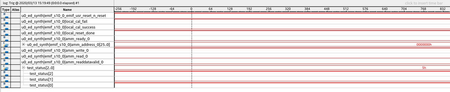
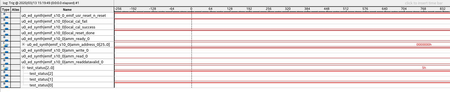
I am using the qts_hilo_ddr4_x72_1066MHz sample project to test the DDR4 HILO in the Stratix 10 MX development kit. I didn't change anything, except upgrading the project from Quartus 18.1 to Quartus 19.4. After downloading the SOF file in the board, I used SignalTap to observe the signals and realized that DDR4 HILO controller module always returned local_cal_fail = 1. Please find the sample project attached and let me know how I can fix the issues. Thank you very much,2.8KViews0likes9CommentsRe: DDR4 HILO in S10MX failed initialization
Thank you for your quick reply. I also built the sample project in Quartus Pro 18.1 and got the same problem. I'm not sure which PLL signal you mentioned as I didn't change anything in the sample project. You can see the reset_n = 1 with local_reset_done = 1 in the SignalTap Also, no timing violation was reported in TimeQuest. Please let me know how I can fix it. Thanks,2.1KViews0likes0CommentsRe: Error: Could not find or load main class com.intel.bts.BtsApp
Thank for quick reply. I believed that it wasn't Quartus problem, but the Java software bts.jar. I run bts.jar in Ubuntu 18.04 at got the same problem Command: java -jar bts.jar Error: Could not find or load main class com.intel.bts.BtsApp Caused by: java.lang.NoClassDefFoundError: javafx/application/Application I wonder if anyone got this problem before. Thanks.11KViews0likes0CommentsError: Could not find or load main class com.intel.bts.BtsApp
I'm trying to run the board test system for Stratix 10 MX development kit in CentOS 7.7 and hit to the error below Error: Could not find or load main class com.intel.bts.BtsApp Is there anyone know how to fix it? Thanks,11KViews0likes16Comments