User Profile

gazel
 New Contributor
Joined 5 years ago


User Widgets
Contributions
The exe file generated after the high level synthesis does not work
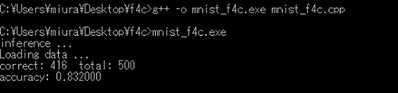
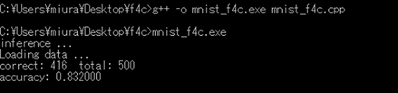
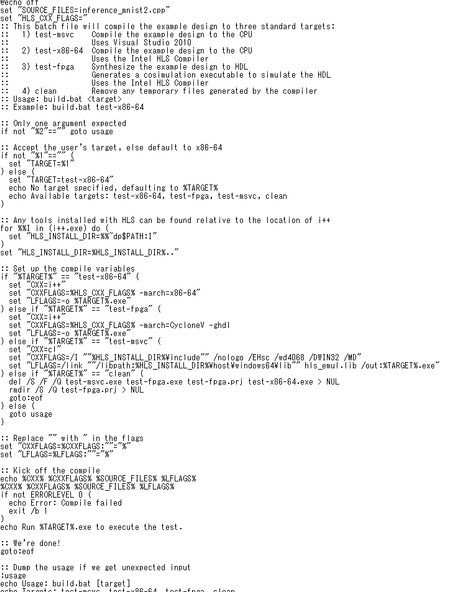
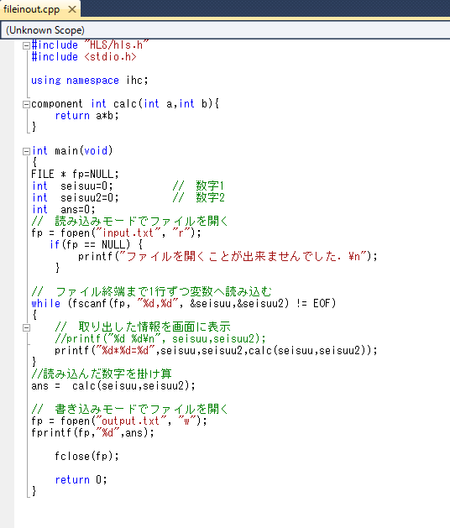
I would like to simulate only the inference part of a MNIST three-layer fully coupled neural network with high level synthesis and modelsim. The weights will be input from a txt file. After the high level synthesis, an exe file is generated, but when I run it, nothing happens. What could be the cause of this? I ran the file input program (fileinout.cpp) for practice and it worked fine. The inference program works when I don't use hls.(same program)661Views0likes1CommentThe exe file generated after the high level synthesis does not work
I would like to simulate only the inference part of a MNIST three-layer fully coupled neural network with high level synthesis and modelsim. The weights will be input from a txt file. After the high level synthesis, an exe file is generated, but when I run it, nothing happens. What could be the cause of this? I ran the file input program (fileinout.cpp) for practice and it worked fine. The inference program works when I don't use hls.(same program)826Views0likes3Commentstestbench description method
I am currently trying to separate the training and inference parts of an all coupled 3-layer neural network using MNIST, and then synthesize the inference part at a high level and simulate it using modelsim. I think I need a testbench for simulation, but how can I write a testbench in C++ and synthesize it and the inference program in high level? inference_mnist_f3 is inference program train_mnist is train program(not synthesize)955Views0likes3CommentsHLScompile error
I would like to synthesize a three-layer fully coupled neural network at a high level. I tried to use HLScompiler to high-level synthesize the C++ code, but I got an error. If anyone can tell me how to solve this error, I would appreciate it. cppcode #include <algorithm> #include <iostream> #include <vector> #include <math.h> #include <fstream> #include <sstream> #include <string> #include <random> #include "HLS/hls.h" using namespace std; void print ( const vector <float>& m, int n_rows, int n_columns ) { /* "Couts" the input vector as n_rows x n_columns matrix. Inputs: m: vector, matrix of size n_rows x n_columns n_rows: int, number of rows in the left matrix m1 n_columns: int, number of columns in the left matrix m1 */ for( int i = 0; i != n_rows; ++i ) { for( int j = 0; j != n_columns; ++j ) { cout << m[ i * n_columns + j ] << " "; } cout << '\n'; } cout << endl; } int argmax ( const vector <float>& m ) { return distance(m.begin(), max_element(m.begin(), m.end())); } vector <float> relu(const vector <float>& z){ int size = z.size(); vector <float> output; for( int i = 0; i < size; ++i ) { if (z[i] < 0){ output.push_back(0.0); } else output.push_back(z[i]); } return output; } vector <float> reluPrime (const vector <float>& z) { int size = z.size(); vector <float> output; for( int i = 0; i < size; ++i ) { if (z[i] <= 0){ output.push_back(0.0); } else output.push_back(1.0); } return output; } vector <float> softmax (const vector <float>& z, const int dim) { const int zsize = static_cast<int>(z.size()); vector <float> out; for (unsigned i = 0; i != zsize; i += dim) { vector <float> foo; for (unsigned j = 0; j != dim; ++j) { foo.push_back(z[i + j]); } float max_foo = *max_element(foo.begin(), foo.end()); for (unsigned j = 0; j != dim; ++j) { foo[j] = exp(foo[j] - max_foo); } float sum_of_elems = 0.0; for (unsigned j = 0; j != dim; ++j) { sum_of_elems = sum_of_elems + foo[j]; } for (unsigned j = 0; j != dim; ++j) { out.push_back(foo[j]/sum_of_elems); } } return out; } vector <float> sigmoid_d (const vector <float>& m1) { /* Returns the value of the sigmoid function derivative f'(x) = f(x)(1 - f(x)), where f(x) is sigmoid function. Input: m1, a vector. Output: x(1 - x) for every element of the input matrix m1. */ const unsigned long VECTOR_SIZE = m1.size(); vector <float> output (VECTOR_SIZE); for( unsigned i = 0; i != VECTOR_SIZE; ++i ) { output[ i ] = m1[ i ] * (1 - m1[ i ]); } return output; } vector <float> sigmoid (const vector <float>& m1) { /* Returns the value of the sigmoid function f(x) = 1/(1 + e^-x). Input: m1, a vector. Output: 1/(1 + e^-x) for every element of the input matrix m1. */ const unsigned long VECTOR_SIZE = m1.size(); vector <float> output (VECTOR_SIZE); for( unsigned i = 0; i != VECTOR_SIZE; ++i ) { output[ i ] = 1 / (1 + exp(-m1[ i ])); } return output; } vector <float> operator+(const vector <float>& m1, const vector <float>& m2){ /* Returns the elementwise sum of two vectors. Inputs: m1: a vector m2: a vector Output: a vector, sum of the vectors m1 and m2. */ const unsigned long VECTOR_SIZE = m1.size(); vector <float> sum (VECTOR_SIZE); for (unsigned i = 0; i != VECTOR_SIZE; ++i){ sum[i] = m1[i] + m2[i]; }; return sum; } vector <float> operator-(const vector <float>& m1, const vector <float>& m2){ /* Returns the difference between two vectors. Inputs: m1: vector m2: vector Output: vector, m1 - m2, difference between two vectors m1 and m2. */ const unsigned long VECTOR_SIZE = m1.size(); vector <float> difference (VECTOR_SIZE); for (unsigned i = 0; i != VECTOR_SIZE; ++i){ difference[i] = m1[i] - m2[i]; }; return difference; } vector <float> operator*(const vector <float>& m1, const vector <float>& m2){ /* Returns the product of two vectors (elementwise multiplication). Inputs: m1: vector m2: vector Output: vector, m1 * m2, product of two vectors m1 and m2 */ const unsigned long VECTOR_SIZE = m1.size(); vector <float> product (VECTOR_SIZE); for (unsigned i = 0; i != VECTOR_SIZE; ++i){ product[i] = m1[i] * m2[i]; }; return product; } vector <float> operator*(const float m1, const vector <float>& m2){ /* Returns the product of a float and a vectors (elementwise multiplication). Inputs: m1: float m2: vector Output: vector, m1 * m2, product of two vectors m1 and m2 */ const unsigned long VECTOR_SIZE = m2.size(); vector <float> product (VECTOR_SIZE); for (unsigned i = 0; i != VECTOR_SIZE; ++i){ product[i] = m1 * m2[i]; }; return product; } vector <float> operator/(const vector <float>& m2, const float m1){ /* Returns the product of a float and a vectors (elementwise multiplication). Inputs: m1: float m2: vector Output: vector, m1 * m2, product of two vectors m1 and m2 */ const unsigned long VECTOR_SIZE = m2.size(); vector <float> product (VECTOR_SIZE); for (unsigned i = 0; i != VECTOR_SIZE; ++i){ product[i] = m2[i] / m1; }; return product; } vector <float> transpose (float *m, const int C, const int R) { /* Returns a transpose matrix of input matrix. Inputs: m: vector, input matrix C: int, number of columns in the input matrix R: int, number of rows in the input matrix Output: vector, transpose matrix mT of input matrix m */ vector <float> mT (C*R); for(unsigned n = 0; n != C*R; n++) { unsigned i = n/C; unsigned j = n%C; mT[n] = m[R*j + i]; } return mT; } vector <float> dot (const vector <float>& m1, const vector <float>& m2, const int m1_rows, const int m1_columns, const int m2_columns) { /* Returns the product of two matrices: m1 x m2. Inputs: m1: vector, left matrix of size m1_rows x m1_columns m2: vector, right matrix of size m1_columns x m2_columns (the number of rows in the right matrix must be equal to the number of the columns in the left one) m1_rows: int, number of rows in the left matrix m1 m1_columns: int, number of columns in the left matrix m1 m2_columns: int, number of columns in the right matrix m2 Output: vector, m1 * m2, product of two vectors m1 and m2, a matrix of size m1_rows x m2_columns */ vector <float> output (m1_rows*m2_columns); for( int row = 0; row != m1_rows; ++row ) { for( int col = 0; col != m2_columns; ++col ) { output[ row * m2_columns + col ] = 0.f; for( int k = 0; k != m1_columns; ++k ) { output[ row * m2_columns + col ] += m1[ row * m1_columns + k ] * m2[ k * m2_columns + col ]; } } } return output; } vector<string> split(const string &s, char delim) { stringstream ss(s); string item; vector<string> tokens; while (getline(ss, item, delim)) { tokens.push_back(item); } return tokens; } int main(int argc, const char * argv[]) { string line; vector<string> line_v; cout << "inference ...\n"; cout << "Loading data ...\n"; vector<float> X_test; vector<float> y_test; ifstream myfile ("train.txt"); if (myfile.is_open()) { while ( getline (myfile,line) ) { line_v = split(line, '\t'); int digit = strtof((line_v[0]).c_str(),0); for (unsigned i = 0; i < 10; ++i) { if (i == digit) { y_test.push_back(1.); } else y_test.push_back(0.); } int size = static_cast<int>(line_v.size()); for (unsigned i = 1; i < size; ++i) { X_test.push_back(strtof((line_v[i]).c_str(),0)); } } X_test = X_test/255.0; myfile.close(); } else cout << "Unable to open file" << '\n'; int xsize = static_cast<int>(X_test.size()); int ysize = static_cast<int>(y_test.size()); int num_data = ysize / 10; // Random initialization of the weights(乱数初期化) //vector <float> W1 = random_vector(784*128); //vector <float> W2 = random_vector(128*10); //学習データをロードする場合 vector <float> W1; vector <float> W2; int tmp; ifstream infile1("W1.txt"); if (infile1.is_open()){ while ( getline (infile1,line) ){ line_v = split(line, ' '); //for (auto it:line_v) { for (vector<string>::const_iterator it = line_v.begin(); it != line_v.end(); it++) { //W1.emplace_back(stof(it)); W1.push_back(stof(*it)); } } } infile1.close(); ifstream infile2("W2.txt"); if (infile2.is_open()){ while ( getline (infile2,line) ){ line_v = split(line, ' '); //for (auto it:line_v) { for (vector<string>::const_iterator it = line_v.begin(); it != line_v.end(); it++) { //W2.emplace_back(stof(*it)); W2.push_back(stof(*it)); } } } infile2.close(); //vector <float> W3 = random_vector(64*10); int correct_cnt = 0; for(int i=0;i<num_data;++i) { vector<float> b_X; vector<float> b_y; for (unsigned j = i*784; j < (i+1)*784; ++j){ b_X.push_back(X_test[j]); } for (unsigned k = i*10; k < (i+1)*10; ++k){ b_y.push_back(y_test[k]); } vector<float> a1 = relu(dot( b_X, W1, 1, 784, 128 )); //vector<float> a2 = relu(dot( a1, W2, 1, 128, 64 )); vector<float> yhat = softmax(dot( a1, W2, 1, 128, 10 ), 10); if(argmax(yhat) == argmax(b_y)) { ++correct_cnt; } } cout<< "correct: " << correct_cnt <<" total: "<< num_data << endl; cout<< "accuracy: "<< (double) correct_cnt / num_data <<endl; }872Views0likes0CommentsMultiplication using file I/O
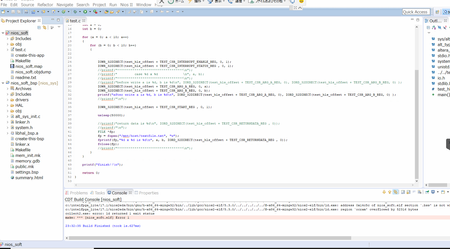
I was able to implement a multiplication circuit using high-level synthesis and display the calculation results on the screen using nios. Now, I want to change the system to read the two numbers to be multiplied from a file and output the calculation results to another file. We think it will mainly be a rewrite of test.c. I know that I need to write FILE*fp; etc., but I would like to know in detail how to pass the numbers from the file to a and b, and how to output the calculation results to a file.1.5KViews0likes3CommentsFPGA implementation of file I/O circuits using HLScompiler
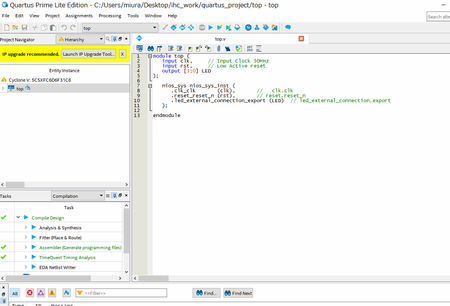
I would like to implement a file input/output circuit (file_in_out.cpp) written in C++ on a DE10-standard (5CSXFC6D6F31C6) using intelHLScompiler. I was able to implement it on FPGA with quartusprime17.1 using high-level synthesis, but it does not work correctly. I tried to turn on the LED at the end of the circuit to check if the circuit is working, but it did not turn on. Personally, I think the placement and wiring of qsys is not good, can you tell me what is wrong? Please help me.Solved1.2KViews0likes2Comments