soc devkit
30 Topics
Design of MAX V CPLD 5M2210 System Controller in Arria 10 SoC board
Hi Altera, Could you help to share the MAX V CPLD 5M2210 System Controller with me? We're in AI research work with Arria 10 SoC board and need the source code of system maxV but is not included in the installer package, arria10_10as066n3f40_soc_v15.1.2.zip. Thank you!400Views0likes7Comments
Workaround for TCK frq. limitations on USB-Blaster I/II/III & Clones (fixing "JTAG chain broken")
Workaround for TCK frequency limitations on USB-Blaster I/II/III and clones (fixing "JTAG chain broken") Hi everyone, I'd like to share a practical workaround for a problem many of us run into when programming Altera FPGAs through test fixtures, level shifters or long ribbon cables. **The problem** In these setups, "JTAG chain broken" or "Unable to scan device chain" errors are common. They are usually caused by signal reflections and poor termination on custom boards and long extensions. Lowering the TCK frequency is the standard remedy, but the options are limited: - USB-Blaster I (and most low-cost clones) runs at a fixed TCK of about 6 MHz. Quartus offers no way to change it. - USB-Blaster II can be set to 6/16/24 MHz via `jtagconfig --setparam <cable> JtagClock <freq>`, but nothing below 6 MHz. In practice this setting is also unreliable: it is not persistent and can fall back to the 24 MHz default (see Altera KB: "Why does the TCK frequency setting of the USB-Blaster II download cable revert to the default value of 24 MHz after being changed?"). In our experience it is a constant source of trouble, especially in production where it has to be set again and again. For really marginal lines, 6 MHz is often still too fast. **The workaround** Disclosure: I'm the developer of the tool described below, so please take this as information from the vendor. Quintus Programmer (by Dution) drives the JTAG lines of the USB-Blaster in bit-bang mode instead of using the adapter's fixed shift clock. This lets you choose the TCK frequency freely, e.g. down to 100 kHz, with the same USB-Blaster I/II/III or clones you already have. With a lower TCK, programming and verification become stable again on long or poorly terminated lines without any hardware changes. The standard USB-Blaster driver stays in place, and Quintus only replaces the programming step. **Before reaching for software, check the hardware basics** The recommendations from the Altera Knowledge Base still apply and often fix the problem on their own: - TCK pull-down 1 kΩ to GND, TMS/TDI pull-up 10 kΩ to VCCIO - a small capacitor (10–22 pF) at TCK near the FPGA against ringing edges - a TCK buffer on long or noisy lines If the layout can't be changed, a lower TCK is a practical way out. More info: search for "Quintus Programmer Dution". Happy to answer technical questions here.200Views0likes2Comments
yolov3_tiny_tf run_inference_stream problem
i have completed successfully Arria 10 SoC demo project resnet-50-tf on Arria 10 SoC devkit. (my tool version intel fpga ai suite 2025.1 and open vino 2024.6). i have used the precompile arria10 wic image. Arria 10 SoC devkit: https://www.altera.com/products/devkit/a1jui0000049utgmam/arria-10-sx-soc-development-kit SoC Demo project: https://www.intel.com/content/www/us/en/docs/programmable/848957/2025-1/soc-design-example-prerequisites.html Then, i have compiled yolo_v3_tiny_tf model with no folding and device fpga, cpu to obtain .bin file. When i run the ./run_inference_stream.sh, it get this error: root@arria10:~/app# ./run_inference_stream.sh Runtime version check is enabled. [ INFO ] Architecture used to compile the imported model: A10_Performance Using licensed IP Read hash from bitstream ROM... Read build version string from bitstream ROM... Read arch name string from bitstream ROM... Runtime arch check is enabled. Check started... Runtime arch check passed. Runtime build version check is enabled. Check started... Runtime build version check passed. Exception from src/inference/src/cpp/core.cpp:184: Exception from src/inference/src/dev/plugin.cpp:73: Exception from src/inference/src/dev/plugin.cpp:73: Exception from src/plugins/intel_cpu/src/utils/serialize.cpp:145: [CPU] Could not deserialize by device xml header. How can i solve this problem? Thank you. Note: root@arria10:~/app# ls build_os.txt libopenvino_auto_batch_plugin.so build_version.txt libopenvino_auto_plugin.so categories.txt libopenvino_c.so dla_benchmark libopenvino_c.so.2024.6.0 hetero_plugin libopenvino_c.so.2460 image_streaming_app libopenvino_ir_frontend.so libcoreDLAHeteroPlugin.so libopenvino_ir_frontend.so.2024.6.0 libcoreDlaRuntimePlugin.so libopenvino_ir_frontend.so.2460 libformat_reader.so libopenvino_jax_frontend.so libhps_platform_mmd.so libopenvino_jax_frontend.so.2024.6.0 libopencv_core.so.4.8.0 libopenvino_jax_frontend.so.2460 libopencv_core.so.408 libopenvino_pytorch_frontend.so libopencv_highgui.so.4.8.0 libopenvino_pytorch_frontend.so.2024.6.0 libopencv_highgui.so.408 libopenvino_pytorch_frontend.so.2460 libopencv_imgcodecs.so.4.8.0 libopenvino_template_extension.so libopencv_imgcodecs.so.408 libopenvino_tensorflow_lite_frontend.so libopencv_imgproc.so.4.8.0 libopenvino_tensorflow_lite_frontend.so.2024.6.0 libopencv_imgproc.so.408 libopenvino_tensorflow_lite_frontend.so.2460 libopencv_videoio.so.4.8.0 plugins.xml libopencv_videoio.so.408 results.txt libopenvino.so run_image_stream.sh libopenvino.so.2024.6.0 run_inference_stream.sh libopenvino.so.2460 streaming_inference_app libopenvino_arm_cpu_plugin.soSolved200Views0likes9Comments
Access to System MAX design for Agilex 5 kit
For the Agilex 7 I-Series Transceiver-SoC Development Kit (DK-SI-AGI027Fx), the design source for the on-board System MAX10 device is included in the installer package, under examples. For the Agilex 5 E-Series 065B Premium Development Kit (DK-A5E065BB32AEx) it is not. Is the System MAX design for the Agilex 5 kit available from somewhere else? If not, is that because of the preliminary status of that kit, or will that design never be made available?Solved199Views0likes6CommentsAgilex5 Eagle ES, NIOS-V + TSE IP
Trying to setup a NIOS-V with a TSE MAC to utilize the ethernet interface connected to the FPGA on the Agilex Eagle ES devkit. NIOS executes firmware and able to read the PHY registers. But when connecting the ethernet cable nothing seems to happen, status registers does not change and no link-up is reported. Does anyone know of any examples using the NIOS-V and TSE with RGMII interface that I can look at to troubleshoot the issue ?199Views0likes5Comments"No Video Input" message on the monitor running Display port design example for Arria 10 SX SoC
Hi, I am stuck trying to test Display Port on my Arria 10 SX SoC board. I need TX only design example. I tried to download full design example from Intel/Altera web sites, but mostly they are for older Quartus versions or for FMC daughter cards. I want to test Display Port onboard connector. My Quartus version is Quartus Pro 25.1, device - 10AS066N3F40E2SG1 Also I tried to generate design example in Platform Designer and I succeeded to receive EDID from monitor and it seems that handshake is done, but I see only "No Video Input" message on my monitor. I spend more than a week discovering the issue and I assume that PMA settings might be wrong or incorrect link rate/clock frequencies. Thanks in advance for any help!199Views0likes7Comments
Device stopped receiving config data: Internal error (0x0000, 0x00000000, 0x1800).
Using Agilex AGFB014R24A (E-Tile board). .jic flashes successfully, but no UART logs are observed after boot. Observed attached logs attached When programming the corresponding .sof via JTAG, configuration fails at ~86%. Device has stopped receiving configuration data Error message received from device: Internal error. (Subcode 0x0000, Info 0x00000000, Location 0x00001800) Operation failed Ended Programmer operation Looking for clarification on this internal error and recommended workaround.116Views0likes3CommentsF2SDRAM max burst length - Agilex5
Hello, I'm using an Agilex 5 E-Series 065B Premium Devkit. I have successfully accessed the DDR4 through the F2SDRAM interface using a 256-bit data bus width and INCR burst type. The problem is I can't set AxLEN > 128 or the AXI4 interface will break. I would like to use AxLEN = 256 for maximum throughput. According to the Hard Processor System Technical Reference Manual: Agilex 5 SoCs (v25.3), page 799, Table 333: AxLEN[7:0] - INCR burst type is 1 to 256 transfers. So AxLEN = 256 should be supported. Can anyone clarify if the maximum burst length is indeed 128 or 256 ? Best regards.Solved107Views0likes3CommentsEMIF HPS errors after upgrading to Quartus 25.3
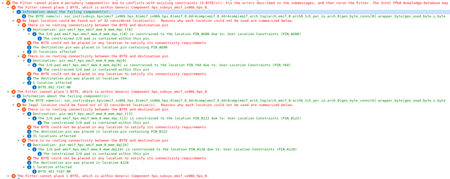
So I'm trying to upgrade an Agilex-5 project from Quartus 25.1 to 25.3 but the project no longer compiles with errors relative to the EMIF HPS IP. I'm using an Agilex 5 FPGA E-Series 065B Premium Devkit. The project was based in the GSRD for Quartus 25.1 (QPDS25.1_REL_GSRD_PR) and had a few modifications, working in version 25.1. Firstly, when upgrading to Quartus 25.3, the auto-update does not work with errors to the Agilex-5 HPS IP and EMIF HPS IP. I'm forced to upgrade manually which also results in errors but fixed with this workaround: https://www.intel.com/content/www/us/en/support/programmable/articles/000102053.html In the end I can Generate HDL sources from Platform Designer but compilation stops with errors in the Fitter stage: I've noticed that the new EMIF HPS IP version has a difference in the signal mem_0_bg that only has 1 bit in the latest version but was 2-bit wide in the previous versions. I don't know if the problem comes from this: Another interesting thing that I found is that in the latest GSRD project (QPDS25.3_REL_GSRD_PR) the EMIF HPS IP used is not the latest version (4.1.0) but a previous one (4.0.0). So I'm guessing someone from Altera already discovered some sort of problem here: Looking for advice on how to proceed.Solved104Views0likes3Comments