Altera_Forum Honored Contributor
8 years agoHonored Contributor[QSYS] Wrong Avalon memory address generation?
Hi folks,
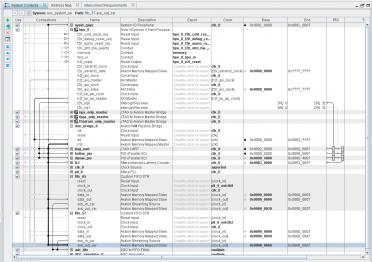
New year, new opportunities, new problems :P Tl;dr: It looks like Qsys generates address outside of the address space (instead of 0x20, it makes it 0x400000020). Does anybody knows why and/or how to fix this? I came upon the following problem. I have a Qsys system for a CycloneV (see attached screen shot) with some custom made FIFOs (I make the FIFOs myself because the Altera FIFOs are too slow for the application). The basis of this Qsys system originates from this tutorial (https://bitlog.it/hardware/building-embedded-linux-for-the-terasic-de10-nano-and-other-cyclone-v-soc-fpgas/). The FIFOs are used to buffer the data coming from the FPGA with the HPS as destination. The Avalon memory mapped interfaces (two data-out interfaces and two Control-Status-Register interfaces) of those FIFOs are at 0x0, 0x20, 0x40, and 0x60. Qsys accepts this system and has no problems generating it without significant warnings. However, when I want to try to compile this system in Quartus, it starts producing errors. It has to do with the interconnect and addresses of these FIFOs. Instead of mapping the FIFOs to 0x0, 0x20, 0x40, and 0x60, it maps these interfaces to 0x400000000, 0x400000020, 0x400000040, and 0x400000060. Those addresses are, of course, out of the 32 bit address space of the Avalon buss, which results in problems. I have no clue why this happens for my custom IPs, while all other (Altera) IPs at the same Avalon h2f_lw buss are mapped to the right memory address. A sniplet of the errorous code generated by Quartus is shown below (in my case it is the file soc_system_lw_mm_interconnect_3_router.sv).
    // -------------------------------------------------------
    // Figure out the number of bits to mask off for each slave span
    // during address decoding
    // -------------------------------------------------------
    localparam PAD0 = log2ceil(64'h400000000 - 64'h0);
    localparam PAD1 = log2ceil(64'h400000020 - 64'h20);
    localparam PAD2 = log2ceil(64'h400000040 - 64'h40);
    localparam PAD3 = log2ceil(64'h400000060 - 64'h60);
    localparam PAD4 = log2ceil(64'h4010 - 64'h4000);
    localparam PAD5 = log2ceil(64'h5010 - 64'h5000);
    localparam PAD6 = log2ceil(64'h10008 - 64'h10000);
    localparam PAD7 = log2ceil(64'h20008 - 64'h20000);
    localparam PAD8 = log2ceil(64'h30100 - 64'h30000);
    // -------------------------------------------------------
    // Work out which address bits are significant based on the
    // address range of the slaves. If the required width is too
    // large or too small, we use the address field width instead.
    // -------------------------------------------------------
    localparam ADDR_RANGE = 64'h400000060;
    localparam RANGE_ADDR_WIDTH = log2ceil(ADDR_RANGE);
    localparam OPTIMIZED_ADDR_H = (RANGE_ADDR_WIDTH > PKT_ADDR_W) ||
                                  (RANGE_ADDR_WIDTH == 0) ?
                                        PKT_ADDR_H :
                                        PKT_ADDR_L + RANGE_ADDR_WIDTH - 1;
    localparam RG = RANGE_ADDR_WIDTH-1;
// ( 0x0 .. 0x400000000 )
    if ( {address,{PAD0{1'b0}}} == 35'h0  && read_transaction  ) begin
            src_channel = 9'b000100000;
            src_data = 6;
    end
    // ( 0x20 .. 0x400000020 )
    // ( no optimization for non-address-span aligned address range )
    if ( ( ( sink_data >= 'h20) && (sink_data < 'h400000020) )
             && read_transaction  ) begin
            src_channel = 9'b000000100;
            src_data = 5;
            src_data = sink_data - 'h20;
    end
    // ( 0x40 .. 0x400000040 )
    // ( no optimization for non-address-span aligned address range )
    if ( ( ( sink_data >= 'h40) && (sink_data < 'h400000040) )
             && read_transaction  ) begin
            src_channel = 9'b001000000;
            src_data = 4;
            src_data = sink_data - 'h40;
    end
    // ( 0x60 .. 0x400000060 )
    // ( no optimization for non-address-span aligned address range )
    if ( ( ( sink_data >= 'h60) && (sink_data < 'h400000060) )
             && read_transaction  ) begin
            src_channel = 9'b000001000;
            src_data = 3;
            src_data = sink_data - 'h60;
    end