Ashoo New Contributor
New ContributorNew Contributor New Contributor
Hi Wincent
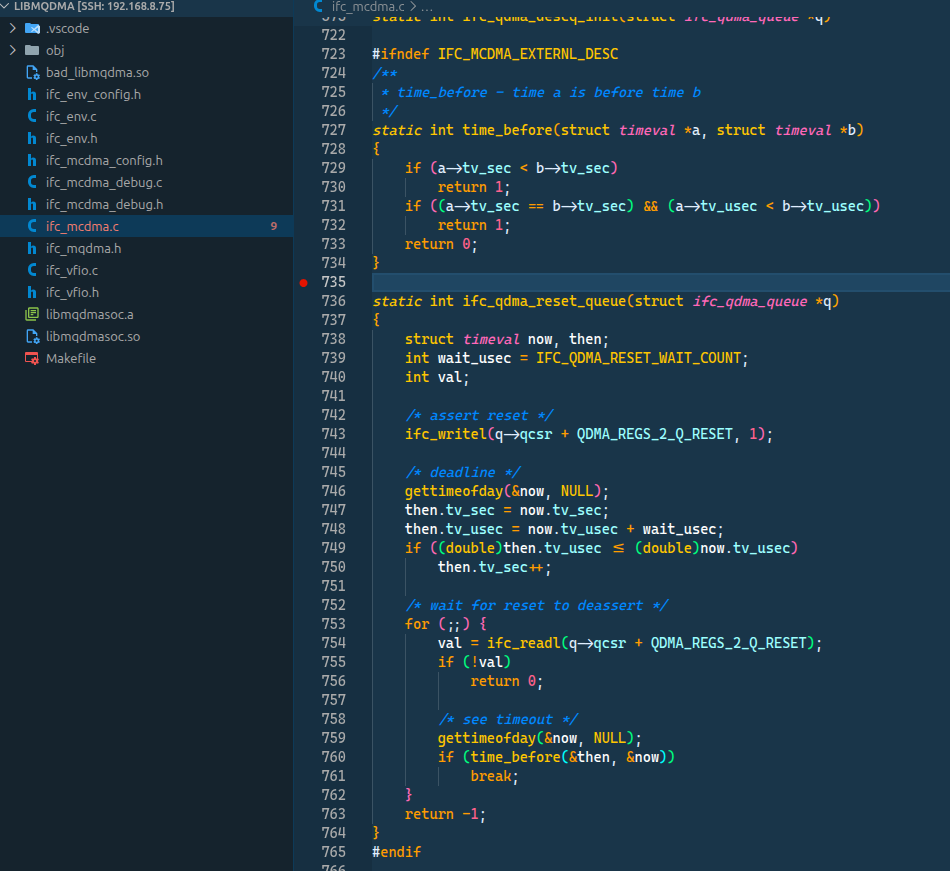
We checked the sequence of channel initialization, queue reset, and resource management and made sure it was according to the official guide, but still the problem persists, nothing unusual was found in desmg log. Therefore we used gdb to check the actual line of code where the problem was occuring.
According to our analysis, problem occured in queue_reset function of ifc and mostly due to timeout being exeeded. Therefore we commented out the timeout block and re-compiled the libmqdmasoc.so lib and the problem resolved, and we are able to create the desired number of channels.
The natural doubt which occured to us was why was the timeout present in the code in the first place ?, Why is that value defined to be 2048 micro seconds?
If we comment it what drawbacks we will get ?
Please give us concrete reasoning.
I am attaching the screenshot of snippet of queue reset function call which is present in ifc_mcdma.c file.
Regards,
Ashoo

 Regular Contributor
Hi Ashoo ,
Glad to hear that you are able to bypass the error, thanks for sharing with me how you work on it.
Based on my understanding.
I recommend you to consider to increase the timeout value that suit with you system , for example 10000us or more.
Regards,
Wincent
New ContributorHi Wincent_Altera ,
Thanks for your explanation regarding the queue reset timeout. We will increase the timeout value as suggested.
However, we are currently observing a different issue during runtime testing.
Previously, all channels were working correctly in D2H mode when initialized one by one. But now, during testing of same design and same application with/without timeout added:
Please provide insights regarding the same.
I have a few questions regarding MCDMA behaviour as well:
Please provide concrete reasoning.
Regards,
Ashoo
Regular ContributorHi Ashoo ,
Based on my understanding..
Question 1 - The behavior where Channel 2 gets stuck when Channel 1 is active, but resumes once Channel 1 stops, is classic evidence of resource contention or starvation. This typically happens at the memory bus (AVMM) or descriptor fetch interface, where one channel monopolizes shared hardware resources, preventing others from proceeding.
Question 2 - MCDMA typically using round-robin for channel access. This can depend on your IP configuration, but in most cases, the arbitration policy is not designed for strict fairness or bandwidth balancing.
Question 3 - As more channels are initialized, each new queue reset takes longer. This is likely due to the reset logic waiting for access to shared hardware (e.g., AVMM, state machines, FIFOs). These delays are aggravated when other channels are active and holding bus resources.
Hope that able to help you to move forward.
I am just trying to share some experience based on what I understand from your issue, do correct me if there is anything I misunderstand.
Regards,
Wincent
Regular ContributorHi Ashoo ,
Is there anything else I can better assist you ?
Regards,
Wincent_Altera
New ContributorHi Wincent_Altera ,
Regarding bandwidth balancing: What are the best practices for efficient bandwidth distribution across channels to ensure high line-rate efficiency and minimum latency, while maintaining arbitration fairness to prevent channel starvation?
Sincerely,
Ashoo