Forum Discussion

 New Contributor
FFT IP Core - Input and output number format?

 Regular Contributor
Hi,
As I understand it, you have some inquiries regarding to the data format for the FFT. For your information, by default, the data format configuration in the FFT = Fixed Point. With Fixed Point, the FFT will treat the input and output data as normal binary data without sign. Note that after the FFT, there will be bit grow. So, you will ensure you have sufficient output width.
Please let me know if there is any concern. Thank you.
Best regards,
Chee Pin
 New Contributor
So using fixed point number format means that the FFT cannot deal with negative numbers and will treat all values as unsigned fixed point with no scale factor. So just whole, positive numbers?
So to see a correct display of my output values in signal tap, I should set the bus display format to unsigned decimal?
Many thanks
Jack
- CheepinC_altera6 years agoHi Jack, Yes, you are right. When you are using fixed point number format, the FFT will treat the number as if positive binary number. You can use unsigned decimal for bus display in signaltap to view. Alternatively, you can also use single floating point if you would like to the FFT to process decimal and signed/unsigned number. Please let me know if there is any concern. Thank you. Best regards, Chee Pin
- JWall406 years ago
Hi Chee
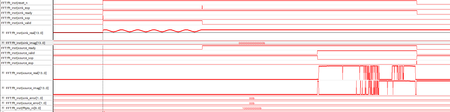
In that case, do you have any clue why my FFT might be outputting such strange values?
I've configure the FFT for fixed point representation, have given lots of extra bits to the output for bit grow (12 bits in, 22 bits out) and have no error flags with all ready/valid outputs working as expected.
But despite a reasonably clean sine input signal, my FFT outputs either near maximum or near minimum out put value seemingly at random (data in and out of the FFT displayed as unsigned line chart).
The output of the FFT always looks different every time, but always just contains a seemingly random array of near min and near max values.
The input is a 1Khz sine wave sampled at approximately 83KHz
Any suggestions are very much appreciated.
Many thanks
Jack


