Forum Discussion

 Occasional Contributor
How to define timing constrains for input and output
 5 years ago
A virtual clock is used for I/O timing analysis. It's created using the create_clock constraint and describes the clock that launches data for an upstream device (an input to the FPGA) or the clock that latches the data for a downstream device (from an output of the FPGA). It's called virtual because it has no target because it never actually enters the FPGA itself. Your set_input_delay and set_output_delay constraints always reference the virtual clock (except for some unique circumstances like source synchronous clocks).
To learn more, see this online training:
https://www.intel.com/content/www/us/en/programmable/support/training/course/odsw1118.html
If you are talking about source synchronous interfaces, where the clock is generated by the upstream device or the FPGA generates the clock to be sent to a downstream device, see these trainings, depending on whether you're talking about single data rate or double data rate:
https://www.intel.com/content/www/us/en/programmable/support/training/course/ocss1000.html
https://www.intel.com/content/www/us/en/programmable/support/training/course/oddr1000.html
 Occasional Contributor
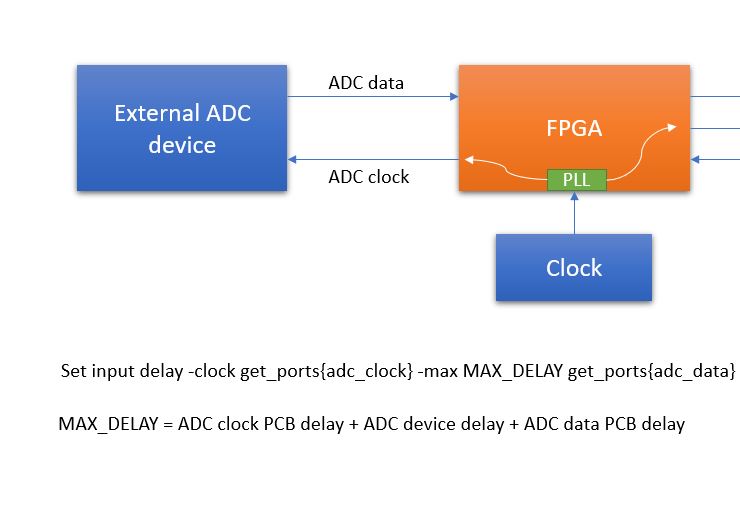
Thanks for your feedback. Could you look at my attached picture?
So there is no difference if I define adc_clock on FPGA port or just virtual clock, right?
I am just thinking virtual clock make you easy to analyze, but nothing different.
Please correct me if I am wrong.
 Super Contributor
So this is a more complicated design. It's referred to as a data feedback design so there is no virtual clock here. The constraints you need are:
1) Input clock (base clock constraint with create_clock)
2) Generated clock output of PLL (use derive_pll_clocks)
3) Generated clock output of device (create_generated_clock with -source pointing to output clock pin of PLL and target pointing to get_ports [adc_clock})
4) False path on output clock path (so output clock path is not analyzed as a data path)
5) Input delay constraint (uses output generated clock in place of virtual clock; your constraint is close but needs to reference #3 above, not the output clock port)
- XQSHEN5 years ago
Thanks a lot!