User Profile

gustifix
 New Contributor
Joined 2 years ago


User Widgets
Contributions
oneAPI on Stratix 10 GX Dev Kit
Hi, In my last thread (https://community.intel.com/t5/FPGA-SoC-And-CPLD-Boards-And/Stratix-10-GX-Dev-Kit-OpenCL-aocl-diagnose-error/m-p/1598920) I got the recommendation to use oneAPI instead of OpenCL for the Stratix 10 GX Dev Kit (device 1SG280HU2F50E2VG). Just to clarify, can I use the OpenCL Board Support Package (latest version 20.2) compiled with Quartus + OpenCL SDK version 20.2 with the current version of oneAPI? Or should I recompile the OpenCL BSP with aoc from the latest oneAPI version? Also, can we only run OpenCL programs with this old BSP or SYCL programs as well? Thank you and best regards! Felix618Views0likes3CommentsRe: Stratix 10 GX Dev Kit OpenCL: aocl diagnose error
Hi @aikeu, Do we also need a oneAPI specific Board Support Package for the card to run OpenCL code? The oneAPI website doesn't list a BSP for the Stratix 10 GX and the documentation mentions "To compile an executable that can run on an FPGA board, install a Board Support Package (BSP) that allows targeting compiles to that board. Intel does not ship BSPs with oneAPI. You must download and install BSPs from a third-party vendor.". Is there a oneAPI BSP for our card available or can we use the existing OpenCL BSP for oneAPI? Thanks again and best regards, Felix1.3KViews0likes0CommentsRe: Stratix 10 GX Dev Kit OpenCL: aocl diagnose error
Hi @aikeu, Thanks! Do you know if we can use oneAPI with the Stratix 10 GX Dev Kit? The Intel FPGA oneAPI website doesn't list a board support package for it under "Choose an FPGA platform" but the DPC++ system requirements page lists the Stratix 10 as supported FPGA device. Can you only use oneAPI with an FPGA using a board support package? Best regards Felix1.4KViews0likes0CommentsRe: Stratix 10 GX Dev Kit OpenCL: aocl diagnose error
Hi Aik Eu, The command "aocl initialize acl0 s10gx" reports "Program succeed." but "aocl diagnose acl0" still gives the errors. However, the first verification failure is not always at the same address and the total number of errors is also different. Best regards Felix1.6KViews0likes0CommentsStratix 10 GX Dev Kit OpenCL: aocl diagnose error
Hello, In my previous post I got the Intel OpenCL BSP for Stratix 10 version 20.2 running on the Stratix 10 GX Dev Kit (part 1SG280HU2F50E2VG). After also adjusting the driver for Linux kernel 6.6, I could run `aocl diagnose`. Now, I get the following errors about memory containing the wrong data: -------------------------------------------------------------------- BSP Diagnostics -------------------------------------------------------------------- Using Device with name: s10gx : Stratix 10 Reference Platform (acls10_ref0) Using Device from vendor: Intel(R) Corporation clGetDeviceInfo CL_DEVICE_GLOBAL_MEM_SIZE = 2147482624 clGetDeviceInfo CL_DEVICE_MAX_MEM_ALLOC_SIZE = 2147482624 Allocated 2147482624 bytes Actual maximum buffer size = 2147482624 bytes Writing 2047 MB to global memory ... Allocated 1073741824 Bytes host buffer for large transfers Write speed: 5897.15 MB/s [5848.87 -> 5946.23] Reading and verifying 2047 MB from global memory ... Verification failure at element 384, expected 180 but read back 10200000138 First failure at address c00 Verification failure at element 385, expected 181 but read back 220100000139 Verification failure at element 386, expected 182 but read back 418c0000013a Verification failure at element 387, expected 183 but read back 22640000013b Verification failure at element 388, expected 184 but read back 64010000013c Verification failure at element 389, expected 185 but read back 6000000013d Verification failure at element 390, expected 186 but read back 1a020000013e Verification failure at element 391, expected 187 but read back 20000013f Verification failure at element 392, expected 188 but read back 60000000148 Verification failure at element 393, expected 189 but read back 1a0200000149 Verification failure at element 394, expected 18a but read back 20000014a Verification failure at element 395, expected 18b but read back 64010000014b Verification failure at element 396, expected 18c but read back 22010000014c Verification failure at element 397, expected 18d but read back 418c0000014d Verification failure at element 398, expected 18e but read back 22640000014e Verification failure at element 399, expected 18f but read back 1020000014f Verification failure at element 400, expected 190 but read back 150 Verification failure at element 401, expected 191 but read back 151 Verification failure at element 402, expected 192 but read back 152 Verification failure at element 403, expected 193 but read back 153 Verification failure at element 404, expected 194 but read back 154 Verification failure at element 405, expected 195 but read back 155 Verification failure at element 406, expected 196 but read back 156 Verification failure at element 407, expected 197 but read back 157 Verification failure at element 408, expected 198 but read back 60000000158 Verification failure at element 409, expected 199 but read back 1a0200000159 Verification failure at element 410, expected 19a but read back 20000015a Verification failure at element 411, expected 19b but read back 64010000015b Verification failure at element 412, expected 19c but read back 22010000015c Verification failure at element 413, expected 19d but read back 418c0000015d Verification failure at element 414, expected 19e but read back 22640000015e Verification failure at element 415, expected 19f but read back 1020000015f Suppressing error output, counting # of errors ... Read speed: 6394.52 MB/s [6392.18 -> 6396.86] Failed write/readback test with 243050504 errors Error: Global memory test failed Error code: 0 I did fairly small adjustments to the BSP (change device part number, slightly adjust PLACE_REGION and ROUTE_REGION in base.qsf). For the driver, I did the following adjustments: +++ b/./aclpci.c @@ -55,7 +55,6 @@ MODULE_AUTHOR ("Dmitry Denisenko"); MODULE_DESCRIPTION ("Driver for Intel(R) OpenCL Acceleration Boards"); -MODULE_SUPPORTED_DEVICE ("Intel(R) OpenCL Boards"); MODULE_LICENSE("GPL"); @@ -409,8 +408,8 @@ int init_irq (struct pci_dev *dev, void *dev_id) { if(pci_enable_msi(dev) != 0){ ACL_DEBUG (KERN_WARNING "Could not enable MSI"); } - if (!pci_set_dma_mask(dev, DMA_BIT_MASK(64))) { - pci_set_consistent_dma_mask(dev, DMA_BIT_MASK(64)); + if (!dma_set_mask(&dev->dev, DMA_BIT_MASK(64))) { + dma_set_coherent_mask(&dev->dev, DMA_BIT_MASK(64)); ACL_DEBUG (KERN_WARNING "using a 64-bit irq mask\n"); } else { ACL_DEBUG (KERN_WARNING "unable to use 64-bit irq mask\n"); @@ -813,7 +812,7 @@ static int __init aclpci_init(void) { } aclpci_major = MAJOR(dev); - aclpci_class = class_create(THIS_MODULE, DRIVER_NAME); + aclpci_class = class_create(DRIVER_NAME); if (IS_ERR(aclpci_class)) { printk(KERN_ERR "aclpci: can't create class\n"); goto err_unchr; +++ b/./aclpci_cmd.c @@ -294,12 +294,12 @@ static int __aclpci_get_user_pages(struct task_struct *target_task, unsigned lon for (got = 0; got < num_pages; got += ret) { #if LINUX_VERSION_CODE >= KERNEL_VERSION(4, 10, 0) - ret = get_user_pages_remote(target_task, target_task->mm, + ret = get_user_pages_remote(target_task->mm, start_page + got * PAGE_SIZE, num_pages - got, FOLL_WRITE|FOLL_FORCE, p + got, - vma, NULL); + NULL); #elif LINUX_VERSION_CODE >= KERNEL_VERSION(4, 9, 0) ret = get_user_pages_remote(target_task, target_task->mm, start_page + got * PAGE_SIZE, @@ -350,9 +350,9 @@ int aclpci_get_user_pages(struct task_struct *target_task, unsigned long start_p if( target_task->mm == NULL) { ret = -EIO; } else { - down_write(&target_task->mm->mmap_sem); + down_write(&target_task->mm->mmap_lock); ret = __aclpci_get_user_pages(target_task, start_page, num_pages, p, NULL); - up_write(&target_task->mm->mmap_sem); + up_write(&target_task->mm->mmap_lock); } return ret; @@ -361,13 +361,13 @@ int aclpci_get_user_pages(struct task_struct *target_task, unsigned long start_p void aclpci_release_user_pages(struct task_struct *target_task, struct page **p, size_t num_pages) { if( target_task->mm != NULL) { - down_write(&target_task->mm->mmap_sem); + down_write(&target_task->mm->mmap_lock); __aclpci_release_user_pages(p, num_pages, 1); target_task->mm->locked_vm -= num_pages; - up_write(&target_task->mm->mmap_sem); + up_write(&target_task->mm->mmap_lock); } } +++ b/./aclpci_dma.c @@ -355,7 +355,7 @@ int lock_dma_buffer (struct aclpci_dev *aclpci, void *addr, ssize_t len, struct dma->ptr = addr; dma->len = len; - dma->dir = d->m_read ? PCI_DMA_FROMDEVICE : PCI_DMA_TODEVICE; + dma->dir = d->m_read ? DMA_FROM_DEVICE : DMA_TO_DEVICE; /* num_pages that [addr, addr+len] map to. */ start_page = (ssize_t)addr >> PAGE_SHIFT; end_page = ((ssize_t)addr + len - 1) >> PAGE_SHIFT; @@ -393,7 +393,7 @@ int lock_dma_buffer (struct aclpci_dev *aclpci, void *addr, ssize_t len, struct // ACL_DEBUG (KERN_DEBUG "p[%d] = 0x%p", i, cur); if (cur != NULL) { // ACL_DEBUG (KERN_DEBUG " phys_addr = 0x%llx", page_to_phys(cur)); - phys = pci_map_page (d->m_pci_dev, cur, 0, PAGE_SIZE, dma->dir); + phys = dma_map_page (&d->m_pci_dev->dev, cur, 0, PAGE_SIZE, dma->dir); if (phys == 0) { ACL_DEBUG (KERN_DEBUG " Couldn't pci_map_page!"); return -EFAULT; @@ -445,7 +445,7 @@ void unlock_dma_buffer (struct aclpci_dev *aclpci, struct dma_t *dma) { // ACL_DEBUG (KERN_DEBUG "p[%d] = %p", i, cur); if (cur != NULL) { dma_addr_t phys = dma->dma_addrs[i]; - pci_unmap_page (d->m_pci_dev, phys, PAGE_SIZE, dma->dir); + dma_unmap_page (&d->m_pci_dev->dev, phys, PAGE_SIZE, dma->dir); } } #endif @@ -1047,7 +1047,7 @@ int hostch_buffer_lock(struct aclpci_dev *aclpci, void *addr, ssize_t len, struc dma->ptr = addr; dma->len = len; - dma->dir = direction ? PCI_DMA_FROMDEVICE : PCI_DMA_TODEVICE; + dma->dir = direction ? DMA_FROM_DEVICE : DMA_TO_DEVICE; /* num_pages that [addr, addr+len] map to. */ start_page = (ssize_t)addr >> PAGE_SHIFT; end_page = ((ssize_t)addr + len - 1) >> PAGE_SHIFT; +++ b/./aclpci_fileio.c @@ -150,7 +150,7 @@ int aclpci_open(struct inode *inode, struct file *file) { /* pointer to containing data structure of the character device inode */ aclpci = container_of(inode->i_cdev, struct aclpci_dev, cdev); - spin_lock(&aclpci->lock); + // spin_lock(&aclpci->lock); if (aclpci->num_handles_open) { printk("Device already in use\n"); result = -EBUSY; @@ -215,7 +215,7 @@ int aclpci_open(struct inode *inode, struct file *file) { result = 0; done: - spin_unlock(&aclpci->lock); + // spin_unlock(&aclpci->lock); up (&aclpci->sem); return result; } Most modifications were just function names or parameters that changed. Removing the locking in the last file was my solution to the driver crashing with the message `BUG: scheduling while atomic ` in dmesg. As far as I understood, removing the locking there would not be a problem as long as there aren't multiple processes calling `aclpci_open()` at the same time. I'd appreciate some feedback where you think the problem with aocl diagnose could come from. Thanks and best regards! Felix1.7KViews0likes8CommentsRe: OpenCL BSP for Stratix 10 GX Development Kit (H-Tile)
OK, generating the pof seems to be the right way. I followed this video to generate flash.pof from top.sof. The only change from the video was to set P1 of CFI_1Gb to 0x00200000 instead of 0x000D0000. After a cold reboot, the device now shows up as "Processing accelerators: Altera Corporation Device 5170" in lspci.1.7KViews0likes0CommentsRe: OpenCL BSP for Stratix 10 GX Development Kit (H-Tile)
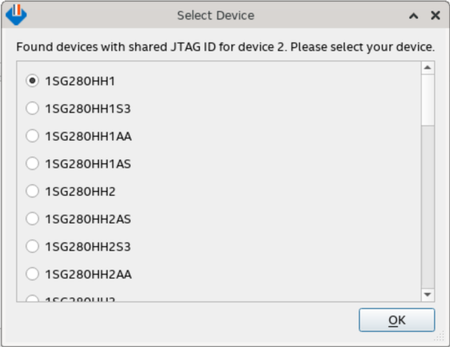
Hi @BoonBengT_Altera, Thanks for the help so far! After a few compiles with different seeds, I got a version that meets timing. I followed the porting guide further and now I have a top.sof file for the 1SG280HU2F50. When trying to program the file via the Quartus programmer, after clicking "Auto detect", I have to choose the exact device number: I choose 1SG280HU2 and get this chain: When I add top.sof, it shows up as a different device: If I delete the 1SG280HU2 so the chain looks like this: I get "Error status: Synchronization failed" when trying to program the device. Does programming the sof directly just not work in this case and should I generate the pof for flash, or is there a way to program the FPGA this way? Thanks and best regards Felix1.7KViews0likes1CommentRe: OpenCL BSP for Stratix 10 GX Development Kit (H-Tile)
Hi BB, Thank you for the answer! After changing the device part number according to the guide, I had to slightly adjust the floorplan (just adding 10 to all the x coordinates in base.qsf seems sufficient) after I got some fitter errors. Compiling the base revision works now, but timing slightly fails. I'm gonna compile it with various seeds until I get a result that meets timing requirements. Best regards Felix1.8KViews0likes0CommentsOpenCL BSP for Stratix 10 GX Development Kit (H-Tile)
Hello, I want to get the Stratix 10 GX OpenCL BSP running on the Stratix 10 GX Development Kit (device part number: 1SG280HU2F50E2VG). It seems that the BSP reference platform targets the L-tile version (1SG280LU2F50E2VG). At least the top.sof file in $AOCL_BOARD_PACKAGE_ROOT/bringup specifies that device. Also, programming the max5_116.pof and flash.pof files works, but after a cold reboot the FPGA does not show up as a PCIe device, I assume because the bitstream in the flash targets the wrong device. Is there a BSP available for the H-tile version of the dev kit or should I follow the porting guide to adjust the reference platform for a different device? As the latest version of the BSP is 20.2, I am using that version of Quartus, the OpenCL SDK, and the BSP on Linux. Regards, FelixSolved1.9KViews0likes5Comments