arria® 10 fpgas and socs
1379 Topics
Why do I unexpectedly observe intermittent DDM Errors?
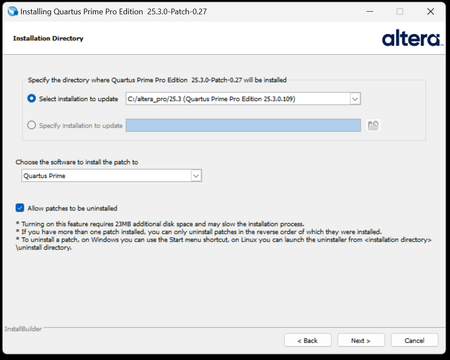
Description Beginning January 10, 2026, executing commands in the terminal or GUI of Quartus® Prime Pro Edition software, Quartus Embedded Edition software or select standalone tools may cause the software or tool to crash with an error similar to the crash signature shown below. This error affects: Quartus Prime Pro Software versions v23.3 through v25.3.1 Standalone Quartus Prime Pro Programmer v23.3 through v25.3.1 Standalone Quartus Prime Pro Embedded Edition v25.3 and v25.3.1 Standalone Quartus Prime Pro Power Thermal Analyzer v25.3 through v25.3.1 This issue is not observed in Quartus Prime Pro Edition versions 23.2 or prior or Quartus Prime Standard Edition. Crash Signature: Error (22912): Unhandled exception: Fatal Error: Assertion failed tools/cpp/ddm/ddm_assessor.cpp:53: DDM_T::verify_token(token) : Cannot identify the client from function assertion_error in tools/cpp/ddm_report/ddm_report_msg.cpp@465 *** Fatal Error: Program termination requested *** *** Below is the stack trace at the time the error occurred. *** The lines beginning "Err Handler" represent frames relating *** to generating this report. *** The point at which the error occurred is somewhere after these lines. *** There may be a few frames representing standard/library code *** before the Quartus frames begin. *** The search for the error should begin with the Quartus frames. *** Unwinder: libunwind *** Stack depth: 15 Quartus 0x24e67: err_terminator() + 0x1bc (ccl_err) Quartus 0xb036a: __cxxabiv1::__terminate(void (*)()) + 0xa (stdc++) Quartus 0xb03d5: (stdc++) Quartus 0xb0628: (stdc++) Quartus 0x1680d: void ddm_throw<DDM_RUNTIME_ERROR>(std::__cxx11::basic_string<char, std::char_traits<char>, std::allocator<char> > const&) + 0x26d (ddm_report) Quartus 0x13fae: DDM_REPORT::DDM_ASSERTION_HANDLER::assertion_error(std::__cxx11::basic_string<char, std::char_traits<char>, std::allocator<char> >) const + 0xde (ddm_report) Quartus 0x12a52: DDM_REPORT::ASSERTION_HANDLER::error(std::__cxx11::basic_string<char, std::char_traits<char>, std::allocator<char> >) + 0x72 (ddm_report) Quartus 0x13e64: DDM_REPORT::detail::assert_at_line(char const*, char const*, int, char const*, ...) + 0x1b4 (ddm_report) Quartus 0x205fb0: ddm_set_lassessor(DDM_T_ASSESSOR*, std::__cxx11::basic_string<char, std::char_traits<char>, std::allocator<char> > const&) + 0x60 (ddm) Quartus 0xf4445: DMS_MANAGER::DMS_MANAGER() + 0x5c5 (dni_dms) Quartus 0xf45b2: DMS_MANAGER::get() + 0x7a (dni_dms) Quartus 0xf6db4: _GLOBAL__sub_I_dms_manager.cpp + 0x58 (dni_dms) Quartus 0x647e: (ld-linux-x86-64) Quartus 0x6568: (ld-linux-x86-64) Quartus 0x202ca: (ld-linux-x86-64) Resolution To work around this problem: For Windows machines Download and unzip the Quartus Prime Pro version zip file that matches your Quartus Prime Pro version from this KDB. Double click on the executable ending in “windows.exe”. When the GUI pops up, press Next. Note that the GUI may look slightly different depending on the version of Quartus you are using. Accept the license agreement Specify the directory where the patch needs to be applied which may be a different location than Quartus install if you have standalone tools in a different directory from your Quartus Prime Pro software installation. Keep “Allow Patch to be uninstalled” selected. Select the software in which to install the patch: The patch will install in the directory of the software or tool you have selected. You will see an uninstall directory for the patch in your software or tool folder where patch is installed; it will contain an executable to uninstall the patch if required for any reason. To confirm patch is installed, you can run quartus_sh -v or corresponding version command for your tool via command line. Alternatively, you can Open Quartus in the GUI and select Help → About Quartus Prime in the main menu. If you are opening up a standalone tool you will navigate to Help-> About <tool_name>. For the Command Line Implementation of the patch in Windows, use the following command: <patch_filename.exe> --mode unattended --installdir <your_install_directory> --accept_eula 1 --patch_to [quartus|qprogrammer|qemb|pta] # An example to patch Quartus Prime Pro Edition Software v25.3: quartus-25.3-0.27-windows.exe --mode unattended --installdir /tmp/altera_pro/25.3 --accept_eula 1 # An example to patch the Standalone Programmer for Quartus Prime Pro Software v25.3: quartus-25.3-0.27-windows.exe --mode unattended --installdir /tmp/altera_pro/25.3 --accept_eula 1 --patch_to qprogrammer For Linux machines: Download and unzip the Quartus Prime Pro version zip file that matches your Quartus Prime Pro version from this KDB. Ensure you run chmod +x on the file ending with linux.run. Run in the command line: ./<installation_patch_run_file>. When GUI pops up, press Next. Note that the GUI may look slightly different depending on the version of Quartus you are using. Accept the license agreement Specify the directory where the patch needs to be applied which may be a different location than Quartus install if you have standalone tools in a different directory from your Quartus Prime Pro software installation. Keep “Allow Patch to be uninstalled” selected. Select the software in which to install the patch: The patch will install in the directory of the software or tool you have selected. You will see an uninstall directory for the patch in your software or tool folder where patch installed; it will contain an executable to uninstall the patch if required for any reason. To confirm patch is installed, you can run ./quartus_sh -v or corresponding version command for your tool via command line. Alternatively, you can Open Quartus in the GUI and select Help → About Quartus Prime in the main menu. If you are opening up a standalone tool you will navigate to Help-> About <tool_name>. For the Command Line Implementation of the patch in Linux, use the following command: ./<patch_filename.run> --mode unattended --installdir <your_install_directory> --accept_eula 1 --patch_to [quartus|qprogrammer|qemb|pta] # An example to patch Quartus Prime Pro Edition v25.3: ./quartus-25.3-0.27-linux.run --mode unattended --installdir /tmp/altera_pro/25.3 --accept_eula 1 # An example to patch the Standalone Programmer for Quartus Prime Pro Software v25.3: ./quartus-25.3-0.27-linux.run --mode unattended --installdir /tmp/altera_pro/25.3 --accept_eula 1 --patch_to qprogrammer This problem has been fixed in Quartus® Prime Pro Edition Software version 26.1. The below table lists the patches that are available and the associated patch number. The patch zip files are attached to the KDB below: Quartus Prime Pro Edition Version Patch Number 23.3 0.52 23.4 0.70 23.4.1 1.01 24.1 0.52 24.2 0.64 24.3 0.35 24.3.1 1.29 25.1 0.36 25.1.1 1.31 25.3 0.27 25.3.1 1.0213KViews5likes0CommentsWhy does my Quartus® Prime Installation fail with certificate error: SSL certificate problem: unable to get local issuer certificate (curlcode 60)?
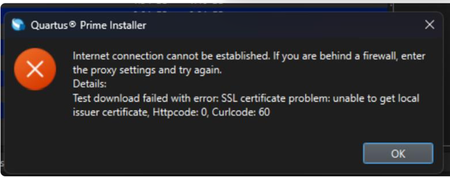
Description Due to a problem in the Quartus® Prime Installer Software, you might see the error message shown below when you click Download & Install. This happens because the certificate bundled with the Quartus® Prime Installer Software is no longer accepted by the Altera® Content Delivery Network (CDN). As a result, secure downloads initiated during the installation process cannot be verified using the outdated certificate. The issue impacts the Installer for the following versions of Quartus software: Operating System Quartus Prime Pro Installer Version(s) Quartus Std/Lite Installer Version(s) Microsoft Windows* 23.3 to 25.3.1 23.1std to 25.1std Linux* 23.3 to 23.4 23.1std The KDB workaround provided below applies to the following versions of Quartus software: Quartus Prime Pro Installer Version(s) Quartus Std/Lite Installer Version(s) KDB workaround applies to 24.3 to 25.3.1 24.1std to 25.1std Note that for all other affected versions not covered by the KDB, you cannot use the installer workaround and must download Quartus software package files individually without using the installer. Separate packages can be found in the Individual Files tab of the Quartus Software Download pages. Resolution To work around this problem, follow these steps: 1. Download and unzip the cacert.zip, which contains the cacert.pem certificate file. 2. Specify the new certificate using one of the following methods: i) Command Line Interface (CLI): Open a command prompt or terminal and run the installer with the--cacert option, pointing to the new certificate file. Windows*: qinst_<version>.exe -sp"--cacert <full path to cacert.pem>" Linux*: qinst_<version>.run -- --cacert <full path to cacert.pem> ii) Graphical User Interface (GUI): - Open the Quartus® Prime Installer, navigate to Settings, locate the CA Certificate Path, and specify the full path to the cacert.pem certificate file. - Then, click Apply > OK. This problem is scheduled to be resolved in a future release of the Quartus® Prime Installer Software.11KViews1like0CommentsWhy does the text overlap in the ALTPLL IP Parameter Editor?
Description Due to a problem in the Quartus® Prime Standard Edition Software version 25.1, you might see that the text overlaps in the ALTPLL IP Parameter Editor on the Windows* Operating System. This prevents the ALTPLL IP from being instantiated. This problem does not occur in the Quartus® Prime Standard Edition Software version 24.1 and earlier. Resolution To work around this problem in the Quartus® Prime Standard Edition Software version 25.1, download and install the patch below: This problem is scheduled to be resolved in a future release of the Quartus® Prime Standard Edition Software.1.4KViews1like0Comments
Error: TBBmalloc: skip allocation functions replacement in ucrtbase.dll: unknown prologue for function _msize
Description Due to a problem in the Quartus® Prime Standard Edition Software version 25.1 or earlier, you might see this error message when generating PLL IP on Windows* 11 Operating System. The IP generation might complete successfully even though this error message is reported. Resolution To work around this problem, follow these steps: Go to This PC, right-click, and select Properties. Click Advanced System Setting. In the Advanced tab, select Environment Variable. Under System variables, create a new variable with the name TBB_MALLOC_DISABLE_REPLACEMENT and value as 1. Click OK and restart the Quartus® Prime Software. The workaround above does not work for the Quartus® Prime Standard Edition Software version 22.1std.2 or earlier. A patch is available to fix this problem for the Quartus® Prime Standard Edition Software version 22.1std.2. The environment variable is still required to prevent the TBBmalloc message from appearing. Download and install patch 2.02 below: Patch 2.02 for Windows (.exe) Readme for patch 2.02 (.txt) This problem is not scheduled to be fixed in the Quartus® Prime Standard Edition Software.1.1KViews1like0CommentsWhy don’t I get a programming file when I compile with the Quartus® Prime Pro Edition software version 25.1.1?
Description Beginning with version 25.1.1 of the Quartus® Prime Pro Edition software, pin location assignments and I/O standard assignments are required for a programming file to be generated. If these required assignments are missing, no programming file is generated. You must add the required assignments and recompile your design to generate a programming file. If you do not want to generate a programming file, you may ignore this behavior change. To determine whether your design is missing pin location or I/O standard assignments, review your compilation messages. If either of the following messages was generated during your compile, your design is missing pin location or I/O standard assignments that are required to generate a programming file: Critical Warning: Some pins have incomplete I/O assignments. Refer to the I/O Assignment Warnings report for details Critical Warning: No exact pin location assignment(s) for <number> pins of <number> total pins. For the list of pins, please refer to the I/O Assignment Warnings table in the fitter report Resolution Review the I/O Assignment Warnings report, found in the Place sub-section of the Fitter section of the compilation report. Alternately, review the <revision>.fit.plan.rpt report file. For any pins in the I/O Assignment Warnings report that are reported as “Missing location assignment” or “Missing I/O standard,” add the appropriate location or I/O standard assignment. For help making these assignments, refer to Assigning I/O Pins After adding any required assignments, recompile the design to generate a programming file. This change applies to all device families supported by the Quartus® Prime Pro Edition software, beginning in version 25.1.1. Missing pin location or I/O standard assignments are reported as a critical warning, not an error. If you script the compilation of projects, the exit code of the compilation process still indicates success even if pin location or I/O standard assignments are missing, because missing pin location or I/O assignments are reported as a critical warning, not an error.600Views0likes0CommentsError : FLEXlm version of vendor daemon is too old
Description In the Questa* FPGA Edition simulator and Questa* FPGA Starter Edition simulator version 2024.1, you might see this error or the following error if you are using the MGCLD daemon v11.16.4 “Unable to checkout a license. Make sure your license file environment variable (SALT_LICENSE_SERVER, MGLS_LICENSE_FILE, LM_LICENSE_FILE) is set correctly” Resolution To avoid this error, upgrade to the Siemens* Flexlm (SALTD) daemon v11.19.5 Download the daemon from the download page There is a change to the Siemens* License in v11.19.5.0. If you’re running a floating license server for Siemens* licenses, manually change the VENDOR daemon line in the license file from mgcld to saltd, for example: VENDOR saltd <path to saltd> Note: Do not change any of the INCREMENT lines. Leave the INCREMENT lines with the original vendor daemon name (mgcld).599Views0likes0CommentsWhen does the Quartus® Prime Design Software, IP cores, and Questa*-Altera® FPGA Edition Software check out a license?
Description Below is a description of how the Quartus® Prime Design Software, IP cores, and Questa*-Altera® FPGA Edition Software utilize licenses: Resolution Quartus® Prime Design Software: All Quartus® Prime Design Software processes check for a valid license, including the Quartus® GUI, Analysis & Synthesis, Assembler, and TimeQuest Timing Analyzer. These processes start only if a valid license is available. They do not hold or occupy the license; they only validate that one is available. However, the Fitter checks out a license when it starts and holds it for the duration of the Fitter process. IP cores: A license for an IP core is checked out when the Quartus® Prime Design Software opens the first encrypted file of the IP core for synthesis. This license is held for the duration of synthesis. The Assembler checks out the license for every IP core to create the programming file and holds it for the duration of the Assembler process. Questa*-Intel® FPGA Edition software: Once Questa*-Intel® FPGA Edition Software loads a design unit during elaboration, a Questa-Intel® FPGA Edition license is checked out. It remains checked out until the simulation ends (quit -sim), or the simulator is closed. Once a waveform is loaded into the simulator, a Questa*-Intel® FPGA Edition Software license is also checked out for viewing Wave Log Format File (.wlf), and it remains checked out until the waveform window is closed. Related Articles What happens to a license if the Quartus II software terminates unexpectedly? Can I perform multiple compilations using the Quartus II software at the same time on one computer with a one seat floating license or one fixed (node locked) license file?500Views0likes0CommentsHow can I simulate the ASMI Intel FPGA IP with internal and external memory models when using the Intel® Arria® 10 and Intel Cyclone® 10 GX devices?
Description For internal memory model use case, we currently only support simulation of the ASMI Intel FPGA IP in Intel® Arria® 10 and Intel Cyclone® 10 GX devices with the flash model for the EPCQL1024 serial configuration device. Follow the steps in the Resolution section to perform the simulation with the internal EPCQL model (Note: This simulation was tested with Mentor Graphics* ModelSim* SE simulation software). Resolution Create a simulation model for ASMI block and set the enable_sim parameter to true in file: <project directory>/<ASMIIP name>/<altera_asmi_parallel_<quartus_version>>/<sim>/<ip_name>altera_asmi_parallel_<quartus_version>_<unique_ip_id>.v Create a testbench file with initialization of ASMI block as shown in the following example: <ip_name>_altera_asmi_parallel_<quartus_version>_<unique_ip_id> dut( .clkin (clkin), // clkin.clk .fast_read (fast_read), // fast_read.fast_read .rden (rden), // rden.rden .addr (addr), // addr.addr .read_status (read_status), // read_status.read_status .write (write), // write.write .datain (datain), // datain.datain .sector_protect (sector_protect), // sector_protect.sector_protect .sector_erase (sector_erase), // sector_erase.sector_erase .die_erase (die_erase), // die_erase.die_erase .wren (wren), // wren.wren .read_rdid (read_rdid), // read_rdid.read_rdid .en4b_addr (en4b_addr), // en4b_addr.en4b_addr .ex4b_addr (ex4b_addr), // ex4b_addr.ex4b_addr .reset (reset), // reset.reset .sce (sce), // sce.sce .dataout (dataout), // dataout.dataout .busy (busy), // busy.busy .data_valid (data_valid), // data_valid.data_valid .status_out (status_out), // status_out.status_out .illegal_write (illegal_write), // illegal_write.illegal_write .illegal_erase (illegal_erase), // illegal_erase.illegal_erase .read_address (read_address), // read_address.read_address .rdid_out (rdid_out) // rdid_out.rdid_out ); Run simulation. To simulate with an external memory model, follow these steps: Create a simulation model for ASMI block and set the enable_sim parameter to false in file: <project directory>/<ASMI IP name>/<altera_asmi_parallel_<quartus_version>>/<sim>/<ip_name>altera_asmi_parallel_<quartus_version>_<unique_ip_id>.v Create a testbench file with initialization of ASMI block (as shown in the previous code example): Create a wrapper for external memory In a simulation project, compile the following files for your working folder: flash simulation model asmi_sim_model design wrapper testbench file(s) Run simulation.499Views0likes0CommentsHow do I extend Windows* Server 2016 file path support from 260 to to 1024 characters?
Description Windows* Server 2016 supports file paths up to 260 characters by default. From build 1607, Windows Server 2016 now supports longer paths up to 1024 characters with the proper registry configuration. The Intel® Quartus® Prime Pro Edition Software can now support file paths up to 1024 characters when Windows Server 2016 registry is correctly configured. Resolution To configure your Windows* Server 2016 system registry to support long file paths, follow these steps: Verify or edit the Registry settings to support long paths: a) Open the Registry Editor (Press Windows* Key and type regedit and press Enter key) b) Navigate to HKEY_LOCAL_MACHINE\SYSTEM\CurrentControlSet\Control\FileSystem c) Change the LongPathsEnabled value to 1. If you do not see LongPathsEnabled listed, you must create the entry by right-clicking the FileSystem key, choosing New > DWORD (32-bit) Value, and then naming the new value LongPathsEnabled. Verify or edit any Group Policy to support long paths: a) Open Group Policy Editor* (Press Windows Key and type gpedit.msc and hit Enter key) b) Navigate to the following directory: Local Computer Policy > Computer Configuration > Administrative Templates > System > Filesystem > NTFS. c) Click Enable NTFS long paths option and enable it. These changes have been verified with Intel® Quartus® Prime Pro and Windows* Server 2016 build 1607 only. Other Windows OS, such as Windows 10 have not been verified.499Views0likes0CommentsWhy does Linux report "DMA engine initialization failed" error when EMAC uses GMII interface?
Description When supporting GMII interface for HPS EMAC, there are three clocks exported to FPGA: emac_tx_clk_i(input), emac_rx_clk_i(input), emac_gtx_clk(output) The Linux would report below error if the emac_tx_clk_i clock is not connected correctly: ...... [ 4.291414] socfpga-dwmac ff802000.ethernet: Failed to reset the dma [ 4.297785] socfpga-dwmac ff802000.ethernet eth1: stmmac_hw_setup: DMA engine initialization failed [ 4.306806] socfpga-dwmac ff802000.ethernet eth1: stmmac_open: Hw setup failed ...... Resolution Besides connecting the emac_rx_clk_i(125MHz) for GMII, the emac_tx_clk_i also needs to be connected correctly (2.5MHz or 25MHz), although it is not used in GMII mode. The emac_tx_clk_i requirement information has been added in the HPS document beginning with version 21.2.499Views0likes0Comments