Forum Discussion

 New Contributor
Writing to DDR3 with bypassing NIOS2
 New Contributor
Hi
thank you very much for your suggestion. It work fine and it is much easier with pipeline bridge then what i had i mind. I also added a clock crossing bridge since my logic out side nios doesnt run on the same clock as NIOS.
I have a system here with Cyclone V and 2G DDR3. There is some other periphery there also but i will leave it out for a moment.
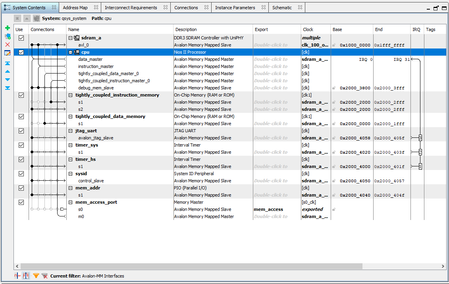
Here is a picture of my system
DDR3 is addressed from 0x0000_0000 to 0x0FFF_FFFF. This is the addressing of bytes, 0x0FFF_FFFF is 268KBytes which makes it 2Gbits. So that is fine. In NIOS software i declare a volatile pointer of int to address 0x0FF0_0000. Further more i initialize the value of this address to 0. When i run my nios software, in the command line i can see that value at the address to which pointer is pointing is correctly setup to 0, and also the address of the pointer is 0x0FF0_0000.
My external logic is setup such that every second a 1 is written to 0x0FF0_0000. So very second i expect NIOS software to write me "pFlag assigned 1". But that never happens. I tried looking at the signal tap to seewhat is going on
mem_bridge is the interface port to my logic, while qsys_system_sdram, is the qsys generated logic. From the picture you can see that when signal mem_bridge_write=1, mem_abridge_address=0x0FF0_0000, mem_bridge_byteenable=0xF, mem_bridge_writedata=1, mem_bridge_burstcount=1 and waitrequest is low. Accordig to the instructions those are to conditions for a valid write. About 20 clocks later you can see that simillar signal config is also on the sdram controller. The only difference that i see is in the address. IT looks like the address is shifted to bit down. I figure that is because sdram controller does addressing in 32-bit mode while bridges the do everything in 8 bit mode.
However i am still out cold. My while loop never gives me a message sayting that flag was set to 1.
I dont know what i am doing wrong, does someone have any ideas.
Thank you


