Altera_Forum Honored Contributor
Honored ContributorHonored Contributor Honored Contributor
Hello,
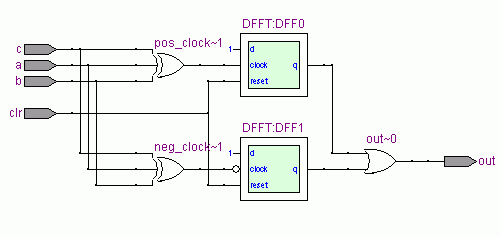
to start with a simple thing. What I had remembered from Verilog specification is actually under 9.7.5 implicit event expression list and doesn't apply here. So probably the original construct could be valid Verilog code in behavioral simulation, but to my opinion can't be synthesizable. The flipflop bidirectional edge detection in contrast is basically synthesizable and the code, after a few corrections, understandable to Quartus (I also changed DFF d and q to their usual meaning), as the RTL viewer shows.module edge_detection(a,b,c,clr,out);
input a,b,c,clr;
output out;
wire pos_clock,neg_clock;
assign pos_clock=a^b^c;
assign neg_clock=!(a^b^c);
wire out0,ou1;
wire eins = 1'b1;
DFFT DFF0(eins,out0,pos_clock,clr);
DFFT DFF1(eins,out1,neg_clock,clr);
assign out=out0|out1;
assign out1a=out1;
endmodule
module DFFT(d,q,clock,reset);
input d,clock,reset;
output reg q;
always @(posedge clock or posedge reset)
if(reset) q<=1'b0;
else q<=d;
endmodule