Forum Discussion

 Occasional Contributor
Unified FFT giving incorrect output
 1 year ago
Hi David,
I've consulted Factory about the function of the parallel FFT IP. Actually, a parallel FFT processes a single FFT instance with high data rate channels.
For example, 16 instantiations of a single-wire streaming FFT (FFT IP) will calculate 16 different FFT instances in parallel. This is appropriate if you're processing 16 different channels. A 16-wire parallel FFT(parallel FFT IP) processes a single FFT instance. This is appropriate if you're processing one very high data rate channel.
Back to your question about why you saw multiple peaks in one frame. The reasons are:
1. You have two sine waves in one FFT instance.
2. It's a 2-wrie parallel FFT, the processing cycles should be half of the single FFT, for example, for a 64 points FFT, the frame cycles is 64 for a single wire FFT, but 32 for a 2-wire parallel FFT.
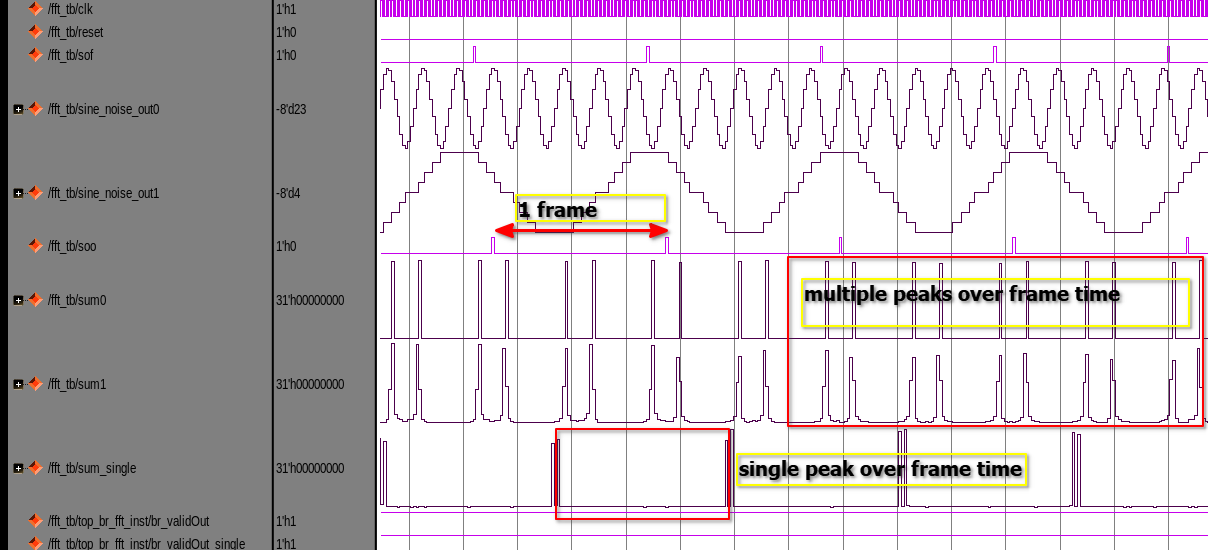
Based on above, I modified the input of the parallel FFT(assign d = {8'h0, sine_noise_out1, 8'h0,sine_noise_out1};) to better show the case, and here is what I got:
As you can see, the sum0 has 2 times of peaks of sum_single in "one frame".
Please note that what I did above is just to show the function of the parallel FFT based on your design. The parallel FFT should be one FFT instance, which means you should combine sine_noise_out0 and sine_noise_out1 as one input sequence and then pipe it into two channels. The same with the output, you should pipe the 2 channels data into one sequence.
Best regards,
Leo Feng
 New Contributor
Hi David,
I furtherly checked your codes and the simulation waveform, it looks fine for me. Can I see your simulation results? Why you are saying that the output is not sensible?
Here I attached the output of both parallel FFT and the single FFT of the simulation that I did.
Notice that the output of parallel FFT and single FFT are not aligned because of the latency difference, but the data seems correct.
Best regards,
Leo Feng
 Occasional Contributor
Hi Leo,
Firstly thanks for taking the time to investigate.
I have attached a screen shot of my simulation and will explain why I still think there is a problem.
The input to the FFT's is a sine wave with small amount of added noise.
I would expect to see two peaks in the output spectrum (double sided output frequency spectrum).
This is exactly what I do see in the single FFT trace.
However, this is what I DO NOT SEE in the outputs from the parallel FFT.
Of course, maybe I am missing something here.
Please tell me what you think.
David