Forum Discussion

Altera_Forum Honored Contributor
14 years agoHonored Contributorthe waitrequest of avalon
Hi: the output shoud use the register many paper write that,but I find that if the waitrequest output with register will lead to delay a cycle.it is difficult to design the register timing.if us...

Altera_ForumHonored Contributor
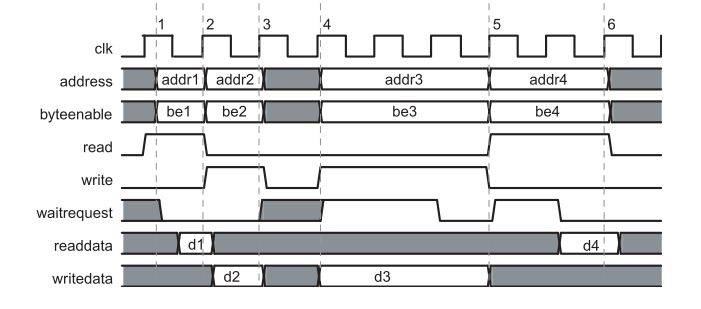
14 years agoHonored Contributor --- Quote Start --- There's really only two hardware interfaces for custom slaves (ignoring Altera provided IP for DDR controllers and the like); 1) The slave is slow. <snip> 2) The slave is fast. <snip> --- Quote End --- Your classifications of interfaces is incorrect and not necessary. An Avalon component needs to have a wait request or it must accept commands on every clock cycle. This is spelled out in the Avalon spec and has nothing to do with a slave that is 'fast' or 'slow'. As an example where your classification breaks down, consider a simple fifo inside the slave. The fifo exists because the output at certain times cannot keep up with the input. The input side can accept new data on every clock cycle (so it would be 'fast' by your classification), but could fill up so it would need to have a wait request output which is connected to the fifo full signal. Having the wait request would make it 'slow' by your classification. So this example would be both 'fast' and 'slow' according to you. Your classification of 'fast' and 'slow' is meaningless and does nothing to define how to implement wait request. --- Quote Start --- The examples shown in the Avalon-MM spec would require combinatorial paths to implement. They are not very good examples. --- Quote End --- Not true. Kevin Jennings