Forum Discussion

 Contributor
I/O D1/D3 delay values higher than needed.

 Regular Contributor
Hi Ivan,
Quartus II software chooses different delay settings based on the timing constraints, it is important that we have tight, complete and accurate timing constraints.
With same constrain try to fix the locations of all the internal registers using location assignments in the Assignment Editor, so the I/O timing paths from internal registers to the output pins are fixed.
Regards
Anand
 Contributor
Hi Anand.
My internal registers are located in Fast I\O, they are part of TSE IP Core and it puts them into Fast I\O automatically.
So the paths are totally fixed.
I will try to create a simple project and if the problem will still be present I will attach it here.
Thank you.
--
Best regards,
Ivan
- IDeyn7 years ago
Hi Anand.
For now, what have I done.
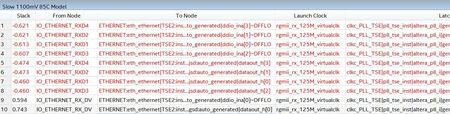
New simple project with TSE was created, and it works fine, I/O delays are chosen by the software correctly and timing meets with positive slacks on both setup and hold.
It's strange because TSE I/O timing is independent from other design parts - because it is I/O timing.
But in the full version of the project I still observe wrong values, and I noticed an interesting thing - choosing Quartus 16.0, I acquired better performance -
for example RXD1 Slack changed from -0.613 to -0.202. I had compared fitter settings (16.0 vs 17.1) and hadn't found any differences there.
So for now I can say that it looks like the issue which is located deep inside the engine and depends on version of Quartus.
--
Best regards,
Ivan
- AnandRaj_S_Intel7 years ago
Okay, Thanks for update.
Regards
Anand

