Forum Discussion

 Occasional Contributor
How to effectively implement PCIe transfer?
 2 years ago
Hi Allen,
Thank you for reaching out.
From the steps given, I believe that you are looking into 8.2. Write DMA Example instead of 8.1. The two questions you've raised are:
1. Do I only need to use one or a few descriptors to complete the transfer?
2. Is there a better way to implement data transfer?
To address your questions, the findings below are according to the user guide 21.1 as mentioned.
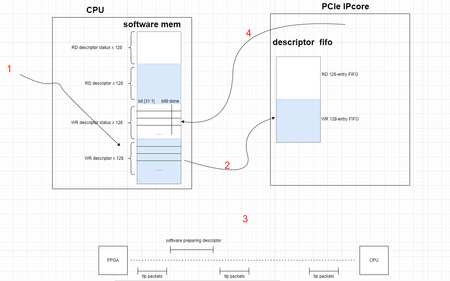
1. To use one or a few descriptors to complete the transfer, it is up to the transfer size that you wish to transfer. In PCIe system memory, the read and write descriptors are stored in separate descriptor tables. And each table can store up to 128 descriptors. Each descriptor is 8DW / 32 bytes. Based on the descriptor format, the maximum transfer size is (1 MB - 4 bytes). Hence, if you need to transfer large amounts of data, which is more than 4 bytes, you'll need to use a few descriptors (more than one) to complete the transfer. On the other hand, if the data is less than 4 bytes, then one descriptor will be enough to complete the transfer. However, take note that to avoid a possible overflow condition, allocate the memory needed for the number of descriptors supported by WR_TABLE_SIZE.
2. No. This is the way it works for DMA data transfer, as the descriptor ID will loop back to 0 after reaching WR_TABLE_SIZE.
If you want to process more pointers than the WR_TABLE_SIZE, there are two steps that you must follow:
1. Process the pointers up to WR_TABLE_SIZE by writing the same value as in WR_TABLE_SIZE.
2. Next, write the number of remaining descriptors to WR_DMA_LAST_PTR.
User Guide: https://www.intel.com/content/www/us/en/docs/programmable/683667/21-1/introduction.html
I hope these address your questions well.
Thanks.
Best Regards,
VenTing_Intel
 Frequent Contributor
Hi Allen,
I’m glad that your question has been addressed. I now transition this thread to community support. If you have a new question, please login to https://supporttickets.intel.com/, view details of the desire request, and post a feed or response within the next 15 days to allow me to continue to support you. After 15 days, this thread will transition to community support. The community users will be able to help you with your follow-up questions.
Thanks.
Best Regards,
VenTing_Intel
p/s: If any answers from the community or Intel support are helpful, please feel free to mark them as solutions, give them kudos, and rate 5/5 for the survey.
 Occasional Contributor
Thank you very much for your previous answer.
I would like to continue with another question regarding interrupts. In a given scenario, let's assume that an FPGA needs to continuously upload data to a CPU. However, the data bandwidth is much smaller than the PCIe bandwidth. So, I am using DDR as a cache to accumulate a sufficient amount of data. Once enough data is collected in the DDR cache, the CPU configures the descriptors to initiate a DMA write transfer, allowing the data to be uploaded to the CPU.
Since the CPU doesn't know when it can execute a transfer, the FPGA needs to send an interrupt to notify the CPU. If I intend to use the MSI-X interrupt mode and I need a total of three interrupt numbers, including those for functionalities other than DDR transfer, how should I configure the IP core? How do I initiate the interrupts? I am aware of Xilinx's XDMA, which can export a 3-bit signal called "pcie_user_irq". When the user raises this signal once, it triggers an MSI-X interrupt and IPcore will send a MSI-X tlp packet. However, it seems that Intel's IP does not have a similar mechanism.
During working, the FPGA will continuously send interrupts, and the CPU will consistently respond interrupts and configure descriptors to achieve transfer. Is this the only way to accomplish this? Are there better methods to achieve this application scenario?


