fpga
35 Topics
A Full Vision Pipeline: Using MIPI in Agilex® 5 and Agilex® 3 FPGAs
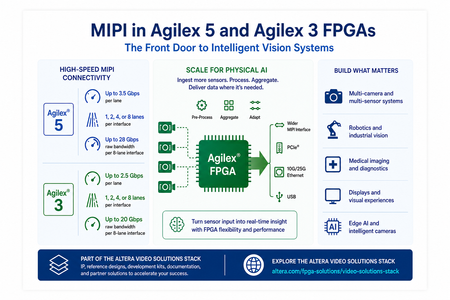
Agilex® 5 and Agilex® 3 FPGAs now provide native MIPI D-PHY support for CSI-2 camera and DSI display interfaces, making it easier to bring sensor and display data directly into FPGA fabric for real-time processing, aggregation, adaptation, and transport. The blog highlights how scalable MIPI bandwidth, multi-interface connectivity, and integration with the Altera Video Solutions Stack enable high-performance vision, robotics, medical imaging, edge AI, and display systems while simplifying the path from image capture to processing and AI workflows.630Views0likes0CommentsAltera Extends Agilex®, MAX® 10, and Cyclone® V Lifecycles Through 2045 for Long-Life Systems
Altera is extending the availability of its Agilex®, MAX® 10, and Cyclone® V FPGA families through 2045 to support long-lifecycle applications like industrial, aerospace, and medical systems. This helps customers avoid costly redesigns and ensures reliable, long-term supply, reinforcing Altera as a trusted partner for decades-long deployments.1.9KViews3likes1CommentWhy Integration Matters in Direct RF FPGA Design
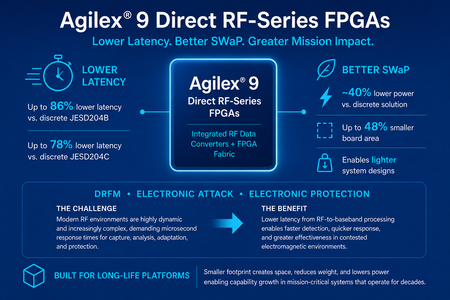
Agilex® 9 Direct RF-Series FPGAs help system designers address two critical RF system priorities: lower latency and improved SWaP (size, weight, and power). By integrating high-performance RF data converters directly with FPGA fabric, Agilex 9 Direct RF-Series FPGAs can reduce RF-to-baseband latency, simplify the signal chain, lower system power, and free up valuable board space for future capabilities addition. In a draft comparison of discrete JESD-based architectures versus an Agilex 9 integrated Direct RF approach, the integrated solution showed up to 78% lower latency versus a JESD204C discrete solution and up to 86% lower latency versus a JESD204B discrete solution. The comparison also showed approximately 40% lower power consumption and up to 48% board-area reduction. These gains support both primary value propositions: faster system response through lower latency, and better SWaP through fewer external components, lower power, and a smaller, more efficient RF design. Digital radio frequency memory (DRFM), electronic attack, and electronic protection are good examples of applications where latency improvements can make a meaningful difference. In these types of RF systems, lower RF-to-baseband latency helps systems act on complex signals faster, improving responsiveness, timing precision, and mission effectiveness in contested electromagnetic environments. The SWaP benefit is also critical in long-lifecycle aerospace and defense platforms which may remain operational for decades, yet have limited space, weight, power, and cooling capacity for new hardware. As signal environments evolve, these platforms need room to add or upgrade capabilities without major system redesigns. By integrating RF data conversion with FPGA processing, Agilex 9 Direct RF-Series FPGAs can help system designers improve responsiveness, reduce board area, simplify the RF signal chain, and create more headroom for future upgrades. Learn more about Agilex 9 Direct RF-Series FPGAs and the benefits of integrated data converters. Discover how Agilex 9 Direct RF-Series FPGAs enable lower-latency and more power-efficient RF system designs Download the Altera® Direct RF-Series FPGA Wideband Product Brief Source for draft proof points: Agilex 9 Direct RF-Series integrated data converter app note draft, version 0.1, last updated March 31, 2026.468Views0likes0CommentsAgilex® 7 FPGAs and SoCs M-Series Extends Production-Ready Memory Leadership with DDR5-6400
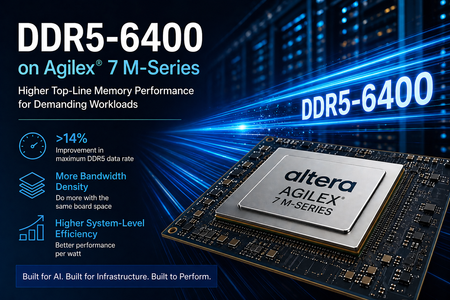
New DDR5-6400 support delivers a 14% increase in maximum DDR5 data rate, strengthening Agilex® 7 M-Series device’s memory leadership on a production device family. This effort reflects Altera’s continued investment to improve features on platforms already in volume production. For customers building high-performance FPGA-based systems, memory capability is a core platform requirement, and the level of memory performance increasingly shapes overall system differentiation. That is why this latest Agilex 7 M-Series enhancement matters. With DDR5 support increasing from 5600 MT/s to 6400 MT/s, Agilex 7 M-Series devices support a 14% increase in maximum DDR5 performance on a device family already shipping in production. The significance of this update goes beyond speed alone. It reinforces a broader story about platform value: more usable bandwidth, better system efficiency, and continued innovation on a platform customers can design around today. More bandwidth, better system efficiency DDR5-6400 is not just a higher interface number. It enables more memory bandwidth from the same platform, helping customers move more data through bandwidth-intensive designs. That added bandwidth can also improve bandwidth density at the system level. In practical terms, it can help designers reach target throughput with a more optimized memory subsystem, potentially reducing DIMM or channel requirements in some designs and improving overall platform efficiency. Those advantages become increasingly important in the kinds of applications Agilex 7 M-Series devices are built to address. Across AI, networking, video processing, and data center infrastructure, system performance depends not only on compute capability, but also on how efficiently data can be moved and sustained through the platform. A broader production-ready platform advantage This update also says something important about the platform itself. Agilex 7 M-Series devices already offer production-ready support for advanced external memory technologies, and DDR5-6400 extends that advantage further. As next-generation infrastructure platforms evolve for AI, scale-out networking, and data-intensive acceleration, advanced memory capability is becoming an increasingly important platform differentiator. DDR5 support is now emerging across a broader range of FPGA segments, including mid-range devices such as Agilex 5 and even power- and cost-optimized devices such as Agilex 3 (with LPDDR5 support). Agilex 7 M-Series devicesbrings DDR5-6400 to a high-end FPGA platform tier built for larger, more data-intensive AI, networking, and infrastructure applications. By combining advanced memory performance with substantially greater logic capacity, it delivers differentiation at the platform level. This enhancement is enabled through an upcoming release of Quartus® Prime Pro Edition and is designed to be backward compatible with previously shipped silicon and boards. Customers interested in enabling DDR5-6400 should contact Altera for additional guidance on supported configurations, applicable speed grades, and implementation details. Conclusion The move to DDR5-6400 on Agilex 7 FPGAs and SoCs M-Series delivers a 14% improvement in maximum DDR5 data rate, improving bandwidth density and system-level efficiency while extending the value of a production-ready platform for evolving customer requirements. Watch the DDR5-6400 Demo Performance Video622Views0likes0CommentsA Practical Look at the Shift from fixed ASSP to programmable FPGA
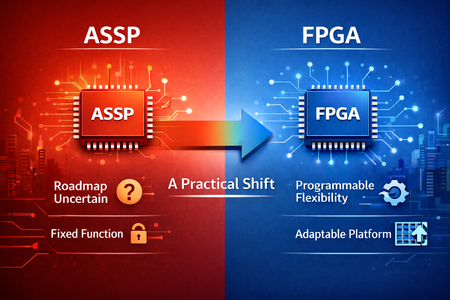
This post explores a practical shift from a fixed-function ASSP to a programmable FPGA platform in response to evolving system requirements. As bandwidth demands, protocol diversity, and feature complexity increased, limitations in a 400G optical transport ASSP and uncertainty in vendor roadmap made continued reliance difficult. The team transitioned to an FPGA-based approach, enabling customization of protocols and features while aligning the system more closely with real usage needs. The article also highlights benefits such as design reuse, reduced hardware variants, simplified inventory management, and greater control over long-term system evolution.185Views0likes0Comments
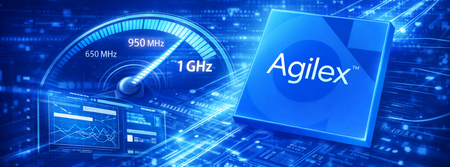
Pushing FPGA Fabric Performance Toward 1 GHz with Agilex® 7
Agilex® 7 FPGAs push FPGA fabric performance toward the gigahertz range by combining the HyperFlex® architecture with Quartus® Prime Pro software optimization. In Altera testing, a 32-bit SIMT soft processor implemented on Agilex 7 operated above 950 MHz, demonstrating how high-performance soft logic can be achieved in real designs. Hyper-registers distributed throughout the routing fabric enable deeper pipelining and advanced retiming, while Quartus Prime Pro optimizes synthesis, placement, routing, and timing to reach aggressive clock targets—allowing compute-intensive FPGA workloads to run faster and scale more efficiently.619Views0likes0CommentsThe FPGA Advantage for Secure 5G Infrastructure – A Dell Perspective
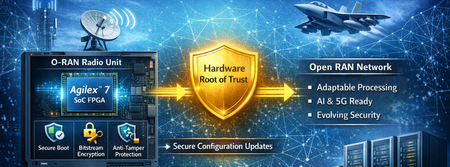
Dell’s Open RAN radio platforms use Altera Agilex® 7 SoC FPGAs to deliver secure, adaptable 5G infrastructure. The FPGA architecture enables hardware-rooted security and post-deployment updates, allowing radio units to evolve with new protocols and threats while maintaining trusted edge infrastructure.523Views0likes0CommentsAltera and Pantherun Launch P4-based Next-Gen Configurable, Secure Networking at Embedded World 2026
At Embedded World 2026, Altera and Pantherun announced a collaboration to deliver flexible, secure, and high-performance networking solutions using FPGA technology. By combining Altera’s programmable platforms with Pantherun’s networking and security IP, the partnership enables scalable, future-ready architectures for industrial, telecom, and mission-critical systems.544Views2likes0CommentsTeaching FPGAs and Microcontrollers to Share
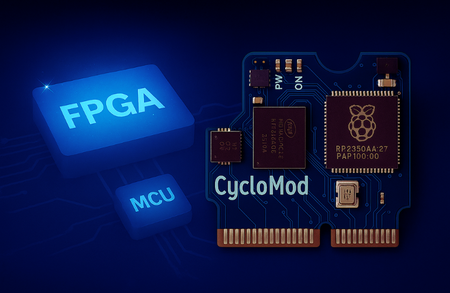
Using FPGAs and MCUs Collaboratively FPGAs and microcontrollers can be used alternatively in some applications, but they can also be used cooperatively. FPGAs provide ultimate flexibility, but microcontrollers often include peripherals like USB or wireless interfaces that may be more convenient for communications and updates. Both devices require supporting circuitry such as power, reference clocks, and storage. Fortunately, these can often be shared when using FPGAs and microcontrollers together. This blog introduces an open-source tool that enables microcontrollers to load a programming file into a programmable device, and the practical application of this with the Raspberry Pi RP2350 MCU. An Open Standard for Loading Programmable Devices Loading programmable devices from embedded processors is a common task. The Jam Standard Test and Programming Language (STAPL) was originally developed by Altera engineers to address challenges in programming programmable logic devices (PLDs) in-system, such as proprietary file formats, vendor-specific algorithms, large file sizes, and long programming times. It provides a software-level standard for in-system programming (ISP), enabling flexibility and platform independence. Figure 1. In-system programming using the Jam File & Jam Player via an embedded processor. In August 1999, JAM/STAPL was adopted as JEDEC standard JESD-71, making it an industry-recognized solution for JTAG-based programming. The language introduced features like compact file formats, branching, and looping, which reduced programming time and file size—ideal for embedded systems. JAM/STAPL consists of two main components: Jam Composer: Generates Jam Files (.jam) containing programming algorithms and user data. Jam Player: Interprets these files and applies JTAG vectors for programming and testing devices. Over time, JAM/STAPL gained widespread support from PLD vendors, programming equipment makers, and test equipment manufacturers, becoming a cornerstone for in-field upgrades, prototyping, and production programming. Its evolution also included a byte-code format (.jbc) for even smaller files, making it suitable for resource-constrained embedded processors. Recently, Altera updated the license terms of the JAM and JBC players source code to MIT-0, to better clarify the usage rights. A Practical Example The CycloMod board is an example of an FPGA and microcontroller working cooperatively. The board combines a Raspberry Pi RP2350 MCU with a Cyclone® 10 LP FPGA in the SparkFun MicroMod form factor. In this board, the FPGA is connected to some of the edge connector I/O, while the RP2350 is used to provide a flexible USB interface. The boot ROM in the RP2350 is leveraged extensively for firmware and FPGA image updates. Figure 2. CycloMod Board At 22mm x 22mm (including the card-edge connector), the MicroMod form factor is quite compact. This necessitates sharing resources, as there is not much room for multiple oscillators or flash devices. The 12 MHz crystal oscillator in the RP2350 is easily shared by routing it to one of the GPIO clock outputs. Both the Cyclone 10 LP device and RP2350 rely on external storage, but this can also be shared. On this board, the flash is connected to the RP2350 to take advantage of the UF2 loading provided in the boot ROM, and the RP2350 loads the Cyclone FPGA. The Cyclone 10 LP device supports active configuration with an external SPI flash device, but it can also be configured/programmed passively through JTAG. Figure 3. CycloMod Block Diagram The STAPL byte code format (sometimes referred to as JBC) is compact enough to be used with microcontrollers like the RP2350. Altera provides source code for implementing the “players” to process these files in embedded systems. They offer players for the ASCII (JAM) and bytecode (JBC) versions of the files. Altera’s Quartus® software provides the option to generate JAM and JBC files. Since STAPL is a JEDEC standard, other FPGA vendors also support generating these files. Using the open-source code provided by Altera, the RP2350 is able to read a JBC file from flash and load the Cyclone 10 LP FPGA through the JTAG interface. A Python script is provided to convert the JBC files to the UF2 format, which the RP2350 uses for drag-n-drop programming. The script also adds a header with the file length and other details. Thanks to the ingenuity of the UF2 format created by Microsoft, this enables cross platform field updates with zero software to install. Results and Link to Source Porting Altera’s JBC player to the RP2350 eliminated the need for a second flash device and enabled user-friendly drag-n-drop FPGA updates. The port is available on GitHub if you want to use this in your system. https://github.com/steieio/pico-jbc2.5KViews0likes0CommentsSee the Next Wave of EW & Radar Technology
We’re gearing up for AOC 2025! From December 9–11, we’ll be at the Gaylord National Resort & Convention Center in National Harbor, Maryland for AOC2025—one of North America’s premier events dedicated to electronic warfare and radar. Visit us at booth #505 to discover the latest innovations in our Agilex™ 9 Direct RF and Agilex™ 5 product families. What to Expect at Altera’s Booth #505: 1. Wideband and Agility Demo using Agilex 9: Overview: Discover the power of frequency hopping with Altera’s Direct RF FPGA, enhancing system resilience and adaptability. Key Features: Demonstrates swift frequency changes and wideband monitoring. 2. Wideband Channelizer Demo using Agilex 9: Overview: Wideband Channelizer features polyphase filter and 65 phases FFT blocks with variable channel support. Key Features: Demonstrates sampling rate that supports 64 GSPS with 32GHz instantaneous bandwidth. 3. Direction of Arrival Demo using Agilex 5: Overview: Explore Direction of Arriaval estimation and signal detection using AI-based approach with deployment of neural networks. Key Features: Demonstrates neural networks implementation using DSP Builder Advanced Blockset (DSPBA), showcasing end-to-end operation running real time inference. 4. Altera COTS Partner Showcase: Come see our Agilex based COTS boards from partners including Annapolis Microsystems, CAES, Hitek, iWave Global, Mercury Systems, & Spectrum Controls. We are hosting customer meetings at the event, contact your local Altera salesperson to schedule a slot.182Views0likes0Comments