Forum Discussion

 Occasional Contributor
RX Mac segmented interface detailed information
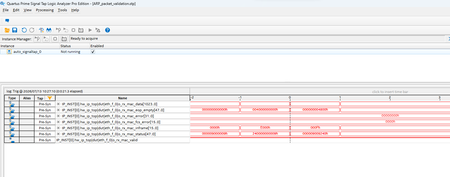
 Occasional Contributor
Some Follow-up question
I am using 400Gbe configuration, so far my assumption is that in a given cycle there can be either
- 1 sop and 1 eop - i.e complete frame in mac_data
- 1 sop or - i.e frame started and mac_data contains partial data
- 1 eop or - i.e frame ended and mac_data contains partial data
- 1 eop, 1 sop - i.e frame ended and mac_data contains partial previous frame data and a new frame has started can contains partial data
I feel that above scenarios are valid as per waveform given in Figure 44. Receiving Data Using the RX MAC Client Interface. can you confirm if my above assumptions are true or false?
My question are following scenarios valid?
- When rx_mac_valid == 1 can Inframe bits have
- 2 or more SOP
- 2o or more EOP
I am using 400Gbe configuration so 16 inframe bits and 1024 (128 bytes) data bits are there. There can be small (ethernet frames like ARP which are 60 bytes). So theoretically its possible that one RX mac segmented interface cycle could have 2 or more complete frames. But from IP point of view can you tell me if these scenarios are possible or not?
I am finding RX mac segmented interface very complex. lets say if "RX maximum frame size" is set to default value of 1518 bytes. Max RX frame size can not be more than 1518*8 =12,144 bits. Do you have a example verilog code to extract out valid ethernet frames out of RX mac segmented interface? Once frames are extracted out I have my user logic in place to process the frames and use Tx mac interface to send out Tx response frames
 paveetirrasrie_Altera30 days ago
Frequent Contributor
1. Your four basic scenarios (single SOP, single EOP, both, or neither)
Yes, all four of your scenarios are valid. The F-Tile Ethernet Hard IP RX client interface allows the application to read frame data from the RX MAC segmented when it is received, and packets may start on any 8-byte segment. RX MAC Segmented Client Interface The inframe signal encodes SOP/EOP transitions per segment, so any combination of those four cases can appear in a given cycle.
2. Can there be 2 or more SOPs or 2 or more EOPs in a single cycle?
Yes,
At 400GE you have a 1024-bit (128-byte) data bus with 16 inframe bits, where each segment is 64 bits (8 bytes). RX MAC Segmented Client Interface A minimum-size Ethernet frame (e.g. ARP) is 60 bytes = 7.5 segments, so it fits comfortably within one 128-byte cycle. That means in a single cycle with
o_rx_mac_valid=1you can have:Two or more complete frames (each with its own SOP and EOP transition in the inframe vector)
Two or more SOPs (start of multiple frames)
Two or more EOPs (end of multiple frames)
For multi-segmented interfaces, a new packet may start and the previous packet end within the same cycle. RX MAC Segmented Client Interface At 400G with 16 segments per cycle, this can happen multiple times in the same clock.
3. How SOP and EOP are encoded in o_rx_mac_inframe[15:0]
The
o_rx_mac_inframetransition from 0→1 (between two consecutive segments) indicates a start of packet (SOP); the SOP begins at the segment whereo_rx_mac_inframeis set to 1. When the packet ends,o_rx_mac_eop_emptyis set to the number of unused bytes ino_rx_mac_data. Theo_rx_mac_eop_emptytransition from 1→0 (between two consecutive segments) indicates the end of packet (EOP); the EOP ends in the segment whereo_rx_mac_inframeis set to 0. RX MAC Segmented Client InterfaceSo for 400G: scan
o_rx_mac_inframe[15:0]bit by bit. A 0→1 transition at bit i means segment i is the first segment of a new frame. A 1→0 transition at bit i means segment i-1 was the last segment of the previous frame, ando_rx_mac_eop_empty[(i*3)-1 : (i-1)*3]tells you how many bytes in that last segment are unused. The minimum number of bytes on the last cycle is 1. RX MAC Segmented Client InterfaceAlso note: the interface does not take direct backpressure. RX MAC Segmented Client Interface Your logic must be ready to consume data every cycle.
4. Verilog frame extraction example
I can't share a file, but here is a conceptual Verilog snippet to get you started. This is general guidance, adapt it to your pipeline and timing requirements:
// 400GE: 16 segments, 64 bits each, 3 eop_empty bits per segment
// Inputs (registered from IP):
//   o_rx_mac_valid
//   o_rx_mac_data    [1023:0]
//   o_rx_mac_inframe [15:0]
//   o_rx_mac_eop_empty [47:0]  // 3 bits per segment
//   o_rx_mac_fcs_error [15:0]

// Detect SOP: bit i is 1 and previous bit (or previous cycle's bit 15) is 0
// Detect EOP: bit i is 0 and previous bit is 1

reg prev_inframe; // bit 15 of inframe from previous valid cycle

always @(posedge clk or posedge rst) begin
    if (rst) begin
        prev_inframe <= 1'b0;
    end else if (o_rx_mac_valid) begin
        prev_inframe <= o_rx_mac_inframe[15];
    end
end

integer seg;
always @(posedge clk) begin
    if (o_rx_mac_valid) begin
        for (seg = 0; seg < 16; seg = seg + 1) begin
            // Determine "previous" inframe bit
            // For seg==0, previous is prev_inframe (last bit of prior cycle)
            // For seg>0,  previous is o_rx_mac_inframe[seg-1]
            wire prev_bit = (seg == 0) ? prev_inframe
                                       : o_rx_mac_inframe[seg-1];

            // SOP: transition 0->1
            if (!prev_bit && o_rx_mac_inframe[seg]) begin
                // Segment 'seg' is the first segment of a new frame
                // Data bytes: o_rx_mac_data[seg*64 +: 64]
            end

            // EOP: transition 1->0
            if (prev_bit && !o_rx_mac_inframe[seg]) begin
                // Segment 'seg-1' was the last segment of a frame
                // (handle seg==0 case: EOP was in segment 15 of prev cycle)
                // Empty bytes in that last segment:
                //   o_rx_mac_eop_empty[(seg-1)*3 +: 3]  (for seg > 0)
                // FCS error:
                //   o_rx_mac_fcs_error[seg-1]           (for seg > 0)
            end

            // Mid-frame: inframe[seg]==1 and no transition
            // Data is valid payload bytes for the current frame
        end
    end
end
Key implementation notes:
You need to track
prev_inframe(the inframe state at the end of the previous valid cycle) to correctly detect SOP/EOP at segment 0 of the current cycle.Multiple SOP/EOP pairs can occur within the same 16-segment cycle — your loop must handle all of them, not just the first.
For each EOP, check
o_rx_mac_fcs_error[seg]to know if the frame is good. Theo_rx_mac_fcs_errorsignal is valid only on EOP segments; a high value indicates the frame had an FCS error, was malformed, was undersized, or was oversized and truncated because the MTU enforcement feature of the RX MAC was enabled. RX MAC Segmented Client InterfaceThe
o_rx_mac_eop_empty[2:0]per segment tells you how many bytes at the MSB end of that 64-bit segment are unused (padding), so valid bytes = 8 − empty_count.Since the interface gives no backpressure, you'll typically want a wide FIFO or buffer behind this logic to absorb bursts.
The 1518-byte MTU you mentioned means a maximum frame spans at most ⌈1518/8⌉ = 190 segments = ~12 cycles at 400G, so your frame reassembly buffer needs to handle that depth. Small frames (60 bytes = 8 segments) can easily pack 2 per cycle, confirming your intuition about multiple SOPs/EOPs.


