User Profile

mnasser431998
 New Contributor
Joined 5 years ago


User Widgets
Contributions
Re: GUI for NIOS based systems
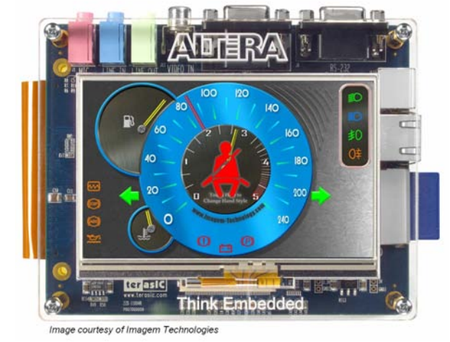
I'm so sorry for my late response. I haven't checked my e-mail for a while. Thank you first for your response. I know that NIOS is a softcore and I know about Qsys (or) Platform Designer. I have been looking for a way to build interactive GUIs with FPGAs like the vehicle dashboard shown previously. In software world I think they use graphical libraries or Qt to build these kind of GUIs. Someone advised me to store the images(frames) of the GUI with different states and to store in a memory and load it one by one according to my needs. When I saw the picture shown above of NIOS embedded kit which is exactly the type of GUI I need to build something like I thought that Intel provides something like IP cores or software libraries or something that can help me build interactive GUIs like this one. We chose an FPGA for this purpose because of the configurability that we will be further needing. To summer up my long speech, I just need to know what is the most efficient and cost effective way to build a GUI like this one using an intel FPGAs for real-time applications like a vehicle dashboard.1.9KViews0likes1CommentGUI for NIOS based systems
Hi everyone, can someone help me with this please? I need to know how to build GUIs like this one. Do I need to use NIOS ii to build this? If that was the case does the nios need to run an embedded linux or bare metal is fine? are there any graphics libraries (non-commercial) that can help me with this? Thanks2KViews0likes5Comments- 1.8KViews0likes0Comments
IO banks voltages
Hello everyone, I have a simple question about IO banks voltages from PCB design point of view. I noticed that DDR memories work SSTL IO standard which is about 1.2V and I know that I can change IO standard type in FPGA PinPlanner but how are these voltages generated? do I need to generate them with external supply and connect the bank VCCIO to the supply I need to work with then change the IO standard type within the PinPlanner? or I can hook the VCCIO of all banks to a higher voltage for example 3.3V and then the FPGA internal circuitry takes care of generating the required voltage type? or there are specific voltages I need to connect the FPGA with( ex 3.3, 2.5, 1.2) in order to be able to generate all IO standards? Thanks in advanceSolved1KViews0likes1CommentRe: cyclone iv PCB design
Thank you for your fast reply, I have a further question related to IO. I noticed that DDR memories work SSTL IO standard which is about 1.2V and I know that I can change IO standard type in FPGA PinPlanner but how are these voltages are generated? do I need to generate them with external supply and connect the bank VCCIO to the supply I need to work with then change the IO standard type within the PinPlanner? or I can hook the VCCIO of all banks to a higher voltage for example 3.3V and then the FPGA internal circuitry takes care of generating the required voltage type? or there are specific voltages I need to connect the FPGA with( ex 3.3, 2.5, 1.2) in order to be able to generate all IO standards? Thanks in advance1.8KViews0likes2Commentscyclone iv PCB design
Hello everyone, I am designing a custom board that hosts cyclone iv E BGA package. The board is intended to be used in video applications and SoCs therefore it has to have good amount of logic elements and a large DDR memory. Other peripherals are not something special. However, I have some questions that I didn't find helpful answers for them. How to use FTDI chip for programming and UART communications between the FPGA and host PC? Are there some considerations for the routing of the DDR in order to function correctly? What are the required voltages on the board needed for the FPGA 3.3V, 2.5V, 1.2V...? and How to connect them to the FPGA? I know that there are boards out there and I have one indeed from trenz but the board I am designing has special custom peripherals I need. Thanks,1.9KViews0likes4Comments