DDR5-6400, LPDDR5-6400, and LPDDR5X Device Compatibility
Quartus® Prime Pro Edition 2026.1.1 expands memory options across the Agilex® FPGA portfolio.
Memory is increasingly setting the performance, power, and lifecycle limits of modern systems. AI acceleration, packet processing, storage, video, industrial automation, and edge computing all depend on moving large amounts of data efficiently. At the same time, memory availability and vendor transitions can force design teams to revisit component choices long after a platform architecture has been selected.
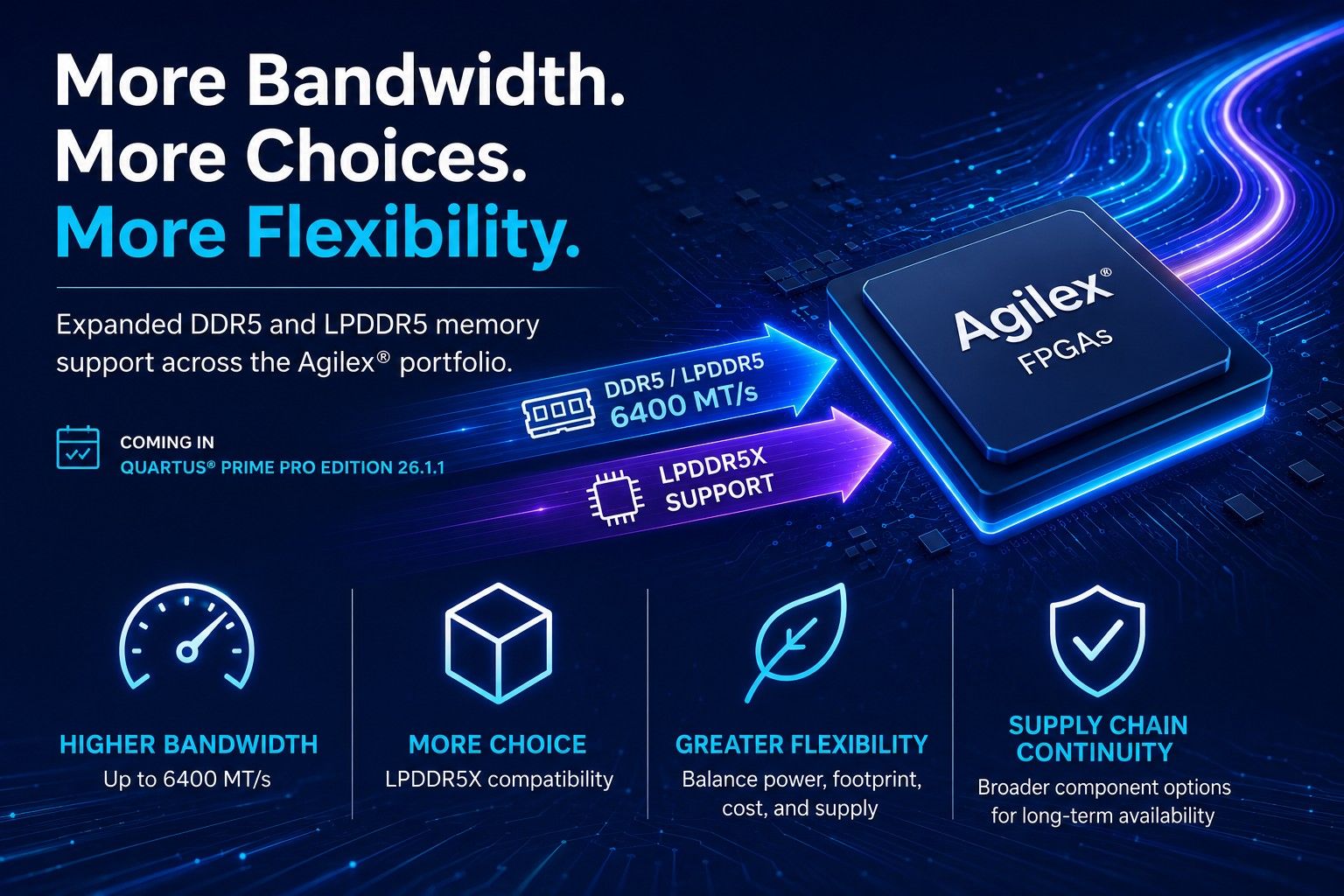
With Quartus® Prime Pro Edition 2026.1.1, Altera expands memory options across the Agilex portfolio. The release brings higher-speed DDR5 and LPDDR5 options to Agilex 7 M-Series FPGAs and SoCs, broadens component choice through documented LPDDR5X device support, and extends LPDDR5 support to Agilex 3 FPGAs and SoCs. Together, these enhancements give designers greater flexibility to balance performance, power, footprint, memory cost, and supply continuity.
What is new with Quartus Prime Pro Edition 2026.1.1
Enhancement | Customer value |
DDR5-6400 and LPDDR5-6400 on Agilex 7 M-Series devices | Higher Memory BandwidthRaises the maximum supported memory data rate from 5600 to 6400 MT/s, an increase of more than 14%. DDR5 delivers up to 204.8 GB/s of aggregate bandwidth, while LPDDR5 provides a lower-power, compact-footprint option for bandwidth-intensive designs. |
LPDDR5X device use in LPDDR5-compatible mode | New Sourcing OptionAdds sourcing flexibility when LPDDR5 availability, or component strategy favors an LPDDR5X device. |
LPDDR5 now available for Agilex 3 devices | New Memory Support AddedBrings a modern low-power memory option to power- and cost-optimized Agilex 3 device configurations. |
Two 6400 MT/s paths for high-performance systems
Agilex 7 M-Series FPGAs and SoCs already combine high logic density, high-speed connectivity, and advanced external memory functionality in a device family available today in full-volume production. Quartus Prime Pro Edition 2026.1.1 strengthens that family’s offering with DDR5-6400 and LPDDR5-6400 in approved configurations.
For DDR5, the move from 5600 MT/s to 6400 MT/s increases the maximum data rate by more than 14%. That additional throughput can help AI, networking, storage, and infrastructure designs sustain higher data movement without expanding the FPGA footprint. It can also give architects more flexibility in how they meet a target bandwidth, including the potential to optimize channel count, DIMM selection, board space, and subsystem complexity when the application and supported configuration allow it.
LPDDR5-6400 brings a second option to the same top-line interface rate. LPDDR5 is increasingly relevant beyond mobile products because it combines strong bandwidth with lower I/O power and a compact board footprint. Those characteristics are valuable in embedded systems, smart network interface cards, industrial platforms, edge compute, and other designs, where thermal limits and board area matter alongside performance.
The result is a high-end FPGA platform that lets designers choose between DDR5 for capacity and server-class memory options, or LPDDR5 for power and footprint efficiency, while reaching up to 6400 MT/s and 204.8 GB/s of aggregate memory bandwidth in selected Agilex 7 M-Series device configurations.
LPDDR5X device compatibility adds practical supply-chain flexibility
The LPDDR5X enhancement addresses a different customer need. LPDDR5X devices are backward compatible with the LPDDR5 interface, so components can be used with an Agilex LPDDR5 memory interface while operating at the same speeds, voltages, and specifications as the LPDDR5 configuration.
Customers can now design with LPDDR5X components in LPDDR5-compatible mode with greater confidence, backed by documented Altera support process.
A complete memory offering across the Agilex portfolio
Because the Agilex portfolio spans high-performance, mid-range, and power- and cost-optimized devices, customers can carry a consistent FPGA architecture and Quartus development flow across products with very different memory requirements. That continuity helps reduce redesign effort and gives engineering teams more freedom to scale compute, connectivity, and memory together.
Teams can preserve DDR4 or LPDDR4 where product requirements, temperature range, or supply conditions still favor those technologies. New designs can move to DDR5 or LPDDR5 for higher bandwidth and better system efficiency. LPDDR5X device compatibility provides an additional sourcing path without requiring customers to redesign a separate memory interface.
Explore Agilex FPGA external memory solutions and review the Quartus Prime Pro Edition 2026.1.1 documentation for supported devices, speed grades, memory components, and configurations.

 Occasional Contributor